Australia should embrace the data-centre boom, but not at any climate cost. Artificial intelligence and cloud computing will drive enormous investment over the next two decades and Australia has obvious advantages. Better that we develop them properly than reproduce the regulatory failures emerging elsewhere.
That is the logic behind the approach supported by the Commonwealth and most states and territories at the Energy and Climate Change Ministerial Council in July. Large data centres would be required to underwrite additional renewable generation, provide adequate firming and demand flexibility, and bear the costs attributable to their connection.
Data centres are not ordinary electricity users. Their demand is vast, concentrated and continuous. AEMO forecasts data-centre consumption in the NEM could reach about 34 TWh by 2050, around 12 per cent of forecast grid-supplied electricity. Large data centres will become NEM market participants, effectively small and medium-sized power stations.
The climate consequence is obvious. New demand of that scale cannot cannibalise existing clean generation while the rest of the economy is required to decarbonise. It must bring new low-emissions supply with it.
Handled properly, this is a considerable opportunity. The world’s largest technology companies are highly creditworthy electricity buyers. Long-term contracts can support new renewable generation, storage and firming. The AI boom could help finance the energy transition rather than obstruct it.
But only if governments do not weaken the rules to win projects. That is why the opposition of Queensland and the Northern Territory is so short-sighted.
Queensland’s objections amount in part to the usual ‘we’re Queensland’ argument. Yet climate change is not a states’ rights issue. Australia cannot credibly pursue a national emissions target while jurisdictions compete for new industrial loads by lowering climate standards at the behest of the fossil-fuel lobby.
The Northern Territory position is harder to justify still.
Last month the Territory government awarded 185 hectares near Darwin to Beetaloo Digital for a proposed 2 GW data centre. Its parent, Beetaloo Energy, plans to power the development with shale gas from the Beetaloo Sub-basin.
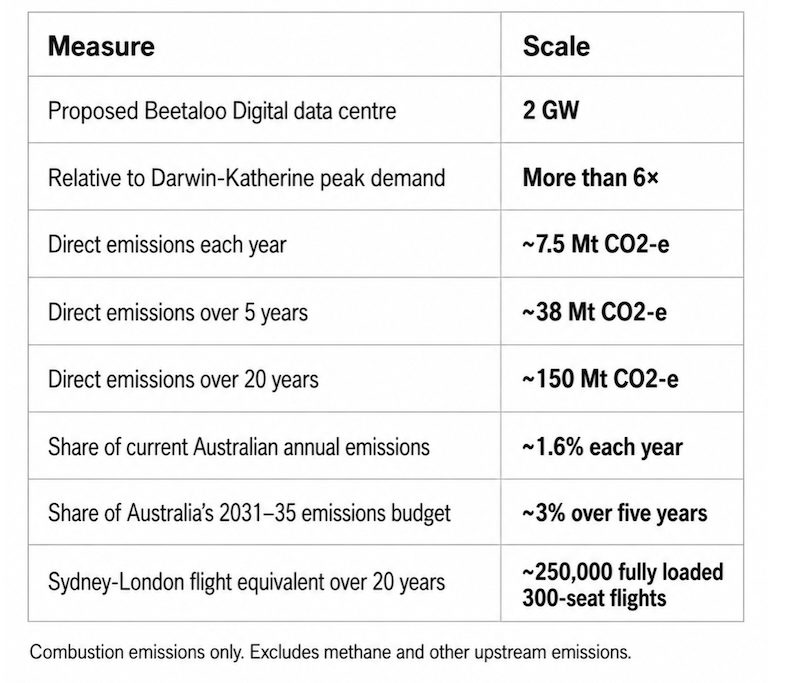
The scale is extraordinary. Two gigawatts is more than six times the maximum demand of the entire Darwin-Katherine power system in 2024-25.
The climate arithmetic should end any pretence that this is simply a matter of local choice. Using the Commonwealth’s standard emissions factor for natural gas combustion, a 2 GW facility operating continuously would produce about 7.5 million tonnes of CO2-e annually. Over 20 years, that is around 150 million tonnes, roughly equivalent to 250,000 fully loaded 300-seat flights from Sydney to London.
Those figures are conservative. They exclude methane, around 83 times more potent than CO2 over the first 20 years, and other upstream emissions from extracting, processing and transporting the gas.
One project could therefore produce direct annual emissions equal to about 1.6 per cent of Australia’s current national emissions. Five years at that rate would produce roughly 38 million tonnes, close to 3 per cent of Australia’s entire 2031-35 national emissions budget.
Numbers thats matter
Allowing this to happen would repeat one of the Territory’s worst regulatory mistakes: creating a permissive regime for online gambling operators while exporting the harm across Australia.
Australia has committed to cut emissions by 62-70 per cent below 2005 levels by 2035. Every additional tonne created by a new gas-powered data centre is a tonne that must be abated somewhere else.
That is what makes the Territory’s ‘special circumstances’ argument so self-interested. It wants the local investment and gas demand while the climate consequences are carried nationally. An off-grid gas plant does not become climate-neutral because it is disconnected from the NEM. Carbon emitted near Darwin does not stay in the Territory.
Nor is this some pure exercise of private commercial freedom. The land has been allocated by government. Gas development, planning, water, infrastructure and environmental approvals all depend on public authority. The question is not whether government intervenes. It already does. The question is whether it intervenes in the national interest.
Australia should set a clear national floor. Large new data centres should bring new renewable generation, firming and flexibility, and meet nationally consistent climate and energy standards. States should remain free to go further, but not to undercut the floor.
Queensland risks encouraging a race to the bottom. The Northern Territory risks something worse: using the data-centre boom to manufacture a captive market for fossil-fuel demand just as Australia is supposed to be cutting emissions rapidly.
We should welcome the investment in data centres, but not at the expense of a gas boom.
Let states compete on planning, infrastructure, skills and execution, not on who is most willing to gut climate standards and dump the consequences on the rest of Australia.
Jeremy Cooper is chair of the Carbon Advisory Board Future Group