Elderly farmers in a “cage”, rows of big-rigs and utes, a fidgety horse, and more than half a dozen Country Fire Authority (CFA) trucks gave the impression of a country fair outside Victoria’s state parliament on Friday, but the air of bristling tension betrayed the gathering’s true purpose.
The protest, organised by Across Victoria Alliance, brought around 300 CFA volunteers, farmers, One Nation and National party supporters, and a variety of renewable energy opponents into Melbourne on the sunny Friday morning.
Speakers, mainly men standing inside a large delivery truck, used Trumpian language to play up city-country divisions and went hard on militaristic calls for a war on transmission lines, renewable energy and data centres.
Farmers Fightback founder Ben Duxson called for letting free enterprise run, while in the next breath saying “we’re building an army out there” to fight off multinational energy enterprises.
A younger farmer named Billy, who said his property was on the VNI West route, likened the opposition to transmission projects in Victoria to Australians taking up arms to fight Nazis in World War II.
“All we have to do is go to our front gate and stand there. This is a war. It’s a war… a war without weapons,” he said.
“Everybody needs to stand up and fight, and we will never ever let them on our land. Ever.”
One speaker named Jim alleged Big Build-levels of corruption in the transmission industry and demanded that it be added to the current royal commission into construction corruption in the state.
“Do not let the Labor party gaslight you or gaslight your friends or your neighbours into believing that the WRL [Western Renewables Link] is an inevitable project transmission,” he exhorted the crowd.
The speeches, tapping into genuine grievances about a lack of services and funding for rural communities, urged the crowd to vote the long-running state Labor government out, but didn’t offer an alternative vision for farmers and communities that stand to gain from hosting energy projects.
In 2024, a report by Farmers for Climate Action estimated that payments to farmers for hosting renewable energy infrastructure would reach $1 billion by 2030, and up to $10 billion by 2050.
Another $213 million would be paid to regional communities by 2030 through community benefits funds and other shared benefits offered by developers.
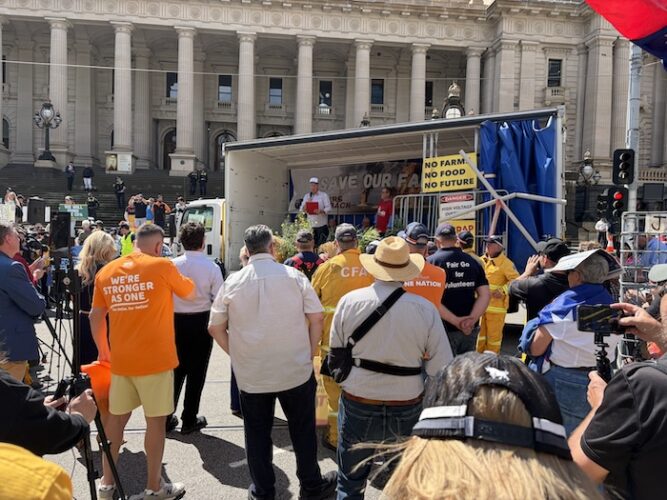
Across Victoria Alliance protest ahead of Victoria election. Image: Rachel Williamson
Touching on a laundry list of competing complaints – from crime rates and cost of living pressures, to anti-mining movements and a lack of funding for the CFA – the protest showed that online anti-renewables groups are successfully mobilising what looks like support for a united cause.
Friday’s protest was organised by the Across Victoria Alliance, a group that started around the middle of 2025.
It was supported by Farmers Fightback, another new largely anti-renewable energy group which claims it is entirely supporter-financed, and has spent more than $66,000 on political Facebook ads in the last 90 days, according to the Meta Ad Library.
Figureheads for the anti-renewable protesters were prominent. Dingwall farmers, Mary and Colin Fenton, who have been fined for refusing to let Vicgrid workers onto their property, sat in a cage while holding a variety of signs protesting against everything from the family-led Nioka solar project in Glenrowan to calling for support for farmers.
Also in attendance was Stop Labor’s Towers, a group which shows how amorphous online protest groups now are.
It has gone by several other names in the past, including Stop Ausnet’s Towers and Darley Power Fight. Behind these brands is a group that was called the Moorabool and Central Highlands Power Alliance Inc – until it lost a bruising court case and had to agree to disband in exchange for the government waiving its $1.5 million in costs – and has now transformed on Facebook into the Western Victoria Community Alliance.
These groups are deeply connected with the Energy Grid Alliance, a self-described energy thinktank that mostly produces papers that attempt to debunk Victoria’s transmission plans.
The gathering on Friday wasn’t all coordinated protesters however.
There was a Gippslander representing the region’s offshore wind opponents, and one older man arrived on a bicycle that featuring a sign that said “make peace not war” alongside One Nation flags.
One Nation, whose bright orange paraphernalia was on show on Friday, is hoping to have a big presence in both upper and lower houses of government in Victoria after the state election on November 28.
Redbridge polling this week has the Coalition in a strong lead, with One Nation and Labor level pegging ahead of the Greens. On Friday, Roy Morgan polling said the Victorian election was “too close to call,” with the ALP/Greens narrowly ahead of L-NP/ONP, with One Nation on track to win more than 10 seats in the Lower House.
Noisy support for the orange party has pushed the Liberals to promise to scrap the VNI West transmission line, impose 2km buffers between energy generators and houses, review all other new transmission and prioritise gas over renewable energy developments in promised “firming” tenders.
That alone is causing jitters in the renewable energy sector, as developers prepare for the possibility of a return to the delays and uncertainty of 2010, when the Liberals last won government in Victoria, or a Queensland-lite style of governing that shuts them out entirely.
One Nation’s influence in a coming government could make those worries melt away entirely, however: the orange party’s energy policy calls for the complete cancellation of all renewable generation and transmission projects — onshore and off — and to build a nuclear power plant in the Latrobe Valley.