Solar farms and regenerative farms are rarely mentioned in the same sentence. Yet in Australia, and increasingly around the world, both are becoming pillars of the same carbon strategy. One captures carbon in the soil. The other avoids carbon by replacing fossil power. Both only work when that carbon stays put.
At Shoals, we spend our days engineering the electrical backbone of large solar sites. The more we look at the land these projects sit on, the clearer one truth becomes: renewable energy farms and regenerative land practices are not two separate worlds. They are parallel carbon systems, and they answer to the same engineering logic.
That logic is simple. Disturbance leaks carbon and stability holds it. A solar power plant loses value when Electrical Balance of System (EBOS) fails, when trenching creates hidden faults, and when traditional construction habits shorten the life of the asset. A regenerative farm loses value when soil is torn up, when natural cycles break, and when heavy, high-emission machinery does the work. Both thrive on the same recipe: less disturbance, more stability, and long-term performance built into the ground from day one.
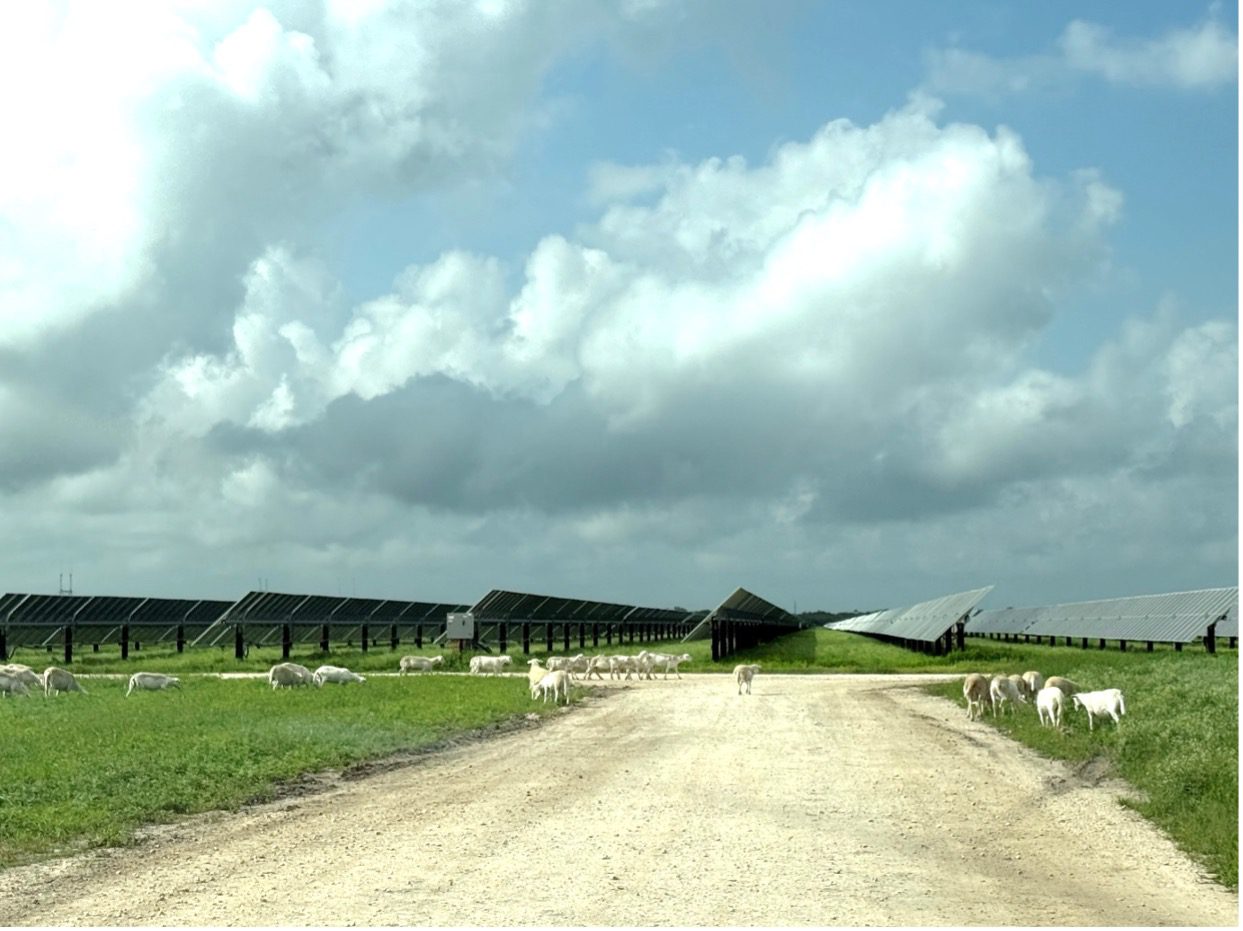
This is no longer a theory. You can see it on real sites today. Sheep graze between solar rows and rebuild the soil at the same time. And modern DC reticulation design, like the systems Shoals builds, replaces trenched, hand-wired construction with prefabricated, modular, above-ground hardware that lasts longer and carries a smaller carbon footprint.
In this article, we look at three things: how regenerative land practices make renewable energy more reliable, how government policy now rewards carbon-positive farming, and why modern EBOS design has become a carbon technology.
Regenerative Agriculture Is Now Carbon Infrastructure
Regenerative agriculture used to be a niche idea. Today, governments treat it as carbon infrastructure. In Australia, national policy now views carbon-rich land as a climate asset worth protecting.
The Carbon Farming Initiative, now delivered through the Australian Carbon Credit Unit (ACCU) Scheme and administered by the Clean Energy Regulator, pays landholders for real, measurable gains in soil carbon and lower emissions. Every tonne of carbon stored or avoided can earn one credit. In practice, this turns everyday farming choices into tradable value. Cover cropping, rotational grazing, diverse planting, and less soil disturbance all become sources of income. Farms earn more, and the country moves closer to its emissions targets.
Other programs reinforce the same idea. The National Soil Strategy treats soil as a strategic national resource. The Future Drought Fund supports farmers who use regenerative methods, because carbon-rich soil holds water better and stays productive through Australia’s harsher seasons.
The rest of the world is moving the same way. In the United States, USDA Climate-Smart Agriculture programs reward cover crops, reduced tillage, agroforestry, and prescribed grazing. In Europe, the Common Agricultural Policy pays farmers through eco-schemes for permanent ground cover, reduced tillage, and diverse systems, with a quarter of direct payments now tied to these practices. The message is consistent everywhere: regenerative farming builds soil carbon, cuts emissions, and makes land more resilient. Governments no longer call it simply good farming. They call it carbon capture.
Renewable Energy Project Is a Parallel Carbon System
Solar farms do not store carbon in the soil. They store it in the emissions they avoid. Every megawatt-hour of solar replaces a megawatt-hour of fossil power. Every outage, every EBOS failure, and every point of lost DC efficiency chips away at that benefit.
For developers and consultants, this changes the goal. A solar project is not just built for uptime and efficiency. It is built for carbon integrity. A site with weak EBOS or poor DC reticulation still makes electricity, but it delivers less carbon benefit than it should. In a world that counts carbon, that gap is real, and it adds up over decades.
Seen this way, a solar farm starts to look a lot like a regenerative farm. Both depend on stability. Both lose carbon when disturbed. And both reward the same habits: minimize disruption, cut operational emissions, and design for the long haul.
Sheep grazing: One practice that serves both systems
Sheep grazing is the clearest place where these two worlds meet. On a regenerative farm, grazing sheep cut the need for diesel mowing, trigger fresh plant growth, feed the soil through natural fertilization, and keep the ground covered so carbon stays locked in.
On a solar farm, those same sheep replace mechanical mowers, lower operational emissions, keep vegetation short to reduce fire risk, and support biodiversity in ways that satisfy ESG goals. A multi-year study across 31 commercial solar sites in the northeastern United States found that grazed sites had significantly higher soil organic matter, soil protein, and active carbon than sites managed by mowing alone.
The benefits reach well beyond the fence line. For farmers, solar grazing opens a new, steady income stream and gives flocks reliable pasture, even in dry years when open paddocks struggle. For the local community, it keeps land in agricultural use, supports local graziers and shearers, and turns a solar site into a working part of the rural economy rather than a fenced-off island. A project that grazes sheep is easier to welcome, easier to permit, and easier to be proud of.
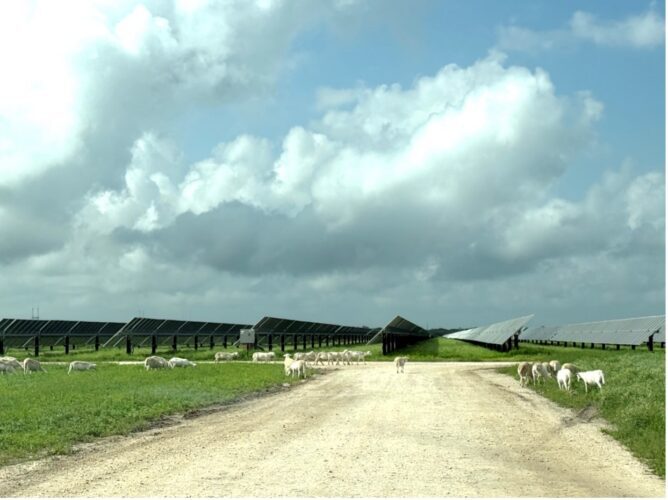
For developers, that makes sheep grazing more than a tidy way to manage vegetation. Research from Cornell University found that solar grazing can cut vegetation management costs by up to 40 percent compared with mechanical mowing, while improving soil health and water retention. Field studies also describe it as a genuine “win-win” for solar operators and sheep producers, supporting healthy forage, healthy flocks, and clear vegetation without a single pass of a mower. It is a simple, real example of regenerative land practice making renewable energy more reliable.
The shared carbon logic
Farming and solar look very different, but they run on the same rule: disturbance releases carbon, and stability captures it.
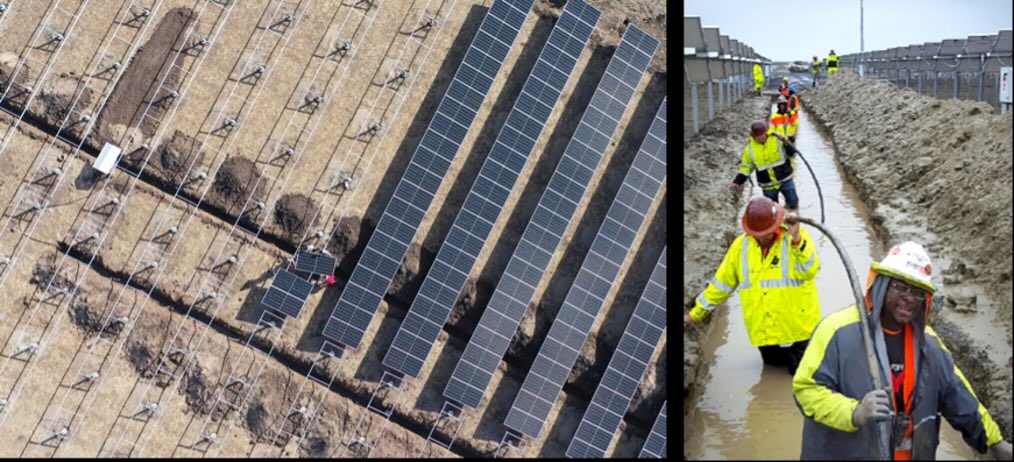
In farming, disturbance means tillage, bare soil, too much machinery, and anything that breaks the natural cycle. In solar, disturbance means trenching, exposed cable, hand-made terminations, and field-fabricated EBOS designs with too many points of failure. Both systems reward the same response. Keep disturbance low and choose integrated, low-impact, reliability-first design. Build for stability, and the carbon benefit grows year after year.
How traditional solar construction leaks carbon
Old-school electrical construction quietly drains a solar project’s carbon performance. Here is where the leaks start:
- – Bare cable and hand-made terminations invite hotspots, arc faults, moisture, and intermittent failures. Each one cuts uptime, raises maintenance emissions, and shortens the life of the asset.
- – Trench-heavy EBOS layouts add embodied carbon through diesel-powered civil works. They also bury failure points that are hard to find and expensive to fix.
- – Commodity EBOS treats wiring as a cheap part instead of a reliability backbone. The result is voltage drop, connector variability, thermal hotspots, and higher failure rates.
Every one of these problems lowers lifetime megawatt-hours, which means less lifetime avoided emissions. In a carbon-constrained world, these are not just operational risks. They are carbon leaks.
How Shoals stops the leaks
This is the problem Shoals set out to solve. We treat EBOS as a system, not a commodity, because the wiring decides how much uptime, efficiency, and carbon benefit a site actually delivers. Here is how our approach closes the gaps:
- – Prefabricated harnesses remove field crimping and cut failure points, so DC efficiency stays high and O&M emissions stay low.
- – Above-ground, modular EBOS skips trenching entirely. That lowers embodied carbon, simplifies maintenance, and improves long-term reliability.
- – Plug-and-play connectors reduce install variability and keep electrical performance consistent across the whole site.

In effect, we apply the same principles that make regenerative farming work: minimize disturbance, maximize stability, and design systems that hold their carbon benefit for decades. Our EBOS architecture is not only a reliability solution. It is a carbon technology.
Designing solar for stability and long-term performance
Regenerative farms and solar farms increasingly share the same land, the same practices, and the same engineering logic. One captures carbon biologically. The other captures it electrically. Sheep grazing serves both, cutting emissions while stabilizing the ground and strengthening the local community.
Both systems lose carbon when disturbed. Both gain carbon when built for stability. And both perform best with modern, integrated, reliability-first design. For developers, EPCs, and consultants, the takeaway is simple. Regenerative land practices and modern EBOS architecture are now essential tools for building solar farms that are reliable, carbon-efficient, and built to last. The future belongs to systems that capture carbon, displace carbon, and hold their ground.
To learn more about how thoughtful EBOS design can support long-term project performance, reach out to Shoals.