NSW’s sole research body set up to help the state prepare for bushfires, floods and other hazards is funded only to next June, raising the risk that vital scientific programs grind to a halt even as the perils from a warming world intensify.
The NSW Bushfire and Natural Hazards Research Centre’s current funding runs out at the end of the 2026-27 fiscal year, and most of the centre’s research projects will conclude at the same time, Rachael Nolan, the centre’s director, told Renew Economy.
Set up in 2023 in the wake of the 2019-20 record-breaking Black Summer of bushfires, the centre has co-designed a research program with universities including in Victoria, NSW government agencies and Indigenous community groups.
“We are now firmly focused on translating that research into practice,” said Nolan, an assistant professor based at Western Sydney University.
“But there is much more work to do. It takes time to test and evaluate new research, build the tools agencies need, and ensure research can be effectively implemented.”
Nolan noted that climate change was making fire seasons less predictable, affecting opportunities for planned burning. It was also aggravating the risks associated with other natural hazards researched by the centre, including floods.
“NSW needs sustained investment in fire and natural hazards science so that governments, agencies and communities have the evidence and tools they need to prepare and respond,” she said.
“We cannot wait for the next catastrophic fire season to invest in the science that will help us prepare for it.”
The NSW BNHRC is not alone among Australian science agencies facing funding curbs even as the risks of climate change increase.
CSIRO, the country’s flagship science agency, earlier this year cut 92 positions from its environment unit, including a third of its climate modellers.
The Australian Climate Service, which produced the inaugural national climate risk assessment, has not been funded to produce follow-up reviews even though it identified many knowledge gaps.
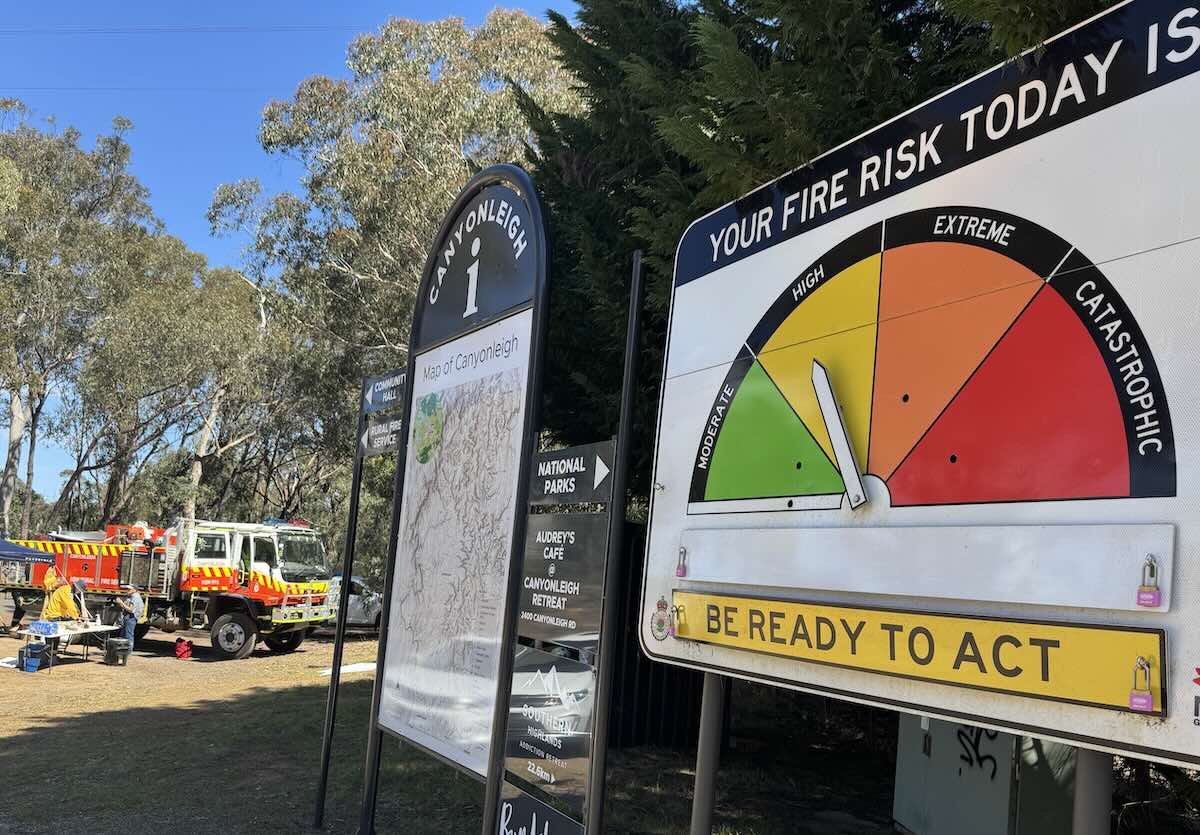
The revelation that a $2m annual allocation for the NSW research centre may not be extended into next year comes days after the Sydney metropolitan and Hunter regions declared an early season “total fire ban” amid “extreme” bushfire conditions.
Sydney, which posted its earliest ever 32-degree day last month, reached almost 35 degrees on Monday, with Newcastle slightly hotter at 35.2 degrees.
The Bureau of Meteorology also forecasts a warmer than average November-February for the whole country, influenced in part by a record strong El Nino event in the Pacific.
Renew Economy sought comment from the NSW government, including emergency services minister, Jihad Dib, and climate change minister, Penny Sharpe, and the NSW Rural Fire Service.
The sole response came from the department of climate change, energy, the environment and water, stating that future funding would be considered through the 2027-28 budget as is standard.
Renew Economy also sought comment from the opposition’s emergency services spokesperson, Tanya Thompson, a Nationals MP.
Sue Higginson, the NSW Greens environment spokesperson said NSW had recorded more than 100 natural disaster declarations since the BNHRC centre’s establishment just three years ago.
“Yet the Minns Labor government has committed just $2m for 2026-27 and left its future funding in doubt,” Higginson said. “That is reckless.”
“Climate change is making these disasters worse, and at a time where funding should be certain and increasing, the Minns government is treating the research that protects lives and homes as an optional budget expense,” Higginson said.
“Researchers should be working to keep communities safe, not spending their time begging the government to fund work it already knows is essential,” she said.
“Long-term disaster preparation demands long-term funding.”
According to the RFS annual report, it is one of eight NSW government end-user agencies of the BNHRC’s work.
The RFS is the lead agency on research from the centre including:
– Evaluating backburning and firebreak operations (with the University of Wollongong)
– Effectiveness of mechanical fuel management treatments including grazing (with the University of Melbourne)
– Fire management on ridgelines (with the University of NSW)
– Incorporating fire extent severity mapping into fuel accumulation curves (with Western Sydney University)
– Identifying burn windows and opportunities for remote monitoring of moisture conditions (with Western Sydney University)
– Validating satellite-derived fuel moisture content in NSW (with the Australian National University)
– Understanding the effects of vorticity-driven lateral spread on backburn escape (with UNSW)
– Understanding extreme fire/pyrocumulonimbus regimes (with UNSW)
– Understanding present and future impacts of critical fire weather (UNSW)