Home » Renewables » Biggest ever turbines set sail for Australia, headed for Fortescue’s first wind project in Pilbara

Biggest ever turbines set sail for Australia, headed for Fortescue’s first wind project in Pilbara

Envision wind turbines ship
Photo: Envision Energy.

The first wind turbines to be sent to Australia by Chinese manufacturer Envision Energy have set sail, bound for Port Hedland in Western Australia and to the first wind project to be built by iron giant Fortescue as it chases its goal of reaching “real zero” emissions by the end of the decade.

The Envision EN-182/7.8 megawatt (MW) wind turbines will be the most powerful yet seen in Australia, and will also be the first delivery by the Chinese manufacturer in the Australian market.

They will be installed in the Pilbara with the help of ground-breaking “self-lifting” technology developed by Spain’s Nabrawind, now owned by Fortescue itself.

The self-lifting technology allows for smaller foundations, less concrete, smaller cranes and lower costs – and is particularly important for remote areas such as the Pilbara, and where the extreme summer heat can make such installations very difficult.

A total of 17 Envision turbines will be used for the 132 MW Nullagine wind project, which is likely to be followed by a much bigger installation at the neighbouring Bonney Downs facility to take total wind capacity to more than 800 MW.
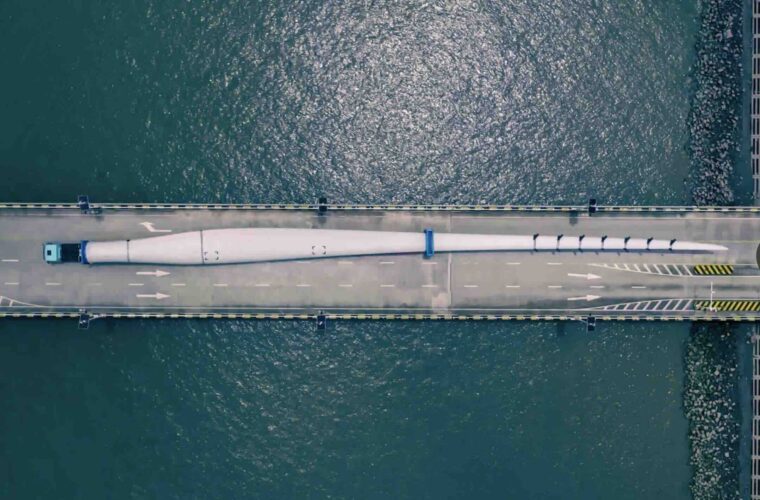
Photo: Envision Energy.

Fortescue is also building two large solar farms – amongst the largest ever built in Australia – that will take its total solar capacity to more than 1.4 gigawatts.

It expects to achieve a “green grid” in the Pilbara by early 2028, and will then work on completing the electrification of its mining operations and equipment to deliver on its goal of eliminating gas and diesel at the Pilbara mines by 2030.

Fortescue CEO Dino Otranto has been in China inspecting some of the equipment that will be supplied by XCMG, including the giant haul trucks, 150-tonne water carts, electric wheel loaders and the like.

“I (took) the battery-electric wheel loader and 150-tonne water cart for a spin, and checked out the battery-electric dozer and grader,” Otranto said in a LinkedIn post.

“They do exist …. and they are very smooth.” Otranto expects the deliveries of the first production models to begin soon. The company expects to buy more than 300 giant electric haul trucks, charged with the 6 MW charging stations it has developed, before the end of the decade.

To join more than 29,000 others and get the latest clean energy news delivered straight to your inbox, for free, click here to subscribe to our free daily newsletter.

To support independent media, and combat AI slop, you can click here to make a one off donation or become a regular supporter of Renew Economy.


Giles Parkinson is founder and editor-in-chief of Renew Economy, and founder and editor of its EV-focused sister site The Driven. He is the co-host of the weekly Energy Insiders Podcast. Giles has been a journalist for more than 40 years and is a former deputy editor of the Australian Financial Review. You can find him on LinkedIn and on Twitter.

Related Topics

Latest posts

S-curve modelling says renewables can kick coal out of Australia by 2032. But is this soon enough?

S-curve modelling says renewables can kick coal out of Australia by 2032. But is this soon enough?

In the race to renewables, the big question is whether “faster than we thought” is the same as “fast enough.” S-curves say we can do the first. Nothing in the modelling tells us we’re on track for the second.
“It’s a commercial system. And it has a customer:” Sodium-ion battery sale hailed as a first for Australia

“It’s a commercial system. And it has a customer:” Sodium-ion battery sale hailed as a first for Australia

The sale of a 100 kilowatt and 200 kilowatt-hour sodium-ion battery system is being claimed as an Australian first – and may herald next generation of storage tech.
Energy Insiders Podcast: Will the green bank save the Tomago deal?

Energy Insiders Podcast: Will the green bank save the Tomago deal?

CEFC boss Ian Learmonth explains why big wind projects may finally get delivered this year. Plus: Tomago aims for 100 pct renewables, and the big utility profits.
Balcony solar or building integrated PV? The emerging options for apartment dwellers and owners

Balcony solar or building integrated PV? The emerging options for apartment dwellers and owners

A Victorian parliamentary inquiry on apartment energy issues has recently reported and identified several issues that require urgent attention to address the failures of energy policy. One interesting issue that relates to both high rise apartments, and plug-in ‘balcony solar’, is where solar fits into apartment occupant energy costs.  High rise apartment buildings have very […]
2 Comments