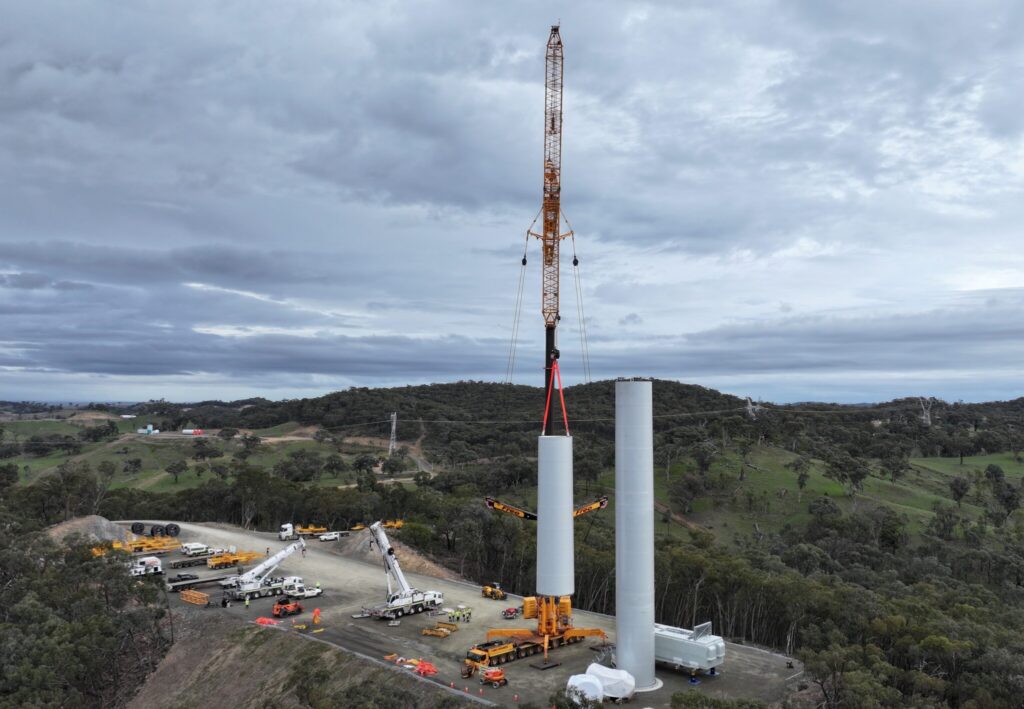
The inability of wind energy developers to get their projects over the line means that Australia is unlikely to reach its ambitious target of 82 per cent renewables by 2030, according to the Australian Energy Market Operator.
AEMO on Thursday released the final version of its latest multi-decade blueprint for the grid, the 2026 Integrated System, which notes falling costs of solar and big batteries, offset by rising costs in wind energy and transmission.
The good news, as Renew Economy editor Sophie Vorrath writes in her overview, is that the rapid growth of consumer energy resources, and rooftop PV and home batteries in particular, is easing the cost burden and will mean that less large scale wind and solar, and few transmission lines will be needed.
The bad news is that – to very few people’s surprise – Australia is currently running well short of the required amount of large scale wind projects, because of a combination of rising costs, social licence issues, grid connections, supply constraints, and in the case of Queensland, government roadblocks.
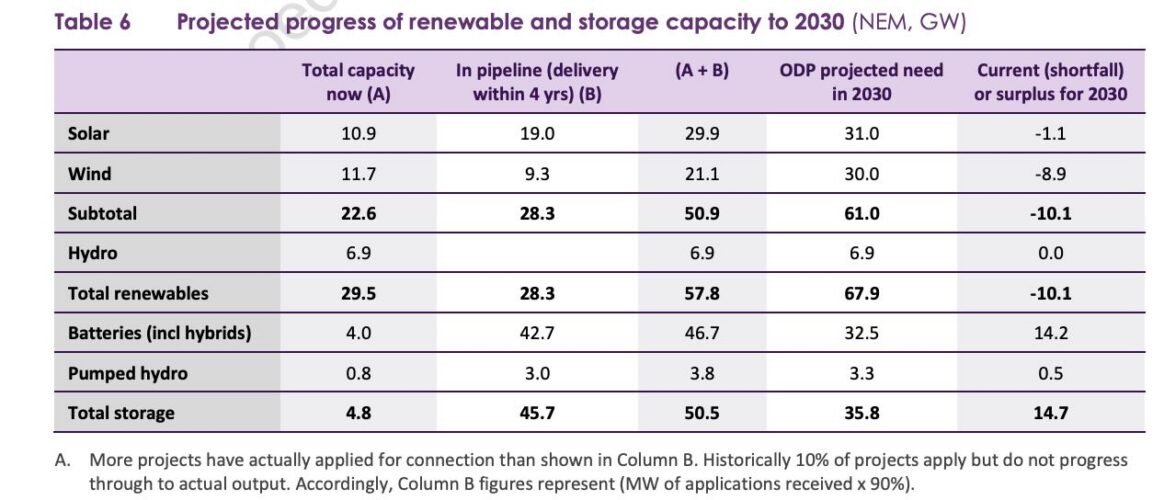
The report finds that the current pipeline of grid-scale renewables – those seeking or having obtained grid connection approvals – would meet only three-quarters of the new capacity that the ISP’s Optimal Development Plan (ODP) requires to meet the 2030r renewable target.
Indeed, about 38 gigawatts GW of new wind and solar capacity is needed. That included some 20 GW of large scale solar, and there are currently around 19 GW seeking connection. But only half of the 18 GW of wind needed is visible in the current connection pipeline.
“The current build of solar and particularly wind in the connections pipeline would fall short of what is needed by 2030 in the Step Change scenario,” it says.
There have been a number of reports suggesting that Australia will fall short of its 2030 renewable target, with some suggesting less than 60 per cent, and others in the 70-80 per cent range.
Federal energy minister Chris Bowen insists the target can still be be reached, although he has conceded that wind energy is finding it tough because of the cost and planning factors, and analysts point to the lack of firm contracts being offered by big energy retailers and other corporate customers.
AEMO creates what it calls its “Constrained Delivery” scenario, which still ramps up the annual delivery rate of large scale solar over the next four years from 1.3 GW to 4.6 GW, and wind from 0.3 GW to 2.3 GW, but it still falls short.
AEMO also assumes in this scenario that offshore wind – being pushed most vigorously by Victoria – suffers a three year delay, and that transmission lines are also slower to be delivered. For many, this is the reality that the grid operator now faces.
“If infrastructure delivery is slower due to constraints, as in Constrained Delivery, the 2030 renewable energy targets would not be met to schedule, and overall costs would increase by even more than the assumed 30% increase in capital costs,” it writes.
“Renewable energy would still contribute 75 per cent of NEM supply by 2030, though falling short of both the 82 per cent renewable energy target for 2030 and the electricity sector’s contribution to the national emissions target.”
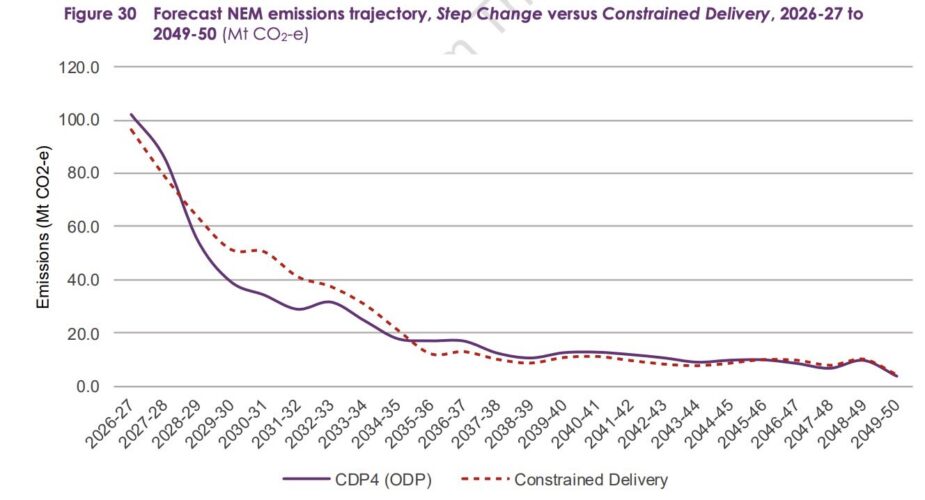
AEMO does not use this as an excuse to throw the plan out the window, as some might suggest. Indeed, it argues that any further slowdown will see prices increase even further, and reliability damaged because of the reliance on ageing coal fired generators.
And it expects that the rate of progress will accelerate in the next five years, with both solar and wind regaining the step change scenario – of 44 GW and 35 GW respectively – by 2035.
The overall picture puts Australia operating at 98 per cent renewables – with up to 17 GW of flexible gas capacity generating on rare occasions and making up the final 2 per cent – well before 2050, depending of course on the Queensland government’s determination to keep its coal fired power stations burning into the 2050s.