More solar, wind and storage, interconnected by bolstered transmission and distribution networks and backed up by small amounts of gas, remains the least-cost way to meet a near doubling of electricity consumption while also quitting coal and slashing energy emissions, a new report has confirmed.
The Australian Energy Market Operator (AEMO) has published the final version of its 2026 Integrated System Plan (ISP), the biennial blueprint of the optimal development path (ODP) to meet consumer electricity needs and government energy policies out to 2050.
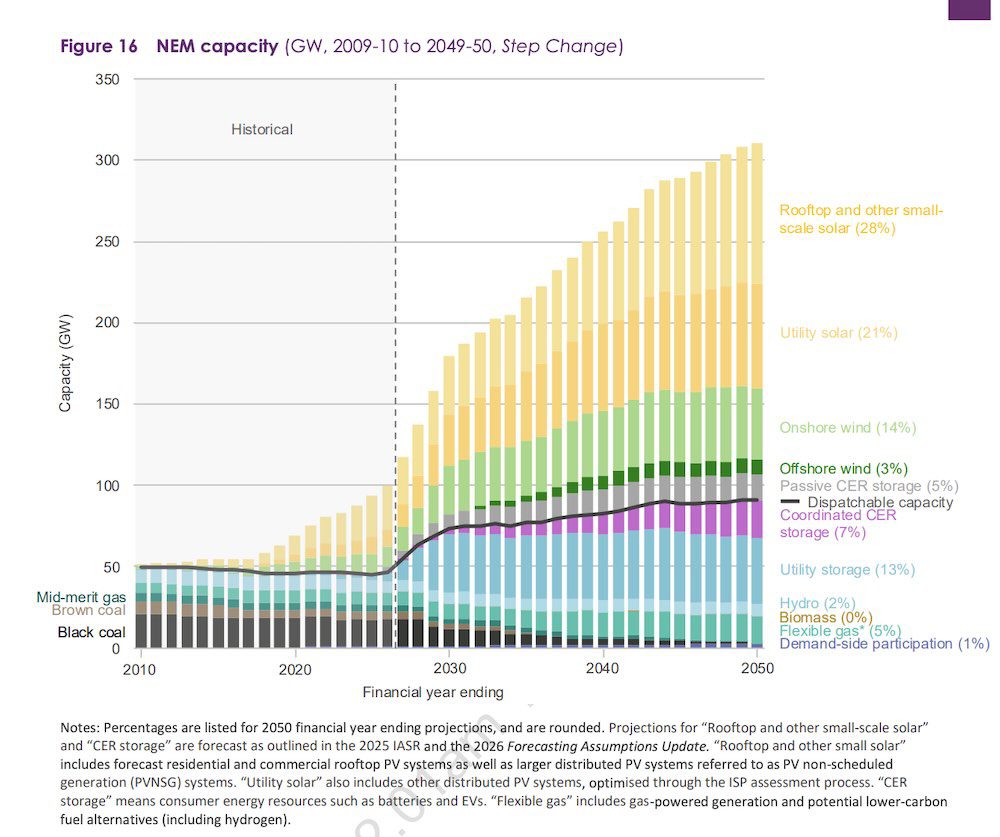
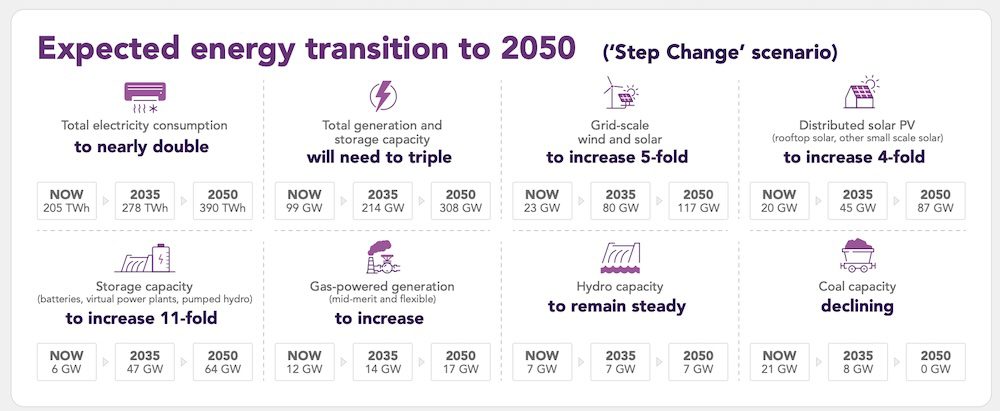
AEMO says that under this least-cost path, Australia can achieve the 82% national renewables target by 2030, and deliver 98% by 2050, underpinned by around 120 gigawatts (GW) of utility-scale wind and solar – about five times the current level – and almost 50 GW of utility-scale storage and hydro.
Fielding in slips would be 17 GW of flexible gas generation – up from about 8 GW of “peaking” plants, now – and to connect the pieces of this integrated puzzle together, the existing 44,000 km transmission network would need to expand by 6,000 km.
Source: AEMO 2026 Integrated System Plan
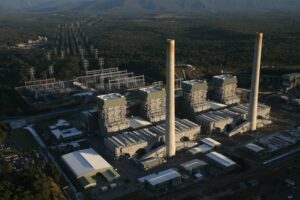
Coal, meanwhile, heads in the opposite direction, with most of the National Electricity Market’s (NEM) remaining coal fleet due to withdraw by 2038, and all of it destined to be gone by 2049. That closure is much delayed from the 2024 ISP because of the Queensland LNP governments decision to keep coal open as long as it can.

Source: AEMO 2026 Integrated System Plan
The cost of this transition will be around $106 billion, AEMO says, with around $6 billion of that number going to transmission, $3 billion for system security investments, and the remaining $97 billion divided between generation, storage, firming and distribution.
The key changes since the 2024 ISP – which was costed at $122 billion – reflect falling solar and battery costs, higher costs for transmission and wind, and stronger growth in consumer energy resources. But AEMO has offset some this with a much lower cost of capital, which it says best reflects the nature of its regulated returns.
The latest number is also lower because some projects have already been actioned, and AEMO’s numbers are based on what remains to be done.
The biggest wildcard by far has been the galloping success of battery storage – including batteries installed in hundreds of thousands of homes – which AEMO chief Daniel Westerman says are “fundamentally changing” the electricity system and the outlook for supply, demand, pricing and planning.
As of early 2026, around 600,000 residential batteries had been installed on the NEM – more than half of that number in just the last year through the federal rebate – and 4 GW/10 gigawatt-hours (GWh) of utility-scale batteries were in operation, up from 1.3 GW / 1.8 GWh in the 2024 ISP.
Even more impressive, however, is the big battery pipeline, which AEMO says has “increased substantially,” from 3 GW in September 2022, to 17 GW in 2024 and to a whopping 45 GW in 2026.
“This is now well ahead of the 33 GW of battery storage that the ODP projects would be needed in 2030,” the ISP says. “To date, battery projects have taken just over two years to go through the connections process.”
At the other end of the scale, the market operator’s forecast for distributed battery storage – the systems installed in homes and businesses to store rooftop solar – has also changed dramatically.
Source: AEMO 2026 Integrated System Plan
Under the 2026 Step Change, small-scale batteries are projected to grow from 5 GW/12 GWh in April 2026 to 12 GW/33 GWh in 2030, and then 35 GW/78 GWh in 2050. By 2050, around two-thirds of homes with solar are forecast to have batteries.
“It’s incredible really,” said Westerman in an interview with Renew Economy. “We’ve seen a real step change in the way the consumer and demand side … has been factored into the Integrated System Plan, and it is becoming more of an integrated system plan.
“It’s really putting the consumer first … and creating the least-cost energy system that sees large-scale investments working alongside consumer energy resources in a way that we haven’t done before.”
The ISP says consumer resources are reducing overall and peak demand from the grid in a way that is benefiting all consumers – even those unable to install solar or batteries – by moderating wholesale prices in peak periods and reducing the need for grid-scale spend.
This effect is magnified the more that consumer energy resources (CER) are bundled and coordinated through virtual power plants for solar and batteries and and vehicle-to-grid (V2G) in the case of electric cars.
According to the 2026 ISP, orchestration of around half of the collective CER capacity could avoid up to $5 billion being spent on additional grid-scale storage in the NEM through to 2050.
But as Westerman noted in his keynote address to Australian Energy Week at the start of the month, even passive batteries have far surpassed the market operator’s expectations of their benefits to the grid.
This is because, as the ISP confirms, households with solar and battery systems are often able to both meet their own needs and export to the grid during the evening peak, an attribute that is already proving to cut average peak grid demand by about 1 kilowatt (kW) per household.
“The ISP really does show the value of those consumer resources being active rather than passive, but I would say, as I said at Energy Week, we really shouldn’t let perfect get in the way of good progress,” Westerman told Renew Economy.
“The volume of home batteries that sit on the system, just in a passive way, at the moment, is incredibly helpful – not just for those who’ve invested in them, but for all consumers, which is really great to see.”
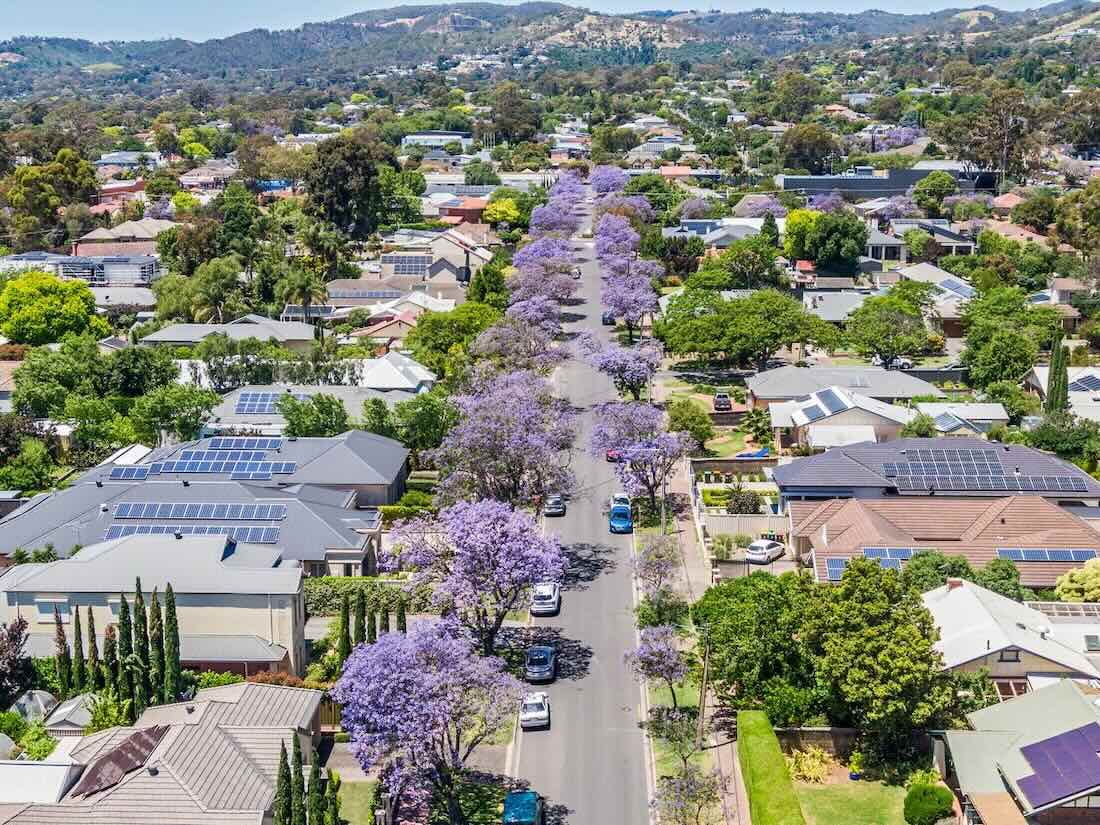
Rooftop solar, too, is expected to continue to make an outsized contribution to Australia’s energy transition, coupling with home storage to slash residential energy demand, even as houses electrify and EVs plug in.
While total underlying consumption across the NEM is forecast to nearly double from the current 205 terawatt-hours (TWh) to about 390 TWh in 2050, the ISP says household grid-supplied energy needs would fall 44 per cent to just 20 TWh.
Currently, more than 36 per cent suitable households in NEM regions have rooftop solar, generating a combined total capacity of 20 GW. By 2035 in the Step Change scenario, 47 per cent of those dwellings would have rooftop solar, rising to 56 per cent in 2050 and a combined capacity of 87 GW.
To cater to all of this consumer energy, AEMO has for the first time factored in a $600 million spend on distribution network developments, including optimisation of voltage management and other “relatively lower cost innovations” that could free up around 4 GW of latent CER capacity and accommodate 8 GW of grid-scale generation and storage, and 3 GW of mid-scale generation.
For transmission networks, the task out to 2050 remains a big one – although nowhere near as big as is often claimed by opponents of the renewable energy transition, and roughly 1,500 km less than projected in the 2024 ISP.
According to the optimal development pathway of the 2026 ISP, transmission projects would extend the existing 44,000 km national network by about 6,000 km or one-seventh by 2050 – including all committed, anticipated, actionable and future projects in the Step Change scenario.
AEMO says about 40 per cent of the additional length is needed to strengthen the connection between states, adding reliability and stability to electricity supply across the NEM, while the other 60 per cent connects new capacity in Renewable Energy Zones (REZs) within states.
“This is essential infrastructure,” the ISP says, with more than 90 per cent of the energy supplied by the NEM expected to serve business and industry by 2050.
The proscribed $6 billion transmission buildout is also projected to save consumers $30 billion in avoided capital, operating and fuel costs compared to a pathway without the investments.
“Transmission is essential,” says Westerman.
“What is outlined in the ISP is obviously 6000 km of new transmission, of which 3,500 km is already committed, anticipated, in progress, leaving a relatively small amount for decision down the track – and that small amount of transmission just brings enormous consumer benefits. …So it’s a very important part of the energy system.”
But Westerman says the main message from the updated ISP is that all of the ingredients – large and small-scale solar, wind power, large and small batteries, deep energy storage, and all of the poles and wires – are equally important in the quest for least-cost electricity.
And the next five to 10 years are critical to delivering the transition, with most coal-fired capacity projected to retire by 2038.
“Australia’s energy transition requires a whole-of-system approach, one that maximises value from generation, storage and transmission with the growing contribution of homes and businesses through rooftop solar, batteries and more flexible energy use,” he said.
“As we test this optimal development path against a number of sensitivities, including high growth or the constrained delivery scenario, what we see is that the destination doesn’t really change,” he tells Renew Economy.
“The call to arms here is deliver the planned projects in generation and storage and transmission and distribution that are really needed.”
If you would like to join more than 29,000 others and get the latest clean energy news delivered straight to your inbox, for free, please click here to subscribe to our free daily newsletter.