Australia will struggle to reach its renewable energy target of 82 per cent by 2030, a new report has warned, if current investment and development pipeline challenges persist and if significant downgrades to wind energy forecasts are to be believed.
In its Australia Energy Transition Outlook 2H 2026, published on Monday, BNEF captures the messy middle of Australia’s energy transition, including a new record in large-scale solar investment, big swings in the outlook for wind, and a home battery market that has smashed all expectations.
While Australia’s coal exports are up 3 per cent and emissions reductions are making “limited progress” towards international and national targets, investment in solar and wind increased 341 per cent in the first half of 2026 from the same period a year earlier, albeit from a small base, buoyed by federal Labor’s Capacity Investment Scheme (CIS).
But BNEF says that despite strong federal and state support for renewables through programs like the CIS, and the Long-Term Energy Service Agreements (LTESA) in New South Wales, it does not expect Australia to reach its 82 per cent target by 2030.
“Challenges persist, especially in the states of New South Wales, Victoria and Queensland,” the report says, even despite a buoyant large-scale solar markety and the fact these three states are projected to account for the “lion’s share” of new solar capacity by 2035.
Wind, in particular is letting the side down, with BNEF’s latest forecasts for new wind capacity out to 2035 aligning with the recent outlook from the Australian Energy Market Operator (AEMO), in which it see’s renewables reaching a 75 per cent share of electricity by 2030.
According to the report, a “mere 252MW of onshore wind capacity” was commissioned in the first six months of 2026 – compared to nearly 1.4 GW of utility-scale solar capacity – lifting total operational capacity to 14.6 GW.
And while BNEF “still expects 2026 to be a big year for wind additions,” with four projects, including Acciona’s delayed 923 MW MacIntyre Wind Farm, expected to add 1.7 GW of new generating capacity by year-end, in line with the total capacity that was installed in 2025, the longer-term the outlook is much less rosy.
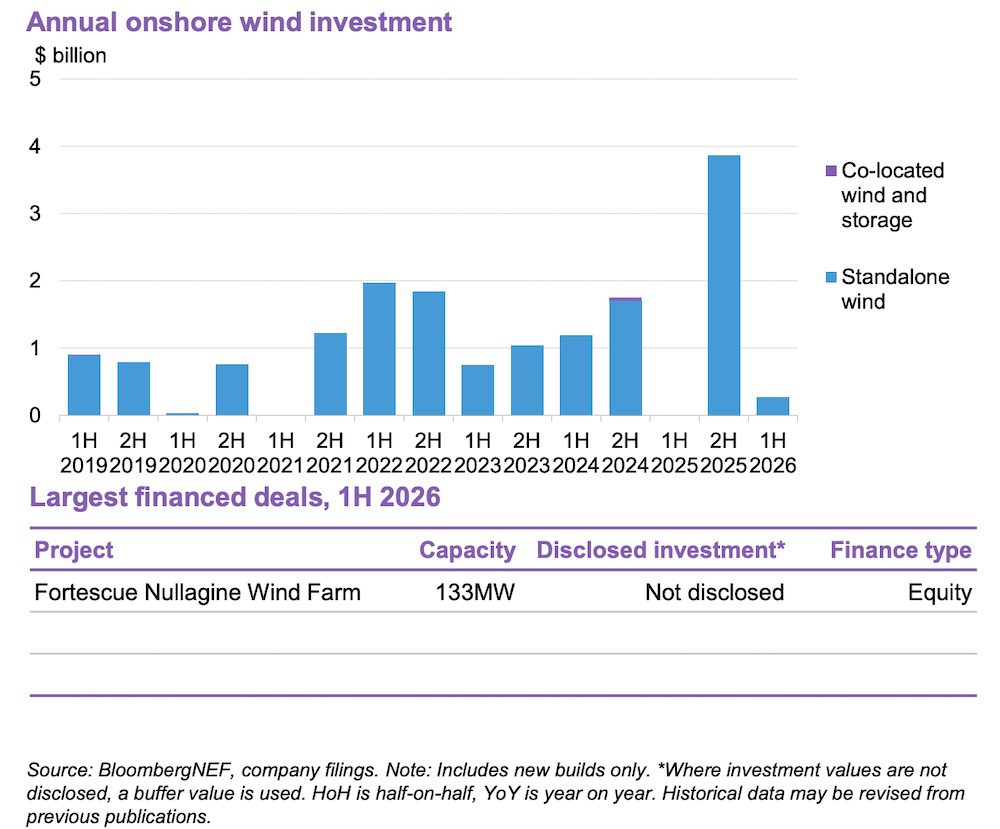
BNEF forecasts a total of 35 GW of wind capacity will have come online by 2035, a 22 per cent downwards revision on its forecast in the previous half thanks to the recent drought in projects reaching financial close, and despite the 31 projects and 14 GW of capacity awarded through federal CIS contracts.
BNEF’s 35 GW by 2035 wind forecast aligns with that put forward by AEMO in June in the final version of its latest multi-decade blueprint for the grid, the 2026 Integrated System Plan.
But AEMO says 18 GW of that 35 GW wind is needed by 2030 to hit 82 per cent renewables. BNEF is forecasting just under 10 GW will be added by that date – and around 13 GW under its high forecast optimal scenario.
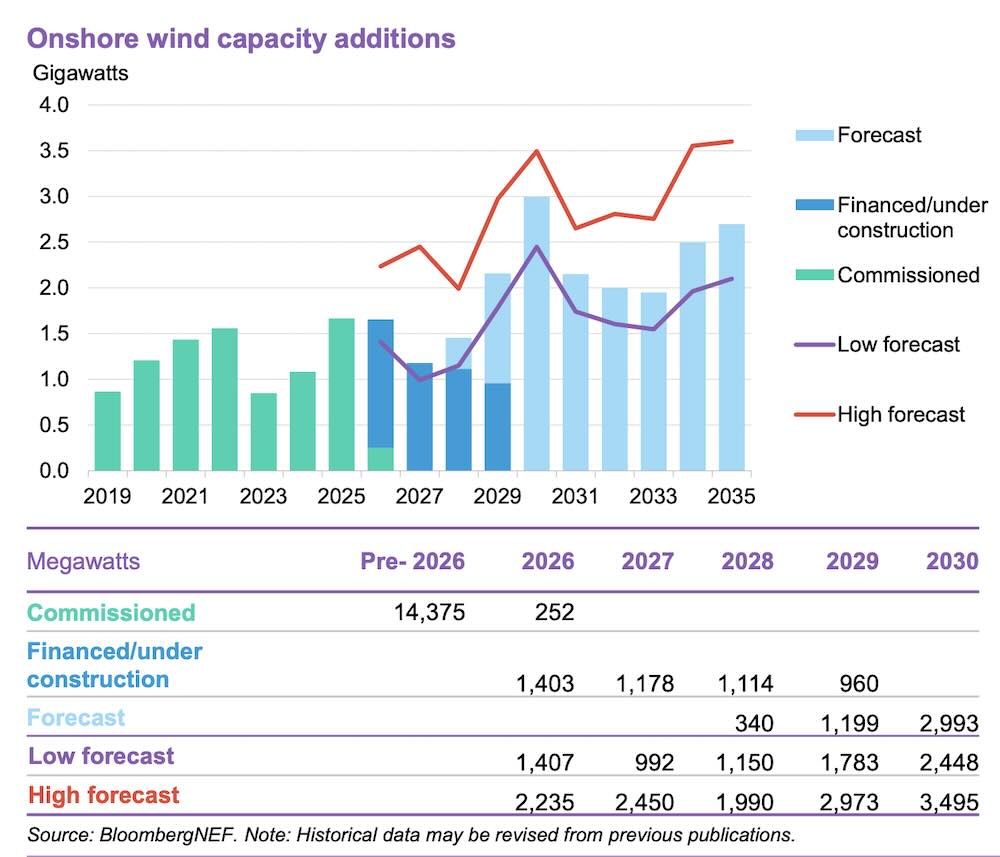
“Rising costs, lengthy permitting and grid connection processes, and growing community opposition have weakened the outlook, especially beyond 2030,” the report says.
“Under BNEF’s high case, operational wind capacity could reach 43 GW by 2035 if conditions improve. If challenges intensify, capacity could reach just 31GW under the low case.”
In more positive news, investment in utility-scale solar reached a record $3 billion in the first half of 2026, up from $876 million in the second half of 2025.
BNEF says this jump was driven largely by Edify Energy’s 720 megawatt (MW) Smoky Creek and Guthries Gap project – which includes a co-located 600MW, four-hour battery – and the more than 1 GW of new solar starts from Andrew Forrest’s Fortescue, at Turner River and Solomon Airport in the Pilbara.
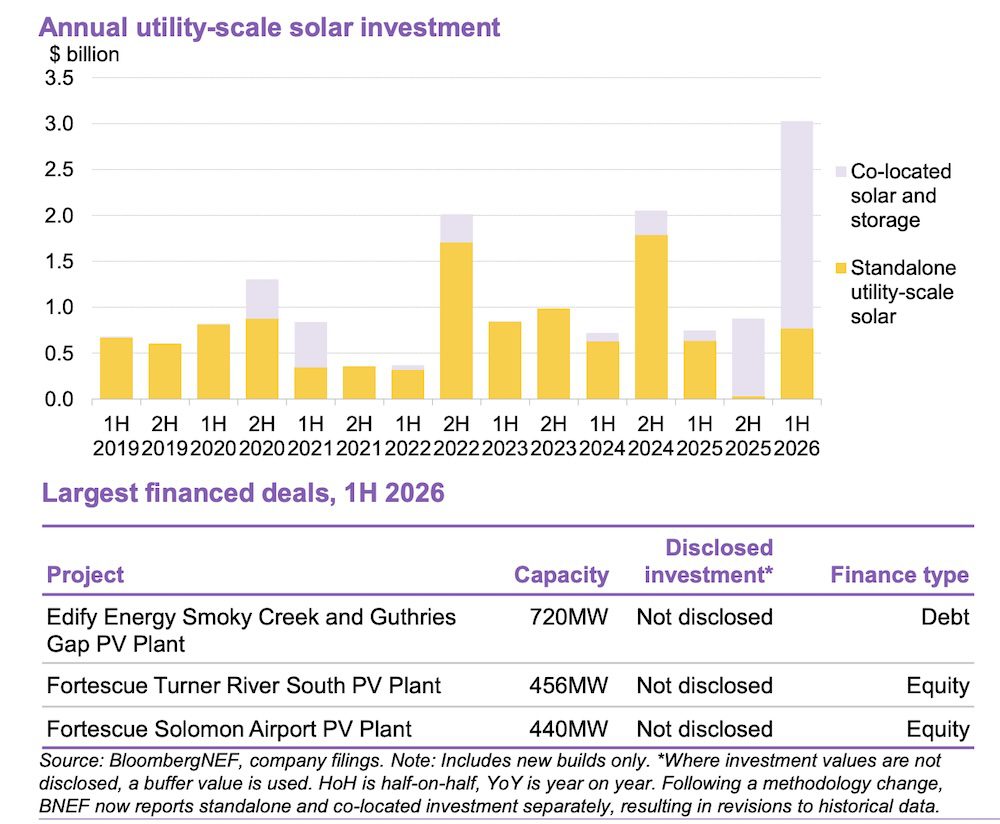
On solar, BNEF has this year started reporting stand-alone and co-located solar investment separately, highlighting what it describes as a “clear divergence” between the two project types.
In the first half of 2026, stand-alone PV projects accounted for five of the eight that were financed, all in Western Australia, including the Fortescue projects, but only around 25 per cent of the new project investment, according to the report. Three co-located projects captured the remaining 75 per cent, including the huge Edify project.
BNEF forecasts that a further 9 GW of large-scale solar will be commissioned by 2030, 17 per cent more than projected six months ago. The cumulative outlook for 2035 has also increased – in this case by a notable 32 per cent – with 35 GW now expected to be operational by then, or 42 GW in the high case.
Record investment in big batteries – and flagging investment in wind – are also giving solar a boost, BNEF says. “As solar deployment grows, co-located batteries can reduce curtailment and improve project economics,” the report says.
“Additionally, higher costs and longer timelines for wind projects are expected to drive greater deployment of solar paired with batteries to meet government targets and corporate demand.”
On storage, BNEF says nearly 2.9 GW of utility-scale battery capacity was commissioned in the first half of 2026, equivalent to 79 per cent of total installations in 2025. This brings total operational capacity to 9 GW, with nearly 10 GW currently under construction and a market headed for 37 GW by 2035.
Under BNEF’s high case scenario, stronger load growth, continued policy support and greater uptake of hybrid projects could lift total installed capacity to 27 GW by 2030 and 42 GW by 2035.

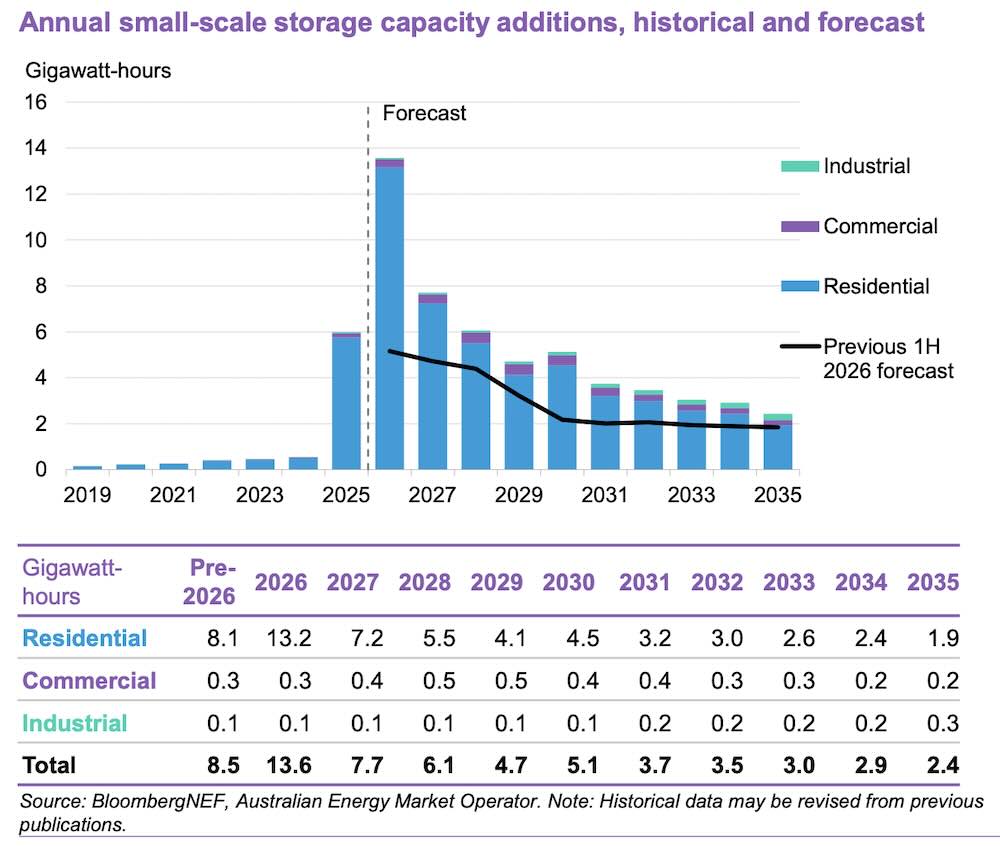
But it is the “unprecedented pace of installations” of home batteries that has analysts scrambling to keep pace.
BNEF says that with 9 gigawatt-hours (GWh) of new capacity added in the first six months of the year, it is now forecasting that cumulative capacity will jump from 18 GWh, today, to 61 GWh by 2035 – a 71 per cent upwards revision on its forecast from six months ago.
Other notable features of the messy middle are illustrated in BNEF’s data on curtailment of large-scale renewables. According to the report, an estimated 12 per cent of utility-scale solar generation and 8 per cent of wind generation in the NEM was curtailed in the first half of 2026, up from 11 per cent and 7 per cent in 1H 2025, respectively.
BNEF says this is largely due to the huge fleet of rooftop solar in the NEM, “depleting the level of generation that utility-scale renewables can send to the grid.”
“This directly affects project revenues earned from the wholesale power market, negatively affecting the economics of utility-scale renewables, especially solar farms, which tend to generate at the same time as small-scale rooftop solar systems,” the report says.
This phenomenon was observed most acutely in South Australia, according to BNEF, with 21% of the state’s large-scale solar generation curtailed in the first quarter of 2026, alone.
Negative pricing also continues to be a feature of Australia’s electricity market, the report says, with prices falling below zero 12 per cent of the time across the NEM, slightly below the 13 per cent recorded in 1H 2025.
BNEF also notes that the NEM experienced “significantly lower” wholesale power price volatility in the first half of 2026 than it did in the first half of 2025, thanks to the addition of large and small batteries.
“Average intraday arbitrage across the NEM fell 59 per cent year on year to $A135/MWh (megawatt-hour), driven by milder weather, fewer major supply disruptions, and greater penetration of renewable energy and battery storage,” the report says.
“Volatility rose in South Australia, however, driven by a combination of lower wind output, a cold snap and a transmission constraint across two days in June.”
BNEF’s update on the share of renewable energy in the National Electricity Market is that wind and solar supplied 38 per cent of the NEM’s electricity in the first half of 2026, up from 35 per cent for the same period a year earlier. With hydro, that share jumps to 44 per cent.
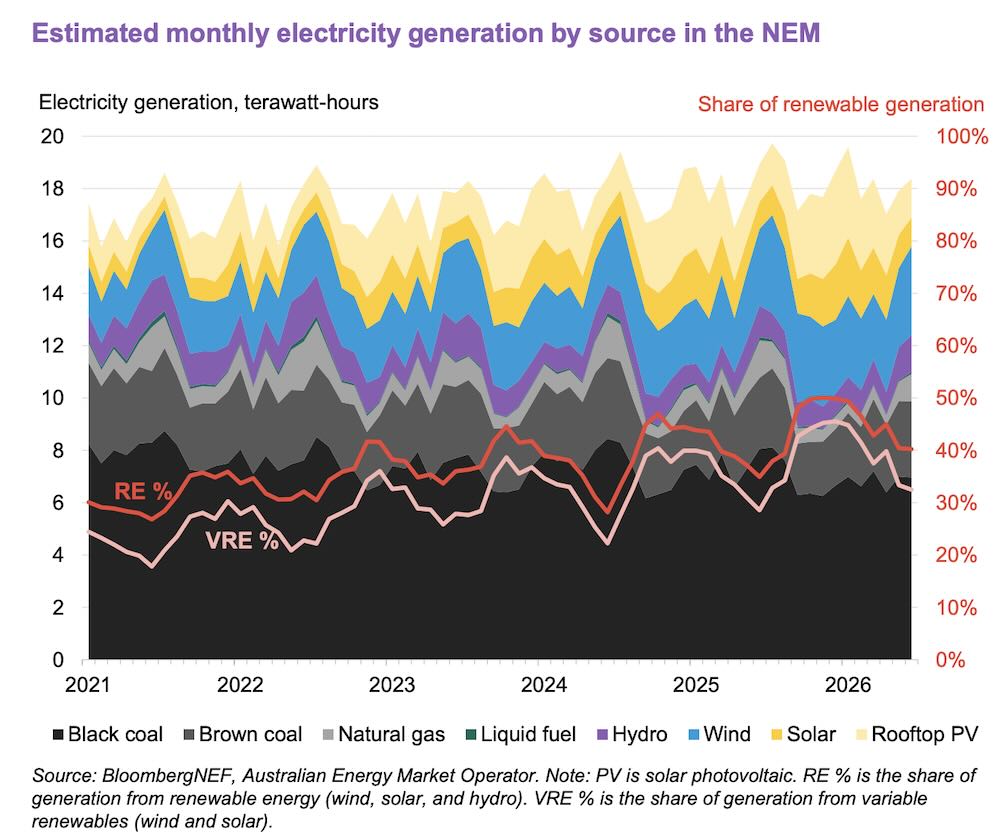
“The retirement of aging coal plants and rapid growth in renewable energy are slowly transforming the energy mix in the NEM,” the report says. “The sheer magnitude of coal generation and its precipitous decline are indicators for the fall in carbon intensity in Australia, as well as the pace of decarbonisation.”
BNEF also warns, however, that Australia will need to ramp up the pace and depth of decarbonisation across multiple sectors to meet its climate commitments.

Economy-wide, national emissions have gradually declined some 25 per cent below 2005 levels, but only by 4 per cent excluding emissions from land use, land-use change and forestry (LULUCF), the report says. Emissions declined just 1.1 per cent from 4Q 2024 to 4Q 2025.
To join more than 29,000 others and get the latest clean energy news delivered straight to your inbox, for free, click here to subscribe to our free daily newsletter.