Back in July, when Prime Minister Anthony Albanese waxed wistfully about Australia having another Medicare moment when it came to harnessing artificial intelligence and the data centre boom, he stoked expectations renewable energy would get a rails-run when it came to supplying the many gigawatts of the required extra power supply.
Albanese told us we would accommodate new data centres in an “Australian way, true to our values and our standards”.
His government would “create a legal obligation for the next generation of large-scale data centres to underwrite new power supply” so these electron-gorging giants would “put at least as much energy into our grid as they take out of it”.
Most watchers assumed the new capacity would be clean energy since the obligation, Albanese said, extended to building “new renewable generation – and firming – to strengthen our national energy resilience”.
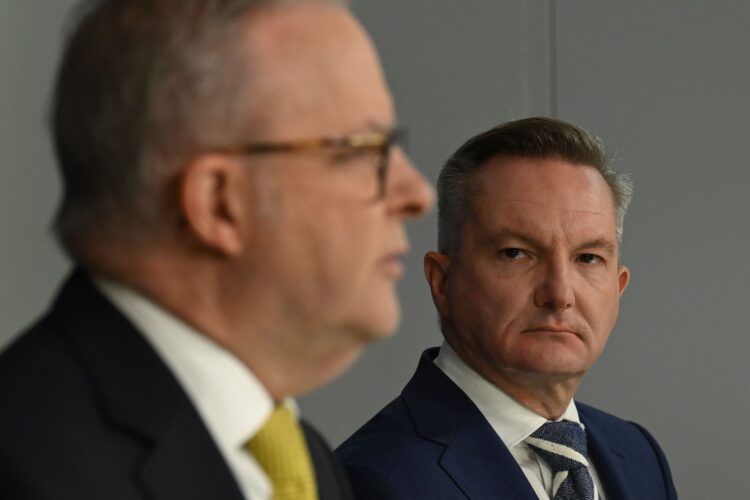
His climate change and energy minister Chris Bowen followed suit, insisting the Commonwealth was “not going to let Queensland run a race to the bottom” by pursuing dirty energy sources such as gas and coal. (Tim Ayres, minister for industry and innovation, was among others to echo that view.)
Bowen’s appearance at the National Press Club on August 5th was expected to include details of how this touted renewables obligation that would be imposed on willing or recalcitrant states and territories.
Instead, Bowen’s pre-speech announcable was to spruik the extension of the small-scale solar support scheme to 1-megawatt capacity. But he did insist the Feds weren’t about to let states fall “over themselves” to lure data centres “at the cost to household bills, reliability or emissions”.
(We noted here how rare it’s been for “emissions” to get a mention in the debate about data centres, or frankly, most energy policies of late. Cost of living, not the climate, is the focus, it seems.)
“We will use all the powers available to the Commonwealth, including Commonwealth legislation, to ensure that Australian households and Australian energy reliability is put first: even if some states have different ideas,” Bowen thundered.
“At the same time, these new rules will be a national standard. States and territories will be free to add more rigorous requirements if they feel that is appropriate for their circumstances, but not to water them down.”
Indeed, NSW’s Minns Labor government has forged ahead, releasing guidelines that require new data centres to source the equivalent of 40% of their electricity needs from wind.
No wonder, then, that Wednesday’s national cabinet meeting in Sydney had fanned so much anticipation. Here would be the PM laying down the outline of what obligations his government would seek to draft as legislation by the year’s end, with the aim of passing those requirements into law by early 2027.
That Albanese appears to have folded after the first card shuffle had more than a few people scratching their heads.
Certainly, Queensland and the Northern Territory, which want to pick their own “energy mix” – read more coal and gas – to lure data centres, claimed vindication if not out-right wins from the meeting of national leaders.
Watered-down is ok, after all.
To be sure, a lot went on behind those closed doors, and Albanese may have decided that conceding on data centres was a price worth paying given there are arguably more immediate, or larger but later, matters to resolve.
At least one state government, we hear, sought help on Thursday from energy analysts to clarify the meaning of what transpired the day before. So scant are the details to date.
And it’s also possible the PM was advised not to stir up additional resistance on the energy front. After all, Canberra will need Queensland, in particular, to drop objections to important grid reform issues, such as the Energy Services Entry Mechanism (ESEM) that will shape the post-2030 National Electricity Market.
Nor should we discount the fact Queensland and Northern Territory are latecomers to the data centre binge anyway, and aren’t likely to attract more than a minor fraction of the investment jockeying for approval in NSW and Victoria.
Let Brisbane and Darwin claim the win to their fossil fuel friends. Greenhouse gas emissions, still too high, won’t rise much further as a result of these victories, the optimists might console themselves.
Still, the person left most out on a limb from the past six weeks of bluster and – apparently – backdown, is the federal climate change and energy minister.
No doubt inured to the daily attacks on his character by the News Corp outlets, Blackout Bowen as the Murdoch media like to call him might be wondering how long he can rely on the PM to fight his corner.
Sure, he can claim some big wins during his four-plus years in the role, such as the Cheaper Home Battery Scheme that came with an $8-billion odd price tag.
But his flagship policy target, 82 per cent renewables by 2030 and the associated emissions targets, now look even further out of reach if Queensland and the NT continue on their plans to power data centres with coal and gas in the case of the former, and fracked gas in the case of the latter.
Bowen has had to wear some other setbacks too. His efforts to secure Adelaide hosting rights for the Conference of the Parties climate summit secured all but Turkiye’s vote, and yet Ankara managed to secure the prize. The talk is that Albanese’s office was not so keen on hosting because it saw political risk.
Yes, Bowen has the consolation of being president of negotiation for COP31 but that’s a grind without the glory of presiding over the global event itself.
With some big climate-related fights to come – not least whether the government will up the Safeguard Mechanism’s 4.9% annual emissions reduction requirement for affected industrial sites after its review – observers can’t help but wonder where Bowen’s ambitions will be curtailed next.
No early answer is clear, though. While Renew Economy contacted Bowen’s office for comment, we learnt from a media release the minister was meeting his Chinese counterpart, Minister of ecology and environment, Huang Runqiu, at Uluṟu-Kata Tjuṯa National Park.