AEMO hosted an informative webinar last week on their FY26 Engineering Roadmap actions and insights on future power system security and grid-forming inverters.
For those who missed it, the webinar may have marked a turning point for AEMO in recognising and planning for the role Grid Forming Inverters (GFM) can play in the future.
Since 2022, AEMO’s Engineering Roadmap (ER) has been updated annually and from December 2026 will be merged into the Transition Plan for System Security (TPSS).
AEMO foreshadowed that the TPSS will include new detailed workplans for three power system criteria: system strength, transient and oscillatory stability (the oscillations that can arise after grid disturbances), and system restoration following a major event.
Large loads (think data centres), DER and operability will continue to be addressed through current initiatives.
A sign of how far AEMO and the wider market have come in understanding inverter capability is that frequency , inertia, and voltage control, are now managed through business as usual (BAU) processes. Only a few years ago managing system inertia requirements was discussed as a key challenge for high penetrations of Inverter based resources.
Andrew Halley, AEMO’s Specialist Engineer within the Future Energy Systems (FES) Group, presented new insights into network protection challenges with increasing inverter-based resources (IBR).
Protection relays detect faults by measuring fault current characteristics and isolating the faulted section of the grid to prevent a cascading effect across wide areas of the network. The ability to supply “protection quality fault current” is one element of system strength.
Today’s protection systems have evolved around the fault response of synchronous machines, which is determined by their physical electromagnetic characteristics: the surge in fault current, and how each electrical phase reacts to different fault types, are both predictable and measurable.
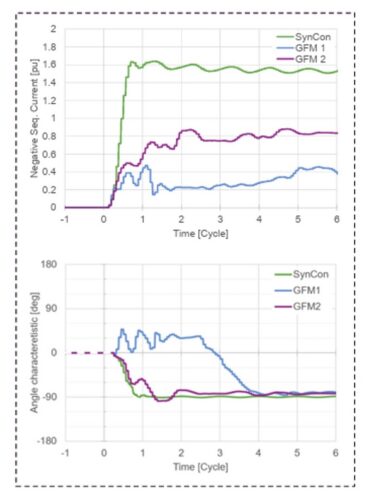
Inverter responses are governed by software and the rating limits of power electronics, both of which can vary across OEMs.
AEMO shared graphs comparing the response of a synchronous condenser with two GFM inverters, illustrating the variation in fault current characteristics across OEM control strategies.
AEMO reported their simulations and preliminary hardware-in-the-loop (HIL) relay testing confirm that misoperation of certain protection elements is possible.
AEMO shared a three-point plan built around the question: “Can GFM BESS be used as a substitute for synchronous machines [e.g. syncons] to help satisfy minimum system strength requirements (NER Schedule 5.1a.9)?”
This is a step forward for AEMO, which in the 2025 TPSS stated: “The provision of protection quality fault current remains a key limitation of GFM”. Over the last year the high cost and long delivery times of syncons have emerged as a constraint, whilst the role of the rapidly growing GFM BESS fleet in the future NEM has become clearer.
The AEMO workplan is based on industry collaboration across networks, market participants and OEMs.
Network service providers will form a protection focused technical forum ; AEMO will run trials with market participants (Type 2 Service Trials) and OEMs, NSPs and developers will collaborate through the recently announced ARENA-funded UNSW PROFILES project (Protection & Relay Operation For Inverter-based Low-inertia Electrical Systems).
This involves the “Deployment, evaluation and testing of multi-OEM inverters and protection devices in a real time simulator (RTS) environment”.
The project aims to “reduce uncertainty associated with how GFM converters respond to disturbances and how protection systems interpret these responses” and “identify pathways for protection system design and operation in IBR dominated power systems.”
AEMO stressed the importance of industry collaboration to “arrive at practical and implementable outcomes”.
AEMO’s Jingwei Lu shared insights into how system strength capabilities and requirements can be quantified early in the design and connection process using frequency-domain scans, and focusing detailed studies on the most relevant options.
Finally, future system damping was discussed in the context of more IBR deployment. Damping describes how quickly power oscillations die away after a grid disturbance; poorly damped oscillations can grow, trip plant and lead to cascading outages.
A study report is due before the 2026 TPSS.
Mark Twidell is an energy transformation specialist and Industry Professor of Practice, UNSW Energy Institute