A $4 million feasibility study. A $15 billion ‘fuel security’ package. And a refinery that, if built, won’t open until the 2030s — announced the same week the Iran war pushed oil prices soaring again.
A refinery study isn’t fuel security. It’s a 20th-century reflex to a 21st-century problem, and it looks a lot more like what fossil fuel lobbyists wanted than what Australia needs.
Most of the world has already made its choice. Asian manufacturers, especially China, are mass-producing electric vehicles and trucks fast enough to define the next global economy, and oil’s grip on land transport is breaking in real time.
The oil death spiral is well underway in the world’s largest car market (Figure 1). Australia is choosing, instead, to argue about how much crude to keep in tanks.
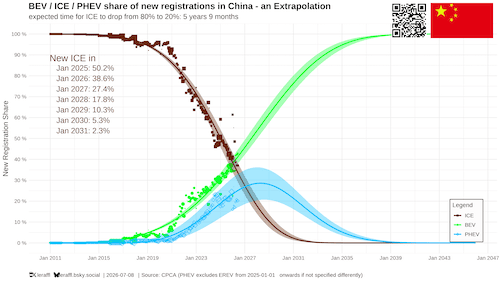
Figure 1. Share of new vehicle registrations in China by drivetrain. (Source: Raphael Wellman).
Isn’t there something better that we should be doing than ensuring we have full tanks of diesel and petrol?
We acted to remove coal from our power grids. Why can’t we remove oil from our cars, trucks and trains? Every EV charged on Australian sunshine is one less vehicle held hostage to a war in the Gulf or a blockade in the Strait of Hormuz. The reform task isn’t storing more oil — it’s exiting it.
A refinery built for a shrinking market
A new oil refinery commissioned somewhere in the mid-2030s is just burning money that makes emissions, to fuel something that makes emissions as well.
More than 90% of Australia’s conventional crude oil reserves have already been extracted, and more than 95% of the fuel refined here comes from overseas, so a domestic refinery of imported oil fails to remove Australia’s exposure to volatile global supply chains.
The first oil shocks of 1973 and 1979 forced rapid policy change, but the pattern that has followed since — more stockpiles, more refining capacity, more subsidy — is no longer fit for purpose. Australia would be transiting shipping lanes, chokepoints and refineries we do not control. We need a new approach.
Former BP Australasia president and Climate Councillor Greg Bourne put it bluntly: building a refinery doesn’t stack up, which is exactly why so many refineries have already closed. More closures will follow as cleaner, cheaper and more flexible alternatives sweep through transport and energy systems (Figure 2).
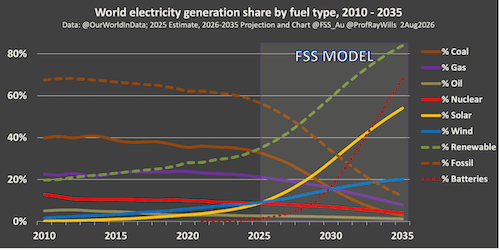
Figure 2. World electricity generation share by fuel type, 2010 to 2025, Future Smart Strategies projected to 2035.
The same short-termism is playing out at the bowser. The temporary fuel excise cut has now ended, a 26 cents a litre relief that was only ever going to be temporary. A discount funded from general revenue can’t survive contact with a budget. Electrification is the only version of ‘relief’ that doesn’t need renewing every six months.
This is the kind of security the world is seeking and its now happening very fast.
What can we learn from gas replacement in electricity?
The rapid build-out of solar, wind and battery storage in Australia’s electricity system is already demonstrating that we can displace gas from grid-support roles; the same technologies, combined with electric vehicles in urban and rural transport systems, can displace oil from our land transport system. Local economic development is now going to follow the production of food and minerals as it all becomes electrified.
None of this happened by accident. China’s mass production model did to EVs and batteries what it once did to solar panels – and having already transformed the grid side of energy security, it is now moving fast to do the same to oil.
The China lesson: the fastest transition in history
China is the clear global leader, and paralleling previous tech shifts in solar and batteries, electrification of transport is now the fastest shift of its kind in human history.
China’s carbon-peaking action plan targets new energy vehicles making up 30% of its entire national fleet by 2030, not just of annual sales, and by June 2026 it already had 49 million NEVs on the road — 13.2% of its total fleet.
That domestic base is now driving export dominance: China exported more than one million vehicles in a single month for the first time in June 2026, up 75% year-on-year, with new energy vehicles for the first time making up the majority of that total.
Australia is already living this shift. In April 2026 China overtook Japan as Australia’s largest source of new vehicles, and more than 80% of EVs sold in Australia are now made in China.
The half a million battery electric vehicles now on Australian roads are measurably reducing petrol demand. And continued uptake leaves Australia less exposed to the next shortage (Figure 3).
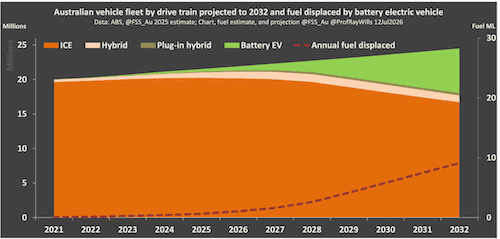
Figure 3. Australian estimated vehicle fleet by drivetrain to 2026, projected to 2032, and estimated fuel displaced by electric vehicles in millions of litres (ML)
This is not only a passenger car story. China’s heavy-truck electrification program targets roughly 40% new-energy heavy-truck sales by 2030, around 1.6 million vehicles in operation, concentrated on the corridors, ports, mines and steel mills that burn the most diesel.
In these high-utilisation segments, electric heavy trucks already captured about a quarter of new sales in 2025, with penetration rising further through 2026 — proof that a minority of vehicles can remove a majority of diesel demand when they run the longest hours on the busiest routes.
The International Energy Agency’s revised 2026 Outlook expects Chinese oil demand to peak this decade. But we think it will be faster: the IEA frames Beijing’s actions through a Western economists’ lens of ‘weakening demand’ rather than recognising China’s deliberate strategic response.
What IEA analysts label as ‘demand destruction” is China very effectively managing its 1.4-billion-barrel strategic reserve tactically — buying low, drawing down when prices spike, and avoiding the expensive replenishment now facing the US — while electrification steadily shrinks the volume of crude it will ever need to import again.
For regional Australia, where diesel dependence is a structural vulnerability for farms and freight, this is not a distant curiosity — it is a preview of the rural corridor-based planning Australia could pursue instead of chasing a $15 billion refinery that may never open.
Solar as the new strategic reserve
The same reframing needed for oil applies to the entire concept of “strategic reserves.” Asia’s latest oil shock has delivered an unmissable lesson: the most effective strategic reserve in 2026 is not a tank farm full of crude, but gigawatts of solar on roofs and in fields, backed by batteries and smarter grids, and the electrification of fleets.
India met a record 256 GW of demand during a brutal heatwave with solar supplying roughly 22% of generation at the system peak, while Pakistan’s rooftop solar boom is a hedge that paid off for households and firms insulated from imported fuel price spikes.
Traditional strategic reserves are finite, depleting buffers — barrels in caverns, tonnes in coal yards. Solar flips that logic: once installed, panels do not run down when used; the infrastructure itself is the reserve, and the sun rising tomorrow is the replenishment.
China’s role in this reframing is pivotal. It now produces majority shares of key clean tech products (Figure 4). The world deeply and perhaps irreversibly dependent on Chinese clean manufacturing for the net zero transition as it moves from utility power systems to transport systems.
The only real question is whether that dependency is managed through antagonism and trade barriers that raise costs and slow deployment, or through purposeful partnerships that accelerate it.
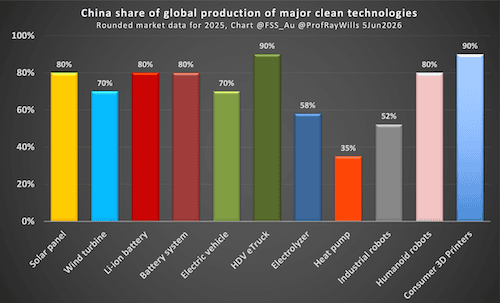
Figure 4. China share of global production of major clean technologies
What should a credible fuel plan include?
A credible, modern fuel-security strategy would ensure minimum short-term liquid fuel stocks for critical services, remote communities and defence. But it must go much further, by:
- Setting a clear timetable to electrify most new road transport, backed by strong fuel-efficiency and CO₂ standards under the New Vehicle Efficiency Standard, so Australia stops lagging the world on vehicle technology.
- Aligning EV rollout with accelerated deployment of solar, wind and batteries — what we have called “solar daylight saving in batteries” — so locally generated energy replaces imported oil and gas in both grids and vehicles.
- Building corridor-scale charging and freight infrastructure for electric trucks on Australia’s grain routes, livestock corridors and mining and freight corridors, rather than treating electrification as a subsidy-driven, vehicle-by-vehicle problem.
- Using EVs and stationary batteries as part of a coordinated resilience strategy, where distributed storage supports communities and critical infrastructure during supply shocks.
- Planning for the orderly decline and exit of oil demand, so that any additional strategic stockholding, or refining capacity, is targeted, modest and reserved for genuine evidence-based national-interest uses rather than measures that simply defend business-as-usual petrol and diesel use.
Temporary relief – a fuel excise cut, a refinery study, another round of stockpile subsidies – is what governments reach for when they are managing a budget cycle, not a transition.
Electrification is what you reach for when you are actually trying to fix the problem.
Australia doesn’t need a new oil farm. It needs to finish the job it already started with coal.