A new report from energy think tank Ember has shown how firmed solar now undercuts most of the new gas power capacity Asia is planning to build and that electrifying the region’s road transport could save more than $US300 billion a year in oil imports.
The report, Electric Asia, describes these two so-called “superlevers” as Asia’s cheapest option for growth, but also the region’s only path to keep growing without deepening a region-wide dependence on fossil fuel imports, which already costs $US1.1 trillion each year.
Currently, Asia boasts only 4 per cent of the world’s oil and gas reserves, even though the region simultaneously accounts for 75 per cent of the electrotech machinery that is transforming how the world uses electricity: solar and wind generators; electrification – from vehicles to heat pumps, and; connections from batteries to digitalisation.
According to Ember, Asia manufactures over 95 per cent of solar panels, 85 per cent of batteries and 75 per cent of wind turbines. At the same time, Asia has enough solar and wind resources to supply at least 14-times its total energy demand and 100 times its oil and gas production.
Moreover, Asia has driven three-quarters of the growth in global electricity since the turn of the century, with GDP and electricity demand rising in lockstep and greater electrification being achieved at lower incomes per capita.
As the world’s electrotech factory, Asia is well placed to replace the fuel resources it lacks with the electrotech necessary to wean itself off its fuel import dependency.
This has never been more apparent than in the last few years when Asia’s supplies of fossil fuels have now twice been hit by massive shocks and disruptions – first in 2022 when Russia cut off Europe and Europe subsequently outbid Asia for gas, and now with the closure of the Strait of Hormuz, through which nearly half of Asia’s oil travels.
“Asia has been highly dependent on the old stability of the Pax Americana, which is being challenged by one oil shock after another, and the closing of Hormuz is a major catalyst for a change,” said Kingsmill Bond, Ember director.
“The economics of electrotech have been transformed in the last five years. The cost of firm electricity from solar backed up by batteries has fallen below that of fossil fuels for almost all of Asia. What was competitive before is irresistible now.”
Ember’s report shows how Asia can decouple itself from such dependency by utilising the technology it creates.
Solar plus batteries, according to Ember, are already cheaper than liquid natural gas (LNG) at three-quarters of the sites across Asia where new gas capacity is currently being planned.
In fact, solar plus battery power now costs less than $US100 per megawatt-hour (MWh) in most of Asia, and with the capital cost of solar already below that of new fossil capacity even before any fuel is bought, the report predicts that solar plus batteries will outcompete LNG everywhere in Asia by 2030.
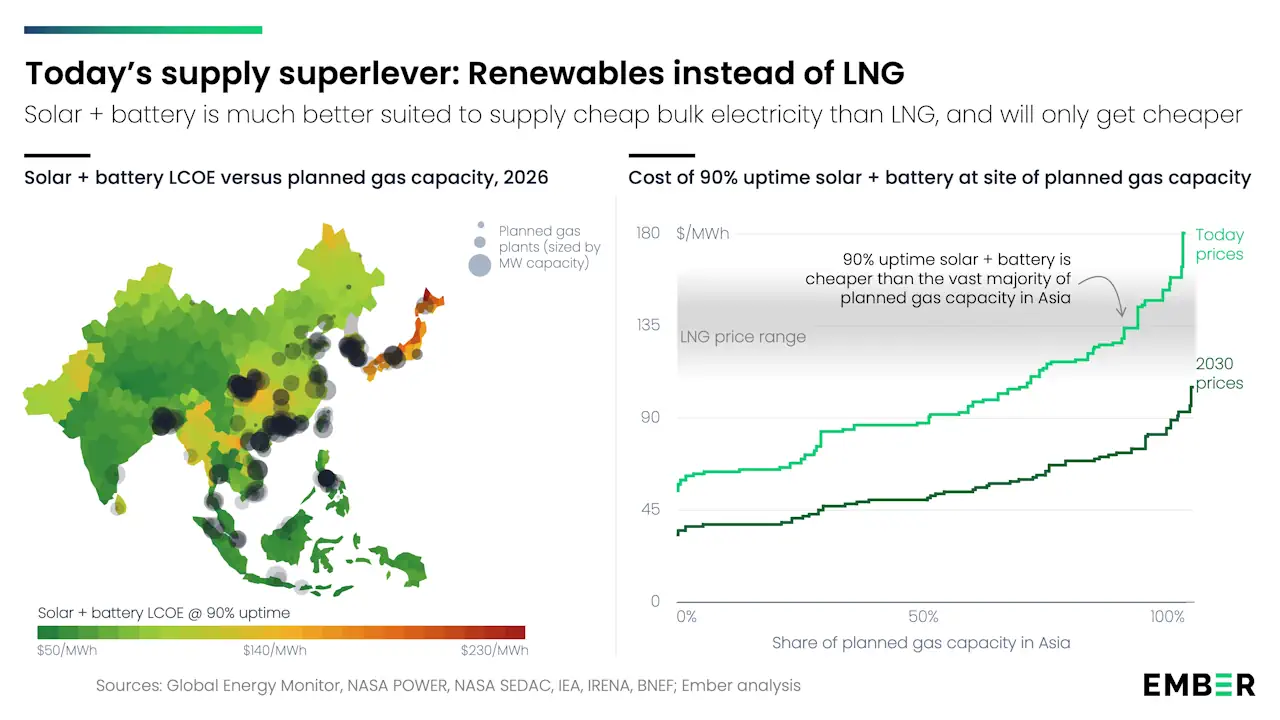
“Solar plus batteries are much better suited to deliver bulk power now in Asia than LNG, and they will only get cheaper,” says Aditya Lolla, Interim Managing Director at Ember and a co-author of the report.
“With strong domestic manufacturing capacity and low electricity prices, the countries in the region are well-positioned to supply their own clean, electrified future.”
With solar plus battery power addressing the supply side of the equation, electric vehicles solve the demand side.
Around 80 per cent of the oil that Asia uses in road transport is imported. Electrifying the region’s road transport sector with the technology it is already developing and manufacturing could save more than $US300 billion a year in oil imports according to Ember.
Ember declares that electric vehicles (EVs) are “now at purchase price parity with petrol” – which is probably something of an oversimplification, though less so in Asia than it would be were the same comment made about Western countries.
Asia, and China in particular, have always put more effort into developing affordable, smaller cars, which remain hugely popular across the region. This has resulted in greater price parity opportunity, whereas across the Western world, bigger has always been seen as better, therefore decoupling the opportunities for EVs to yet reach price parity with petrol variants.
By pivoting towards electric mobility, Asia has the opportunity to reduce the $US1.1 trillion bill it pays each year for imported fossil fuels and redirect that same money into its own supply chains, manufacturing, and infrastructure.
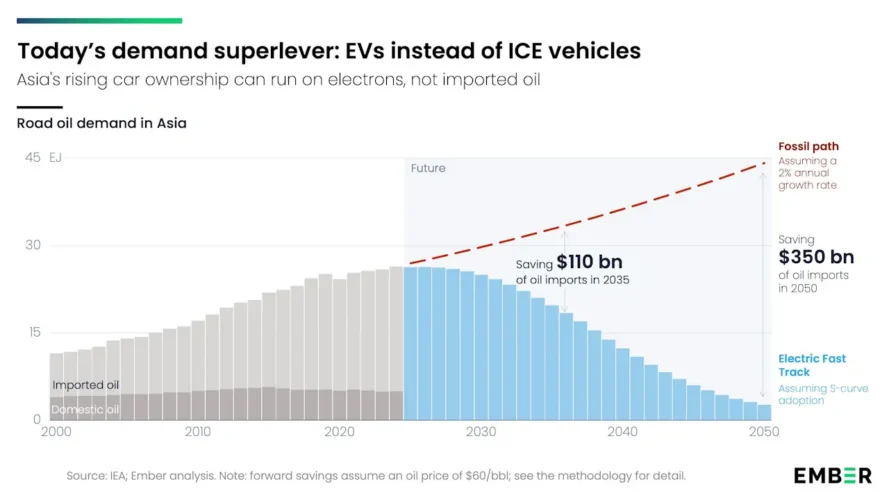
“Electric vehicles are a strategic necessity,” says Daan Walter, Principal at Ember and the lead author of the report.
“Road transport is the single largest source of Asia’s fossil imports, costing over $300 billion a year. Asia could electrify its fleet within twenty years and halve its oil imports. No single lever does more for the region’s balance of payments and energy security.”
Ember’s report also shows that both these superlevers, supply and demand, can be deployed at speeds that fossil fuel infrastructure can’t hope to match.
“Electrotech is fast, modular and consumer-led,” says Walter.
“Faced with a crisis, policymakers can deploy electrotech rapidly, and households can climb the energy ladder one step at a time at low incremental cost. Witness what happened in Pakistan. Households and businesses have installed distributed solar at a pace that has outrun centralised planning entirely. Governments need to keep up.”
If you would like to join more than 29,000 others and get the latest clean energy news delivered straight to your inbox, for free, please click here to subscribe to our free daily newsletter.