The US firm Tesla and South Korea’s LG Chem are tipped to dominate the US battery storage market, which is expected to be worth as much as $US50 billion by 2020.
Analysts at investment bank Morgan Stanley suggest Tesla and LG Chem are best positioned to take big market shares in a market that it predicts will grow faster than most others expect.
Morgan Stanley says the “addressable” battery storage market in the US is 85GWh, or around $US30 billion. But if regulators come on board and allow it to compete in deregulated power markets, then that forecast is nearly doubled to 140GWh or more than $US50 billion.
The analysts predict that Tesla and LG Chem are likely to snaffle 30 per cent of this market each, although it doesn’t rule out that either party could gather a 50 per cent share. In the former, it depends on the success of its Gigafactory. For the latter, it would require its own US manufacturing base.
The US market, however, will be just a fraction of the global market – which the Morgan Stanley analysts expect will be 7 to 8 times bigger. China alone is expected to have double the market size of the US in battery storage.
This report – Energy Storage: An Underappreciated Disruptor – says the US market will be focused mainly at the utility level, where power companies and developers will see value in providing grid stability such as ancillary services, and to meet peak demand and supply variations.
In regional grids such as California, with a heavy reliance on storage, this is likely to make mattes difficult for gas generators, who are unlikely to be able to compete on cost or flexibility. In some markets, such as the PJIM, battery storage is already accounting for most of the grid stability market.
This clearly has implications for Australia, which has the added value proposition of substituting for grid upgrades, and because of the huge electricity costs (mostly from gird prices), and its high gas generation costs, could create a big market for battery storage.
“Energy storage will release stored power during periods of high demand (early evening and early morning) when power prices are at their highest – storage effectively provides a low-cost source of power, eliminating the need for the highest cost, least efficient conventional power plant,” the analysts write.
Morgan Stanley does not see a big residential demand for battery storage, mainly because of the way solar tariffs are structured in most of the US, where solar homeowners get the same retail rate for exports and have no real incentive to store power in a box for use after the sun goes down.
“We believe energy storage will be deployed primarily by utilities rather than by individuals and businesses because the “collective benefits” are typically much greater than the benefit a single customer receives,” they write.
As for Tesla and LG Chem – who incidentally are thought to be the major players in the Australian market so far – Morgan Stanley says other competitors will struggle to match the scale and manufacturing efficiency advantages of these two players.
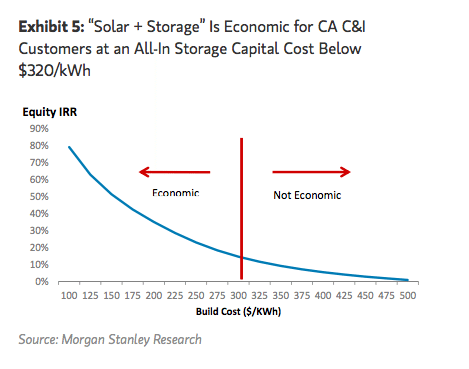
The analysis assumes an average selling price of battery storage starting at $US250/KWh, deflating 5 per cent per year to $US150/KWh by 2027.
Already, that puts storage in the money for certain applications, such as commercial and industrial customers in California who combine it with rooftop solar.
 It is close to economic for grid ancillary services …

And when it gets to $US200/kWh it will be economic for off-peak, on peak arbitrage in markets such as California, putting enormous pressure on the gas peaking plant in place.

The analysts even suggest that either company could capture at least 10 per cent, or as much as 30 per cent, of the global market.
“Our electric utilities team suggests the global market for utility-level battery storage may be as high 7-8 times the size of the US market,” and that the Chinese market is forecast to be twice the size of the US by 2030.
(Note: We are unable to provide a link to the report).