New data published by Victoria’s gas distributors as part of mandatory reporting requirements set in place by state Labor in August have turned up some very interesting patterns on residential gas use – namely, that households are using a lot less of the fossil fuel, even if they’re not disconnecting.
The Victorian Energy Future Network (VEFN) has this week shared its analysis of data released under the 2026 Ministerial Order by AusNet, Multinet Gas Networks and Australian Gas Networks (AGN), including never before seen monthly, postcode-level numbers on gas use and connections.
“All three distributors published the same five tables on 28 and 29 October under the Ministerial Order,” the VEFN analysis says. “Together they cover about 2.25 million residential connections, effectively every gas household in Victoria.”
According to VEFN facilitator John Godfrey the data shows that household gas use has fallen 26 per cent from 2020 to 2025 – or about 22 per cent “after correcting for the weather” – even while active residential connections grew by 4 per cent.

Also notable is the number of homes that have effectively quit gas without disconnecting from the grid.
According to the VEFN’s initial indicative analysis, “long-dormant” residential connections – where no gas has been used for 12 months or more, including active and non-active connections but excluding abolishments – were up 62 per cent in June 2026 from 41,200 in January 2023.

“Households are leaving gas quietly,” Godfrey says on LinkedIn. “By June 2026, 66,700 homes had used no gas for a year or more, but only 32,900 connections had been permanently removed since January 2023.”
But abolishments – where an existing gas connection to a home is permanently retired – are still picking up pace. VEFN says abolishments over the past three and a half years are now running at about 11,000 a year and rising, with dormant stock growing by 25,500.
(The report notes that a dormant connection is not proof of electrification, as it counts vacant homes and rebuilds count too.)

Of the 4 per cent rise in active residential connections between January 2023 to June 2026, VEFN says about two-thirds of this can be traced back to “a dozen estate postcodes” – which suggests much of the growth has come from new housing estates, industrial estates, and large master-planned residential developments.
VEFN says that “like for like,” first-half new connections fell 30 per cent, from 21,200 in 2023 to 14,700 in 2026, when 12,100 were disconnected. While on Multinet, disconnections have exceeded new connections since 2025. And 10 postcodes supply two-thirds of AusNet’s new connections and half of AGN’s, the report says.
This is notable because, under Victorian Labor’s Gas Substitution Roadmap – put in place under former energy minister Lily D’Ambrosio in 2022 – the ban on gas connections to all new homes and most commercial buildings doesn’t come into effect until January 2027.
As Nauru Research’s Tim Baxter notes, this shows disconnection has started building momentum well before the ban comes into effect.
“New data produced by Victoria’s gas networks under a Victorian government Ministerial Order (A parting gift from Lily D’Ambrosio MP!) shows that in 2025-26, more Victorian households disconnected from the gas network than connected for the first time,” Baxter writes on LinkedIn.
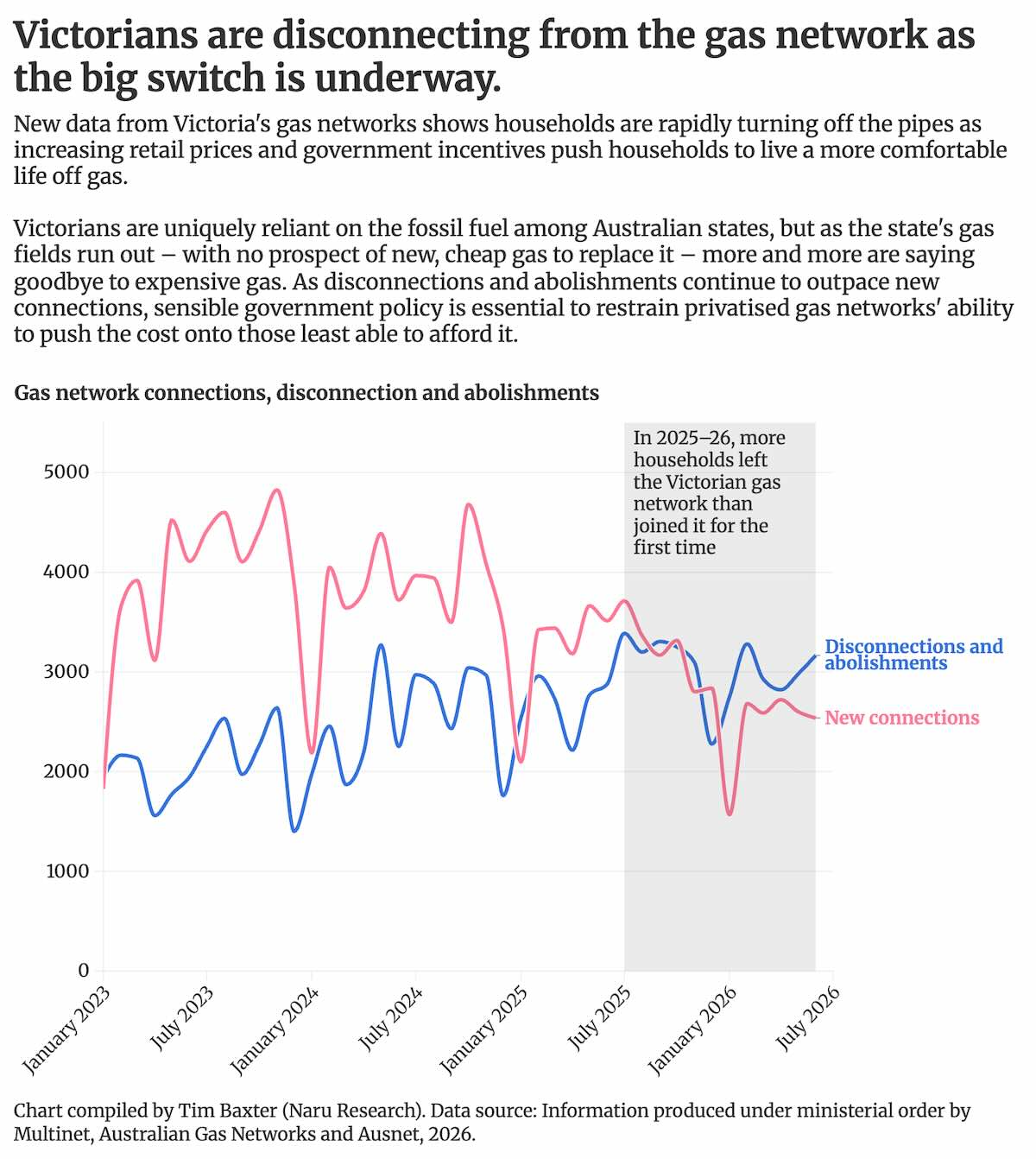
“This is happening long before Victoria’s gas connection ban has even come into place, showing that the desire to disconnect is driven by consumer choice, government incentives and skyrocketing retail gas prices.”
How we got here, and where we’re headed
Victoria is the largest user of residential gas in Australia, with two million households and businesses connected to the reticulated gas network.
Under the Gas Substitution Roadmap, regulations will require households to replace end-of-life gas hot water systems with heat pumps or other efficient alternatives, starting in May 2027. They will also require all new homes and most commercial buildings to be built all-electric by January 2027.
Despite targeted gas industry lobbying ahead of Victoria’s November 27 election, D’Ambrosio’s successor as state energy minister Jaclyn Symes has vowed to take the Gas Substitution Roadmap to the vote unchanged.
The Coalition opposition, however, vows to do the opposite, via shadow energy minister David Davis’ Domestic Gas Choice (Repeal of Gas Appliance Ban) Bill 2026, that aims to undo the rules on connections and appliance replacements and “restore household choice” on cooking, heating and hot water.
This is a big concern, because the Labor gas substitution policies are not just about cutting home emissions and energy bills and creating healthier and more comfortable home environments.
Gas transition rules and electrification incentives are also about trying to manage the inevitable exodus from gas in homes without whipping up a network death spiral that will mostly hurt already vulnerable consumers.
Or, as Tim Baxter puts it: Now, more than ever, sensible government policy is critical.
“Victorians are singularly heavy users of gas in our homes, Baxter writes. “About 60% of all the country’s residential gas use happens in our state. This is a big problem as we hurtle towards the stark reality that the state’s gas fields are all but gone.
“There is no cheap gas to replace them, so recent retail gas price hikes can only go up and up from here.
“Now comes the part where sensible policy must prevail.
“As disconnections outpace new connections, governments and regulators must step in to prevent gas networks from lumping the full cost of maintaining their increasingly useless networks on those least able to pay for it. And to help these people electrify as well.”
Why households are electrifying, and why policy matters
According to a recent report from IEEFA, more than 190,000 Victorians have switched their gas appliances to electric options since incentives were introduced in 2023, saving a cumulative $185 million on their energy bills and saving enough gas each supply more than 40 per cent of the state’s annual demand for power generation.
IEEFA says that if the current rate of electrification continues, the savings could grow to $6.6 billion by 2040, and enough gas could be saved to meet the state’s combined gas demand for power generation and mining.
“These results show that electrification policies in Victoria are working,” said Jay Gordon, an IEEFA energy finance analyst specialising in Australian electricity.
“By cutting gas demand through electrification, Victoria can mitigate against the risk of future gas supply gaps while lowering energy bills. By contrast, importing more gas into Victoria carries significant infrastructure costs that would need to be added to consumer bills.”
But Gordon warns that there’s no room for policy complacency, either.
“Victoria’s major gas users need certainty over the future security of their energy supply. Achieving this will require the successful rollout of further electrification policies, such as new regulations set to commence in 2027,” he says.
And why quiet quitting is not a good outcome for anyone
Who should pay for households to abolish their gas connections remains the subject of hot debate in Australia. As John Godfrey wrote on Renew Economy almost a year ago, the preferred regulator (and industry) approach of “user pays” is fraught with danger.
“This may be tidy on paper, but it is inefficient and unaffordable in practice. With millions of gas connections across south-east Australia, the cumulative cost would reach into the billions,” Godfrey says.
“What will households do instead? They will simply cancel their retail gas contract and leave the physical connection in the ground. That creates a dormant connection; a live, pressurised service line that is no longer monitored, inspected, or billed.”