Western Australia has come a long way since 2012 when its then state energy minister opened the country’s first large scale solar farm at Greenough River near Geraldton and vowed never to open another one. He didn’t.
But the Liberal state government has been moved on, Labor brought an end of a lengthy renewable investment drought and on Tuesday set a formal target of 75 per cent renewables by 2030/31, by which time it has vowed to close the last of the state owned coal generators at Collie, with the one privately owned generator also likely to close.
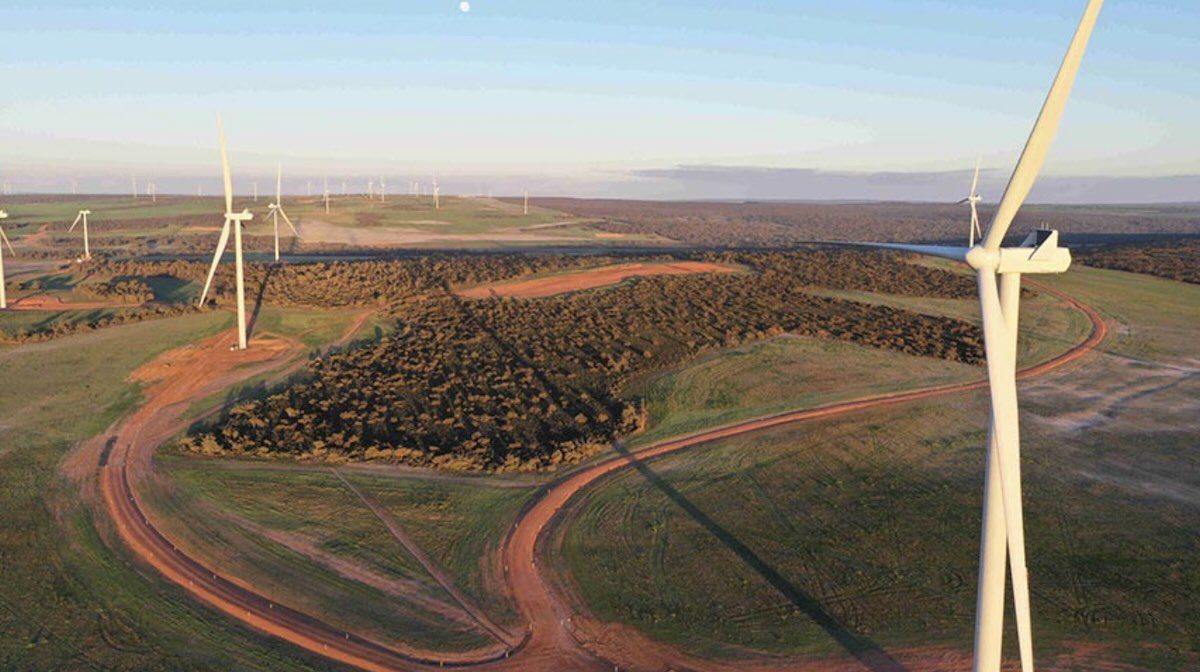
W.A. is now a hub of renewable investment, particularly in wind energy, and the state accounts for half of the country’s 10 wind farm projects that have reached financial close and have started, or are about to start.
The most recent to begin construction – over the weekend – was the biggest to date, the 470 MW Parron Maam Marang project north of Perth, and that is expected to soon be trumped by the 550 MW Marri wind project in the same area.
The state’s electricity grid is dominated by the state owned generator and retailer Synergy, and the state owned network company Western Power, and state owned utilities such as Synergy and Water Corp have written some of the purchase agreements that have underpinned the new developments.
But state energy minister Amber-Jade Sanderson says the new target is a “statement of intent” that is designed to encourage private sector investment.
“We know that renewables, backed by storage and gas, is the cheapest and most reliable energy mix for Western Australia,” she said in a statement.
“That’s why we’re powering ahead with our support for the energy opportunities of the future and encouraging businesses to invest in WA.”
She said the target follows calls from an alliance of industry, investors, unions, and advocacy bodies for a strong RET as a signal of the state’s intent and to mobilise private sector investment.
“This makes it clear that the future of our electricity system is renewables. A strong RET sends an important signal to the businesses, investors, workers and communities who will deliver WA’s next generation of energy infrastructure,” Solutions for Climate WA Director Jessica Panegyres said in a separate statement.
Just energy transition
UnionsWA Secretary Rikki Hendon says a “just energy transition” means secure, well-paid jobs in renewables, including for workers whose jobs are currently tied to coal and gas.
“We’re already seeing demand for electricians, construction workers, transmission line workers, wind & solar technicians, battery installers and engineers,” he said. “This shows WA workers the government is serious about growing this industry.”
Clean Energy Investor Group CEO Richie Merzian says W.A. has already risen to become the third most attractive state in Australia for new invement. “Global & local investors are ready to put capital into Western Australia, but it is competing with investment opportunities in other countries,” he said. “This RET builds on that momentum.”
The WA government says the RET is being accompanied by a Made in WA Energy Affordability Investment Program, which will provide low-interest loans of up to $15 million to help manufacturers install solar and battery systems and upgrade equipment to take advantage of cheaper energy.
It says modelling supported by Boston Consulting found that without the new initiatives, energy prices paid by industry could increase by 89 per cent by 2032.
State by state
The decision by W.A. Labor government follows the move by the state LNP government in Queensland, and the CLP government in the Northern Territory, to scrap their respective renewable energy targets. Victoria’s is also under threat with an election next month that anti-renewable conservative forces are now tipped to win.
South Australia has a target of reaching 100 per cent “net” renewables by the end of 2027, although it is likely to reach that a year later, while the ACT has already met its own 100 per cent “net” renewables target that was reached in 2020.
W.A. is an interesting case because its main grid is connected to other states. In the north, iron ore miner Fortescue is building multiple gigawatts of wind, solar and battery capacity to eliminate fossil fuels altogether by 2030.
Tim Buckley, head of Climate Energy Finance, said other big iron ore miners should join Fortescue’s efforts to decarbonise their respective electricity supplies, preferably through the proposed Common User Infrastructure to service the region.
They should be accelerating the rollout and deployment of firmed renewables and infrastructure to enable a rapid shift from imported high-emissions diesel-based mining operations, and to facilitate onshore processing of our resources using clean energy,” Buckley said.
“This would add value here, and position WA as a key player in the rapid greening of global resources supply chains – a key and overdue industry pivot.
A floor, not a ceiling
” It is critical that our mining industry now build bilateral trade agreements, for example on green iron, to leverage the clean energy resources supply chains of our key north Asian partners as they rapidly decarbonise.”
The Smart Energy Council said it viewed the new RET as a floor, not a ceiling.
“You cannot manage what you do not measure. A clear 75 per cent target sends an unmistakable market signal that Western Australia is open for major clean energy investment,” SEC CEO David McElrea said in a statement.
“WA has world-class wind and solar resources, paired with critical minerals that can command a global green premium when processed with clean power. Our members stand ready not just to meet this target, but to beat it.”
To join more than 29,000 others and get the latest clean energy news delivered straight to your inbox, for free, click here to subscribe to our free daily newsletter.