
Victorian Labor says it has no plans to water down or pause a regulated phaseout of gas from homes and businesses in the state, after a leaked document revealed that one of Australia’s largest gas infrastructure businesses is pressuring the party to reverse its electrification policies.
A paper prepared by a lobbyist for the Australian Gas Infrastructure Group (AGIG) and shared with Renew Economy on Thursday details how the Carroll government should “roll back” its ban on gas connections for new homes and remove restrictions on replacing gas appliances ahead of the state election.
The paper warns that in the absence of a policy rollback, unfavourable new modelling could become public that would see “voters across the board have a strong reaction once they understand the implications for costs and consumer choice.” It also claims that voters “hate” the planned gas bans.
Victorian Labor’s Gas Substitution Roadmap was put in place under former energy minister Lily D’Ambrosio in 2022, to help transition homes and businesses to cheaper, more efficient, and less polluting electric appliances – and to put gas companies on notice that reticulated networks are an investment dead end.
“Victorians have been at the mercy of private gas companies for too long,” D’Ambrosio said at the time. “It’s time to put gas on the back-burner as we help Victorians cut energy bills and halve emissions by 2030.”
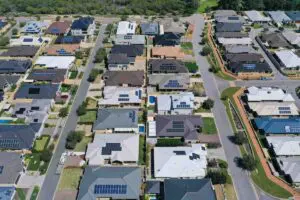
Under the Roadmap, new regulations will require households to replace end-of-life gas hot water systems with heat pumps or other efficient alternatives, starting in May 2027. The rule changes will also require all new homes and most commercial buildings to be built all-electric by January 2027.
But with the November state election looming, gas lobby groups have ramped up their efforts to block the changes, or at least to slow them down. The state Coalition has obliged, with its shadow energy minister last week repeating the party’s pledge to end Labor’s “ideological war on gas.”
With the Coalition in check, the focus has turned to state Labor, with the leaked document essentially warning that going to the November poll with the Roadmap intact will be political kryptonite, due to new numbers on costs that “will likely become public” and alienation of voters, who “hate the bans.”
“Rolling back the bans would reinforce a focus on affordability, consumer choice and economic competitiveness, while neutralising a key Opposition attack line,” the paper says.
“It would signal pragmatic energy policy while continuing to support emissions reduction and electrification through incentives rather than mandates.”
The paper also cites unverified modelling that forecasts gas bill impacts of approximately $100 per household per year, if the Roadmap goes ahead as planned.
“AGIG is currently discussing these price increases with customer representatives as part of their regulatory price reset process, but these numbers will likely become public by mid-September,” the document says.
Extraordinarily, the document then goes on to offer a step-by-step guide to how the gas bans “would be undone,” including when and how a roll-back should be announced, the process for “undoing the regulations” and the need to immediately halt implementation activities to allow network price forecasts to be revised to reflect the policy change.
Despite this advice – and despite signs that the Carroll government is losing its nerve on some of its nation-leading renewables and climate policies – Victoria’s energy minister Jaclyn Symes says Labor’s Gas Substitution Roadmap will go to the vote unchanged.
“We’ve always said gas is part of our energy transition – but the reality is legacy supplies from Victoria’s Bass Strait are dwindling and prices are going up,” Symes said in a statement sent to Renew Economy.
“Our position has not changed. Our focus is on lowering energy bills for families and businesses – not on boosting gas industry profits.
“Jess Wilson’s One Nation-Liberal Coalition will lock Victorians into high international gas prices indefinitely – pushing up bills and cutting off supply for the industries that rely on it.”
AGIG’s warnings of cost rises to gas customers do not come from nowhere – governments and regulators are currently in the midst of nutting out how to avoid a gas network death spiral, where the cost of abandoned assets is sheeted to customers unable to electrify.
But as green groups have pointed out, private corporations like AGIG do not set gas market prices – they put a case to the Australian Energy Regulator (AER) via their access arrangements proposal, and the AER sets the price.
And one of the best ways to avoid this sort of outcome is to have a clear policy framework, like Victoria’s, that gives gas companies and their investors a clear signal on where the market is headed.
Jonathan La Nauze, the CEO of Environment Victoria, says that given it was the state Liberal Party that privatised the state’s gas networks, it would be “extraordinary” if Labor caved to pressure to protect the profits of major multinational corporations.
“Jeff Kennett privatised the gas distribution networks, and that has led to – pun intended – an absolute pipeline of profits,” La Nauze told Renew Economy on Thursday.
“The whole idea of that privatisation was that consumers would benefit from the sort of lowest cost.
“The private sector would supposedly deliver the product at a lower cost, the investors would get a return, but the investors, instead of the consumers, would bear the risk-the long-term risk of those assets declining in value.
“So Jeff Kennett did that. These now foreign-owned private companies have enjoyed the profits, but now it’s come … [to] the risk side of the the bargain they’re coming back and saying we didn’t really mean that bit.
“[And] surprise, surprise, the Liberal Party …has turned around and said, oh yeah, well we’ll protect you from the risk side as well.
“It would be extraordinary, and I don’t believe it’s likely at all that Labor would turn around and say, ‘actually, no, Jeff Kennett was right, we were wrong. We should protect the interests of these foreign private companies over Victorian consumers’,” La Nauze said.
“That’s why I’m confident that the Victorian government won’t back down, because it is very clear who benefits from backing down, and it’s a foreign-owned private company, and who loses is Victorian consumers.”
The fresh focus on Victoria’s transition away from reticulated gas comes as a major new global report finds that faster electrification strengthens energy security and economic outcomes, cutting fuel import bills by more than $US400 billion by 2035.
And locally, a new report from IEEFA has detailed the savings Victorian consumers have already made from electrification and the savings that stand to be made if the state continues on its current policy path, backed by the range of supporting government subsidies and incentives.
IEEFA finds that more than 190,000 Victorians have switched their gas appliances to electric options since incentives were introduced in 2023, saving a cumulative $185 million on their energy bills and saving enough gas each supply more than 40 per cent of the state’s annual demand for power generation.
IEEFA says that if the current rate of electrification continues, the savings could grow to $6.6 billion by 2040, and enough gas could be saved to meet the state’s combined gas demand for power generation and mining.
“These results show that electrification policies in Victoria are working,” says Jay Gordon, an IEEFA energy finance analyst specialising in Australian electricity.
“By cutting gas demand through electrification, Victoria can mitigate against the risk of future gas supply gaps while lowering energy bills. By contrast, importing more gas into Victoria carries significant infrastructure costs that would need to be added to consumer bills.”
But Gordon warns that there’s no room for policy complacency, either.
“Victoria’s major gas users need certainty over the future security of their energy supply. Achieving this will require the successful rollout of further electrification policies, such as new regulations set to commence in 2027,” he says.
“To grow the benefits even further, Victoria should consider broadening its electrification policies in future – particularly when it comes to electrifying gas heating, which is one of the biggest culprits behind high energy bills.”