Too many Australian households are being locked into high energy use, high bills and uncomfortable living conditions through failings of policy, a new national scorecard on energy efficiency has revealed – but some states and territories are much worse than others.
The State Energy Performance Policy Scorecard, published by the Energy Efficiency Council (EEC) on Thursday, ranks how governments are helping households live comfortably and affordably by boosting their access to energy upgrades and thermally efficient housing.
While governments and households alike have leaned in to the subsidised transition to bill busting consumer energy resources like rooftop solar and home batteries, electrification and energy efficiency have been a harder sell, despite the clear cost, comfort and climate advantages on offer.
Just last month, the federal opposition’s housing and environment spokesperson Andrew Bragg said the Coalition would make national energy standards for new homes an “optional extra,” arguing that the cost of enforcing energy efficiency was deepening inequality.
This view was supported by the federal Coalition’s treasury spokesperson, Tim Wilson, who told ABC radio that if people wanted cheaper housing, then they would have to make do without spending “huge amounts of money” on basic energy standards and “put a jumper on” instead.
What this view overlooks – quite apart from the fact that extreme heat is the much bigger concern than cold, with the 2026 European summer linked to up to 40,000 deaths – is that the costs saved from building thermally inefficient housing are much smaller than the costs paid by the people who wind up living in them.
As EEC chief Luke Menzel put it at the time, minimum energy standards are “not some extraneous bauble” but rather “make sure homes are built properly in the first place so they are safe, comfortable and affordable to run.”
“Australians deserve to live in decent housing, not leaky shacks with paper thin walls,” he said. “I never thought I’d see an Australian politician out and about advocating for higher energy bills but here we are.”
Similarly, in Victoria, the state Coalition has been promising to unwind some of the Labor government’s nation-leading policies, including a regulated exit from gas in homes and a highly popular energy upgrades scheme that incentivises investment in efficient appliances and home improvements.
But this is false economy. As the EEC reminds us this week, improving a home’s energy rating from 3 to 5 stars can cut heating and cooling energy needs by around 40 per cent. And households that combine electric appliances and vehicles with thermal efficiency upgrades can save up to $2,250 on bills a year.
“The EEC has run the ruler over the policies that Australia’s states and territories have in place to help households cut their energy bills,” Menzel said in a statement on Thursday.
“We developed a robust methodology, gathered the evidence, and rated each and every jurisdiction for their energy efficiency, electrification and energy flexibility policies and programs.”
And while the findings reveal an urgent need for some states to step up their efforts, Menzel says he hopes that the Scorecard is seen as a household cost-of-living, health and comfort story, first, rather than as a technical policy exercise.
Be that as it may, the scorecard ranks each state on three main policy metrics: electrification, energy efficiency, and demand flexibility.
On electrification, Victoria, with its Gas Substation Roadmap, tops the rankings for prioritising and incentivising the replacement of fossil fuelled appliances with with efficient electric alternatives – a move that cuts emissions and costs and protects households from volatile global energy markets.
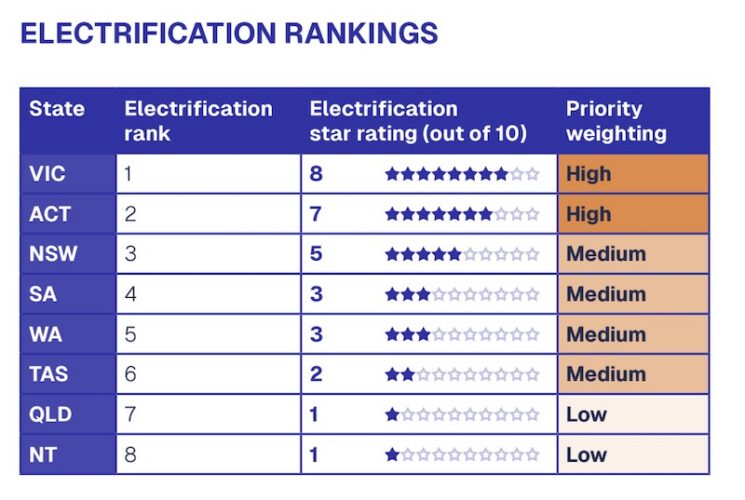
The report notes that both Victoria and the ACT have set regulations requiring new homes to be all-electric, avoiding unnecessary new gas connections.
In the energy efficiency rankings, the ACT tops the charts, for its “strong incentives linked to consumer programs alongside key regulations on ratings disclosure, new buildings, and minimum insulation standards for rental homes.”
As the report explains, energy efficiency means using less energy to deliver the same or better outcome and is almost always the lowest-cost path to cheaper power because it reduces the amount of energy that must be generated, transported and paid for in the first place.

Nevertheless, as the Coalition’s Bragg and Wilson so clearly demonstrated last month, successive governments have lacked the political courage to hold the line on minimum standards for energy efficient housing.
While most states and territories require a 7-Star minimum standard under the National Construction Code – which the Coalition is seeking to defang – states and territories including Tasmania, the NT, and Queensland have lower standards or exemptions.
The result, according to CSIRO and RACE for 2030 modelling, is a national housing stock where the average star rating for houses and apartments sits at 3 and 4.4 out of 10, respectively.
On the final metric of demand flexibility – defined by the EEC as the ability to vary when, how much or how quickly energy is used, without compromising the amenity of energy users – New South Wales, South Australia and Western Australia lead the nation.
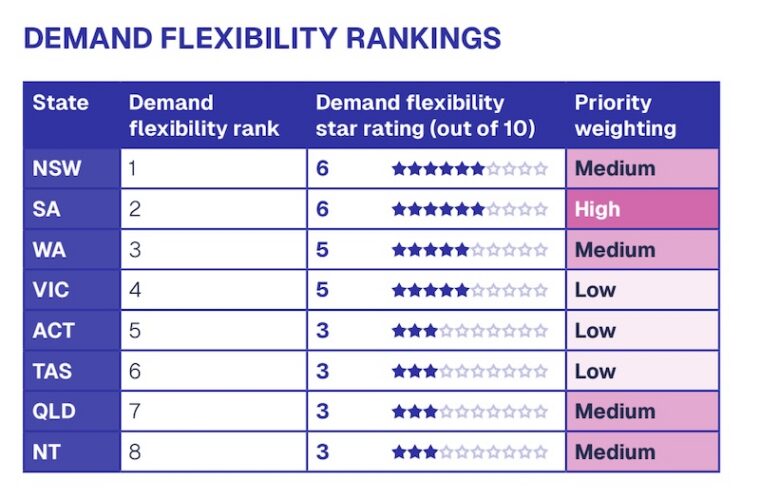
This is due to those states offering additional incentives for batteries if they are connected to virtual power plants, as well as incentives for flex-capable technology and load shifting.
Schemes in South Australia and NSW include incentives for appliances equipped for demand flexibility and to connect existing appliances to demand response aggregators.
Overall, the scorecard finds the ACT is the strongest performer, followed by Victoria and New South Wales. Queensland and the Northern Territory rank seventh and eighth overall, with major policy gaps across household electrification, energy efficiency and flexible demand.
“No jurisdiction is perfect,” says Menzel. “There is room for improvement across the board. But these findings show there is an urgent need for some states to step up their efforts in supporting households to respond to the cost-of-living crisis.”
Energy Consumers Australia, which funded the scorecard project as part of its grants program, says it shows where governments can supercharge electrification and efficiency policies to deliver financial, health and environmental benefits for all households and small businesses.
“Consumers should pay a fair price for their energy, no matter where they live,” ECA manager of consumer advocacy Justin Whelan said on Thursday.
“Electrification and energy efficiency policies mean lower energy bills for Australians – it is that simple.”