Data centres seeking connection to NSW’s power grid now exceed about triple the state’s present average daily demand at a time when aging coal-fired power stations are nearing closure, adding to the urgency of introducing new rules for the sector, a government webinar on Monday heard.
Details of the sheer size of the queue for new connections were outlined during the public session aimed at prompting feedback by 14 September to the state’s new guidelines for the sector released last week.
Among the highlighted issues was the proposal to charge new data centres a “default rate” of as much as $200,000 per megawatt of capacity for connection to the network.
While, “the NSW government supports world-class data centre investment,” the task of absorbing the huge power demands in the pipeline increasingly resembles a cobra trying to ingest a not so small herd of elephants when it comes to the state absorbing the new power demands in the pipeline.
As of last month, data centres were seeking network connections with a total capacity of 28 gigawatts, of which 13 GW of capacity were in advanced discussions to connect, according to a consultation paper issued by the state’s Department of Climate Change, Energy, the Environment and Water (DCCEEW) .
“For comparison, average daily demand from the electricity grid in NSW typically ranges between 7.5 GW and 10 GW,” the paper noted.
The need to tighten oversight of the sector was more pressing because the government is expecting three of the remaining four coal plants in the state to have retired by 2033. “These three coal-fired power stations generated around half of all electricity consumed in NSW in 2026” as part of the energy industry’s “major transformation”, the paper said.
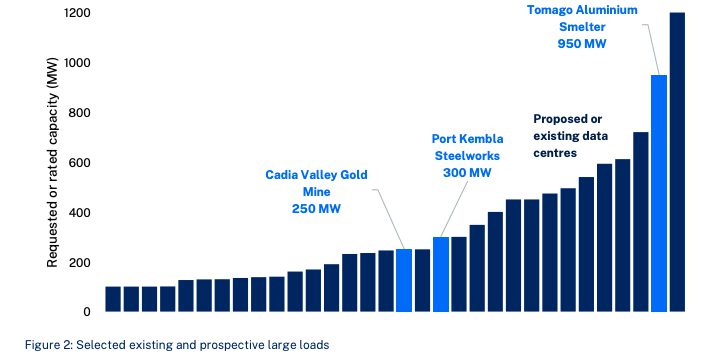
In a chart highlighted at this morning’s webinar, the speakers noted that “some of these proposals are among the largest in the world, and they are set to become the largest individual electrical loads in NSW”.
“One facility currently seeking planning approval would be the largest in the southern hemisphere and have a rated capacity of 1200 MW – a rated capacity 25% larger than Tomago Aluminium Smelter,” the consultation paper noted.
The webinar also highlighted a proposal in the new industry guidelines to require data centre connection applicants to pay a so-called “Major Network Upgrade Fee” with a default rate of $200,000 per megawatt of capacity in the Sydney-Newcastle-Wollongong region, and $100,000/MW elsewhere.

“This fee would be in addition to existing network charges,” the proposal, listed as No.7 in the consultation paper, stated.
“The fee would be paid into the [Electricity Infrastructure Fund] immediately prior to the execution of a connection agreement, with data centre operators required to submit proof of payment to the [network service providers] prior to execution.
“The fee would be levied on the rated capacity of the connection less any ‘flexible’ capacity,” it said. “Flexible” capacity would be any load the customer agrees not to use at certain times or in certain circumstances, such as peak periods.
“This is intended to incentivise the take up of flexible connection arrangements that can improve network utilisation and defer costly network augmentations,” the paper said.
Dylan McConnell, an energy analyst at the University of New South Wales, said the data centre industry had often touted its contribution of 100% of network connection costs.
The insertion, however, of the default fee requirement was “a clear acknowledgement” that the industry claims of paying for necessary augmentations “have never been true”, he said.
McConnell said NSW was leading the states’ response to coping with the flood of data centre applications. That said, it was also the state “with the most issues” and the fattest pipeline of projects.
Renew Economy contacted Data Centres Australia for comment. They pointed to their general statement from last week.
To join more than 29,000 others and get the latest clean energy news delivered straight to your inbox, for free, click here to subscribe to our free daily newsletter.