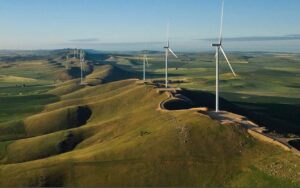
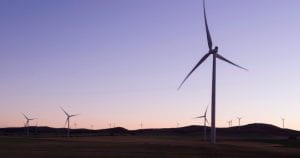
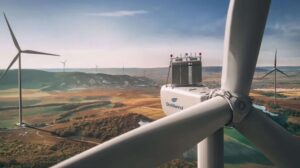
Plans to co-locate batteries with three-quarters of the turbines at a nearly 300 megawatt wind farm proposed for construction in New South Wales have won state development approval, paving the way for what will likely be Australia’s first grid-scale hybrid wind and battery project.
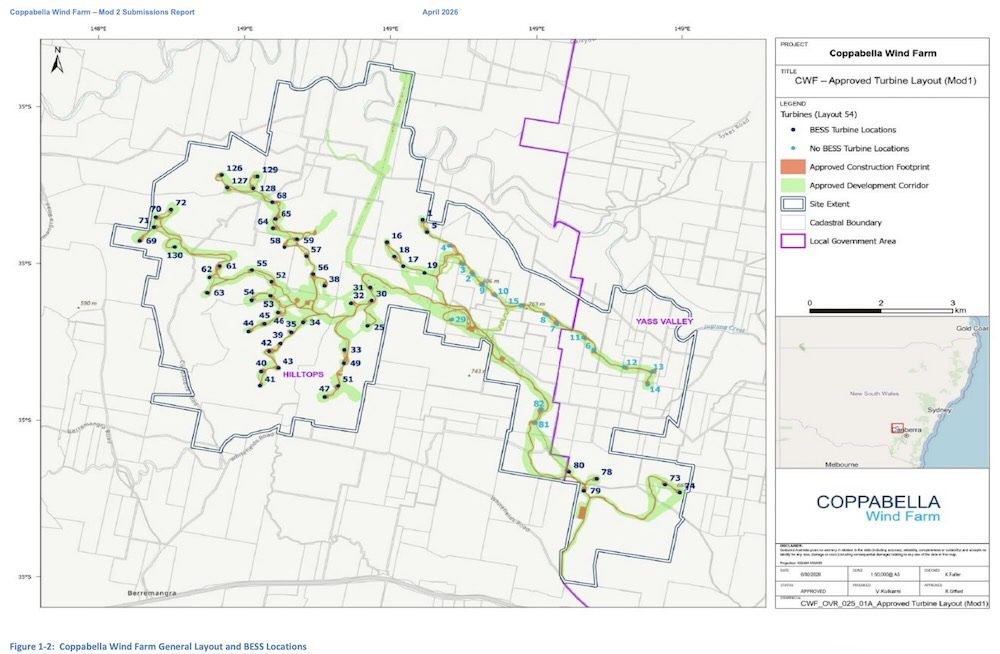
Goldwind Australia late last year applied to the NSW department of planning to include co-located battery energy storage systems (BESS) at 53 turbine locations at its 75-turbine, 298 megawatt (MW) Coppabella wind farm, formerly known as the Yass Valley wind farm.
The modification, lodged in December 2025, proposed to install 5 MW, four-hour BESS units at 53 turbine locations, across the wind farm, which is being developed around 30 km west of Yass, near the towns of Bookham and Binalong.
On Tuesday Goldwind announced that the proposed changes have been approved by the NSW Department of Planning, as well as by network company Transgrid, which has accepted the updated generator performance standards of the DC-coupled project.
The approval allows for up to 53 BESS units to be installed within the wind turbine construction footprint providing a 222.6 MW rated BESS with an installed energy storage capacity of 1,063 megawatt-hours (MWh).
The approvals mark a significant milestone, both for Goldwind, which has plans to make these hybrid systems standard offering for the industry, and for the Australian renewables transition, with the Coppabella project likely to be the first wind project to DC-couple battery storage at scale on the grid.
Nearly all new solar farm proposals in Australia’s busy development pipeline are now combining the the PV and battery storage behind the one hybrid connection, to cut project costs and complexity, optimise the assets’ performance, and improve grid stability.
Just last week, the first large scale solar-battery hybrid of many was connected to the National Electricity Network (NEM).
But the evolution has been slower for wind. Goldwind Australia CEO Ning Chen says the developer’s the DC-coupled BESS design allows substantial storage capability to be added while making efficient use of a project’s existing approved construction footprint.
“Battery storage has become an increasingly important component of Australia’s energy transition,” Chen said in a statement on Tuesday.
“Integrating battery storage into Coppabella’s project design will improve the project’s ability to support higher-value renewable energy delivery and provide greater operational flexibility in the NSW region of the National Electricity Market.”
As Renew Economy has reported, Goldwind has successfully piloted this hybrid wind and battery approach on the National Electricity Market by retrofitting one of the roughly 3 MW turbines at its 312 MW Moorabool wind farm in central western Victoria with a 2 MW/4.8 MWh GoldBlock BESS.
Goldwind Australia director John Titchen says the co-located batteries – which connect to the turbines via short underground cables – provide a range of benefits beyond energy storage and shifting (arbitrage), including reduced cost of construction, increased revenue potential, reduced project footprint, and better integration with, and support of, the grid.
“These batteries provide the market arbitrage opportunity, they also provide the ability for ancillary services and income, but the core of this technology is the lower infrastructure costs,” he told the Tasmania Energy Development Conference in Devonport in June.
“What we’re doing is connecting batteries directly into the DC bus, so that’s effectively in the middle of the turbine. So you put a battery on the hard-stand next to the turbine and connect it into the turbine, share a whole lot of the infrastructure.
“We’re sharing the converter, we’re sharing the civil infrastructure, we’re sharing the reticulation system, the transformation, the grid connection; so it’s a lower-cost way of deploying batteries.
“We all know that batteries are getting more and more competitive; the cost curve is going down. This takes another step, and so the result of that is we find that longer duration is competitive in this sort of configuration.
“One other attribute of it is that if you’ve got wind production and the market price is low, then you can store directly in the battery without having to go out into the transmission system to a battery somewhere else. So… that co-location means that there’s minimal loss between the generation and the storage.”
Co-locating battery storage with wind turbines also cuts time and money spent on “complex and difficult” grid connection processes, Titchen says – one of the major speed-humps currently hampering wind project development in Australia.
“This has one grid model [and] needs to do one set of grid studies – so that’s a major advantage in the practicalities of developing a project,” he told the conference in June.
“In terms of the grid characteristics – we measure grid characteristics in terms of the weakness of the grid – … this technology enables us to connect to what we call very low short-circuit ratios, a very weak grid, and we’ve been testing that it’s very good for the voltage and inertial support.
“Also, there is the potential that this could be the generator that starts a grid in the case of a blackout, because it’s a battery-backed inverter, it could [have] a black-start capability, and we’ve seen that operating elsewhere.”
Listen to the August 03 Energy Insiders Podcast interview with Goldwind’s John Titchen here.
Lumea, part of the Transgrid Group, has supported Goldwind in its application to connect the updated hybrid project to the grid.
“Projects like Coppabella Wind Farm show how flexible and dynamic grid connection solutions can help integrate renewable generation and storage, while supporting the acceleration of the clean energy transition,” Lumea executive general manager, Craig Stallan, said on Tuesday.
If you would like to join more than 29,000 others and get the latest clean energy news delivered straight to your inbox, for free, please click here to subscribe to our free daily newsletter.