In 2030, daytime electricity requirements will be easily met from solar and wind. However, meeting night-time demand as coal retires requires substantial additional wind, storage and load shifting.
Balancing solar and wind
The Australian target for renewable electricity in 2030 is 82 per cent. Currently, 38 per cent of generation in the National Electricity Market comes from solar and wind, which needs to double by 2030.
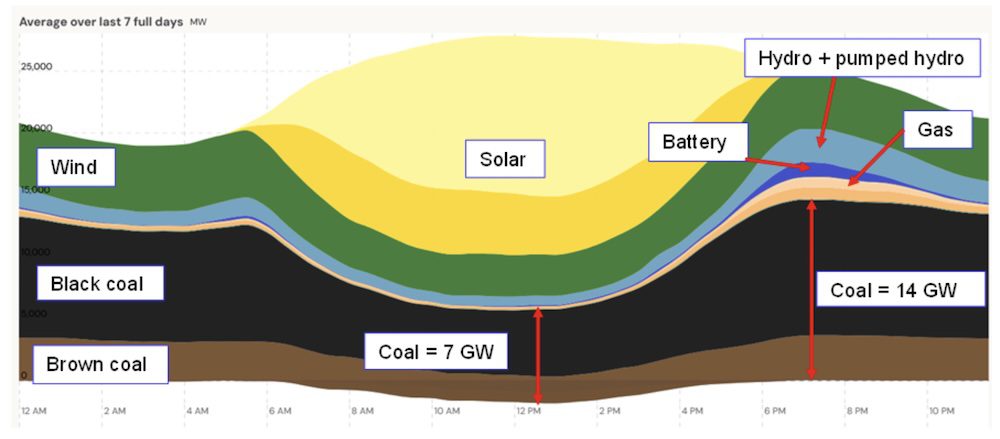
Flexible coal is easily the largest storage-equivalent. The figure from OpenElectricity shows midnight to midnight generation averaged over a recent week.
Coal flexed from 7 gigawatts (GW) in the middle of the solar day to 14 GW during the evening peak. In the middle of the day, recharging of pumped hydro and batteries occurs. Most Australian coal will retire over the next five years.
Fossil gas generation halved to 5 per cent since 2018 because it is expensive. Batteries and pumped hydro displaced most gas used in ancillary services. Fossil gas may have larger climate impact than coal if the methane leak rate is 1 per cent over the entire chain from mining to end-use. This is because the global warming potential of methane is 80 times larger than CO2 for a 20-year time horizon to mid-century.
Pumped hydro and battery generation over the past year was 1.4 per cent (1.6 and 1.3 terawatt-hours (TWh) respectively). Much additional storage is required as coal exits.
Snowy 2.0 can generate at 2.2 GW for 10 hours most nights and then be recharged next day, using only 6 per cent of its water. Over one year this yields 8 TWh. Importantly, Snowy 2.0 can generate flat-out for 160 hours during an occasional high-priced wet and windless week.
For example, average price of $300/ megawatt-hour (MWh) yields $16 million per day. It can be recharged by pumping water uphill to Tantangara whenever prices go low. Any water shortfall in Jounama and Talbingo can be met by natural river flows and a small release from the enormous Eucumbene reservoir.
Load shifting from night to daytime includes storage charging (hot water tanks, EV and home batteries, pumped hydro, ice making) most domestic loads, many industrial loads, and pre-heating and cooling of buildings. The recent announcement that many households will access three hours of free daytime electricity could ignite domestic load shifting.
Night-time loads
The table shows a simplified pathway for meeting the night-time load in the NEM in 2030. It is assumed that daytime and nighttime average loads are similar. Given the large uncertainty in generation and demand in 2030, this scenario is as probable as any other.
It is assumed that demand increases to 250 TWh per year, and that renewables generate 82 per cent. All solar generation is during daytime. Most of the residual coal and gas generation (45 TWh) is at night, particularly during winter. Wind increases to 30 per cent of annual generation, half at night. Hydro generates at night. Storage is charged during daytime and generates at night.
The importance of wind is apparent: the sun never shines at night, but the wind often blows at night. A solar-dominated grid is more difficult to manage at night; storage is essential, as is substantial load shifting to daytime.
| Annual demand & generation (TWh) | 2025 total | 2030 daytime | 2030 nighttime |
| Demand rises to 250 | -218 | -125 | -125 |
| Coal | 116 | 10 | 24 |
| Gas unchanged | 11 | – | 11 |
| Solar PV | 45 | 123 | 0 |
| Wind fraction doubles to 30% | 33 | 38 | 38 |
| Hydro unchanged | 11 | – | 11 |
| Snowy 2.0 | – | -11 | 8 |
| Other pumped hydro quadruples | 1.6 | -7 | 6 |
| Batteries quadruple | 1.3 | -6 | 5 |
| Load shifting | – | -22 | 22 |
Australia is a global solar pathfinder: it generates more solar electricity per capita than any other country; it is physically isolated and must go it alone; hydroelectricity provides only 6 per cent of total generation; and there is no nuclear or geothermal electricity.
What happens in Australia matters, because we are showing that a transition to solar and wind is neither difficult nor expensive.