A massive 1.2-gigawatt (GW), four-hour (4.8 gigawatt hours) battery project, potentially the biggest in the country’s main grid, has entered the federal government’s environmental assessment queue and has also launched its bid for state planning approvals.
The Hanworth battery is proposed by Octopus Australia, an offshoot of British clean energy investment giant Octopus Group, which wants to build the system along one of the state’s main transmission lines, and near the major Bannaby substations, west of Bowral in the southern Highlands.
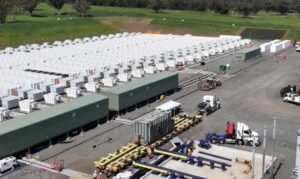
The battery will utilise lithium-iron-phosphate (LFP) batteries housed in 708 battery containers, each of which houses around 56 battery modules, and will also comprise a 33 kV / 500 kV substation and associated switchyard infrastructure, including an underground line to the Bannaby Substation.
The Hanworth project’s submission to the federal government’s EPBC queue comes seven months after Octopus Australia acquired the project from development company Enervest, which is still working on planning approvals.
It was one of two projects Octopus Australia snagged, along with the smaller Dunmore hybrid project in Queensland from Korean giant Samsung, which will combine a 300 MW solar farm with a 150 MW/300 MWh battery.
The Hanworth battery, as currently envisaged, would be the biggest in the country if built now, although other projects are also looking to expand and may trump it in storage size over time, particularly as some look to six and eight hours of storage.
See: The 15 biggest utility battery projects in Australia – and what they will do for the grid
“Australia still needs new power stations to replace ageing coal plants,” Sam Reynolds, Octopus Australia CEO, said at the time.
“The difference is that today we can build them using a mix of solar, wind and batteries instead of smokestacks.
“By owning and operating our projects as one portfolio, we can deliver reliable power every day of the year – not just when the sun shines or the wind blows. This is about replacing coal with clean energy that works in the real world.”
The federal application says that the battery will be built on “low value agricultural land, suitable for low density stocking rates for grazing animals.”
The Bannaby substation is significant as it will also host the new 500 kV Humelink transmission line, which is expected to connect Snowy 2.0 and the south-west renewable energy zone into the main load centres around Sydney.