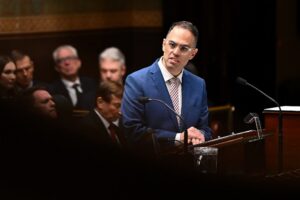
NSW climate and energy minister Penny Sharpe says Australia has managed to weather the latest global fossil fuel supply crisis “relatively well”, but says it remains an “existential issue” that has forced a rethink about EVs, fertiliser and diesel supplies and energy security as a whole.
“I think we’re okay, until we’re not,” Sharpe said at the Energy Efficiency Council national conference in Sydney on Thursday.
“This is an existential issue that we have very little control over. If the Strait of Hormuz does not open properly in some time, there is a limit to the amount of that we can do before we actually have to get into those really serious conversations.
“And there’s been a huge amount of discussion at federal and state and industry, and a whole range of people around, would we have to ration, we don’t want to have to, but it’s not in our ultimately it’s not in our hands.”
Sharpe says the issue has clearly inspired many consumers to turn to EVs, and for the agriculture sector to think carefully about the supply and cost of diesel and fertiliser. Some at the conference suggested that electrification could be thought of as a smarter too than interest rates to tackle inflation.
“I think it’s forced us to have conversations about what does energy security really mean,” Sharpe said. “How exposed are we? What does that mean for national security and resilience into the future?
“I think it’s actually shown that actually our systems in Australia are able to work together pretty well when we need to, but you know, never waste a crisis as well.”
Sharpe noted the “incredible” numbers of EV uptake in NSW, now at 135,000 cars that are saving 150 million litres of petrol. “Consumers are driving it. It’s also forcing that kind of innovation and change and acceleration, and a lot of things like charging and rules, and my personal favorite that I want to get going, bi-directional charging.
“I think we’ve done okay, but it’s only really a four or six week window before things could get tough.”
Sharpe said that the actions identified in the state’s consumer energy strategy continues to be rolled out should be completed by the end of the year, or early next year, including the home energy savings program which has a budget of around $240 million.
“There’s a lot of sort of technical work we’re rolling out the work in terms of energy standards, rentals, all of those,” she said.
“But look, the key part of it really is the home energy savings program, it really has two aims: the first is to allow those that currently haven’t really been able to access home upgrades in terms of solar and batteries to be able to do so, so really this is the equity piece.
“There’s a lot of people that have been able to put in solar and batteries, it still costs quite a lot of money. One of my key focus is that we’re to sell a transition and to keep support in the community and to allow people to take control over their energy costs. We need to make sure that it’s available for everyone, so we’re very close to that.”
Back on the fossil fuel supply crisis, the soaring cost of diesel and other fuels has added to inflationary pressures, in turn forcing Australia’s central bank and others to jack up interest rates as a response.
Amandine Denis-Ryan, CEO of the Institute for Energy Economics and Financial Analysis, says Australia is particularly vulnerable because it imports all its diesel and it has gone from being one of the lowest diesel users in the world (per dollar of GDP) to one of the highest.
“Oil has become a big driver of inflation, directly through the increase in household transport costs, as well as indirectly through the cost of distributing and producing goods,” she said.
” When you look at the monetary monetary policy tools that we’ve got available, like increasing interest rates, they’re not good at addressing the root causes of this, they pretty much address some of the symptoms trying to avoid the spillover to increases in costs for the economy.
“And that often comes at a pretty high economic cost, because they have to slow down the economy to do that, and even potentially trigger a recession.
“So, there’s been a number of voices that have been starting to raise the fact that actually we need to now start considering energy transition as a form of monetary policy, because it can more effectively protect us from those impacts, and we’ve been looking at some of the opportunities.
“There’s so much that can be done, even in the short term, improvements, process improvements in freight and mining could likely deliver a few savings of about 10 to 20% in a matter of weeks, and really help with the with the short term issues.
“There’s been lots of discussion of electrification being already cost effective in many places and becoming even more so in the coming years, but these things are not happening at the moment due to a number of barriers … there’s a really strong place for government to intervene to accelerate this.”
If you would like to join more than 29,000 others and get the latest clean energy news delivered straight to your inbox, for free, please click here to subscribe to our free daily newsletter.