Transgrid has released an amended version of the preferred route for the New South Wales side of the controversial VNI West transmission project, after moving its path further away from a nearby town and altering it to affect fewer landholders.
In a statement on Wednesday, the network company said it had modified around 35 per cent of the draft route for the NSW part of the project in response to feedback from community and landowners after the release of the draft report in January outlining four options.
Transgrid says that, in addition to “verbal feedback,” it received 48 written submissions, with 46 per cent coming from landowners within the corridor, 35% from the local community, 4% from industry and 15% “other.” The majority – 79% – expressed their opposition to the project, while 13% were neutral and 8% expressed support.
The Victoria to New South Wales Interconnector West, or VNI West, aims to create a second transmission link between the two states to accommodate more renewable energy in the region and improve reliability of the electricity supply. The Victorian side of the project is being managed by Transmission Company Victoria (TCV).
The high voltage, 500 kilovolt (kV), double-circuit overhead transmission line will connect the Western Renewables Link project (at Bulgana, Victoria) with EnergyConnect (at the Dinawan substation, north of Jerilderie) via a new substation near Kerang.
The huge project has faced strong opposition on both sides of the border, as one of the more controversial and hotly contested parts of the Australian Energy Operators 30-year planning blueprint – also a centrepiece of the federal Labor government’s Rewiring the Nation program.
It has attracted criticism from landowners and local councils over visual and environmental impacts and the fate of endangered species. It has also divided experts over whether it offers best value for money and the best support for renewables.
Transgrid says the main complaints raised in the latest round of NSW consultation centred around how close the route might get to homes and the township of Moulamein, its potential disruption to agricultural production, and the threat to endangered flora and fauna species.
With the release of its Preferred Route Report this week, the network company will be hoping to have allayed at least some of these concerns with the amendments made to the transmission line’s route.
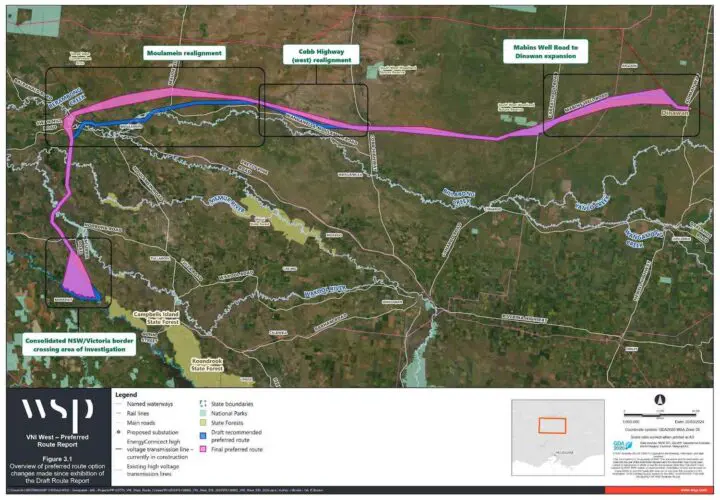
The most “significant change,” according to Transgrid, has been to move the proposed transmission line further away from Moulamein, extending the buffer for the south-western NSW township to nearly 6km.
Other changes include avoiding some of the previously affected agricultural land, improving environmental outcomes for Billabong and Moores creeks and decreasing the number of affected landowners from 12 to five.
“We have listened and acted in direct response to this feedback, making a significant change to the preferred route around Moulamein to reduce impacts on the local community, landowners, agriculture and the environment,” said Transgrid’s VNI West project director Colin Mayer in a statement on Wednesday.
Transgrid says the next step in the process will be to narrow the proposed route to a proposed construction corridor and, ultimately, a final 70-metre easement.
“We will continue to work with community members, landowners and key stakeholders as we refine the preferred route and further minimise agricultural, environmental, economic and social impacts,” Mayer said.