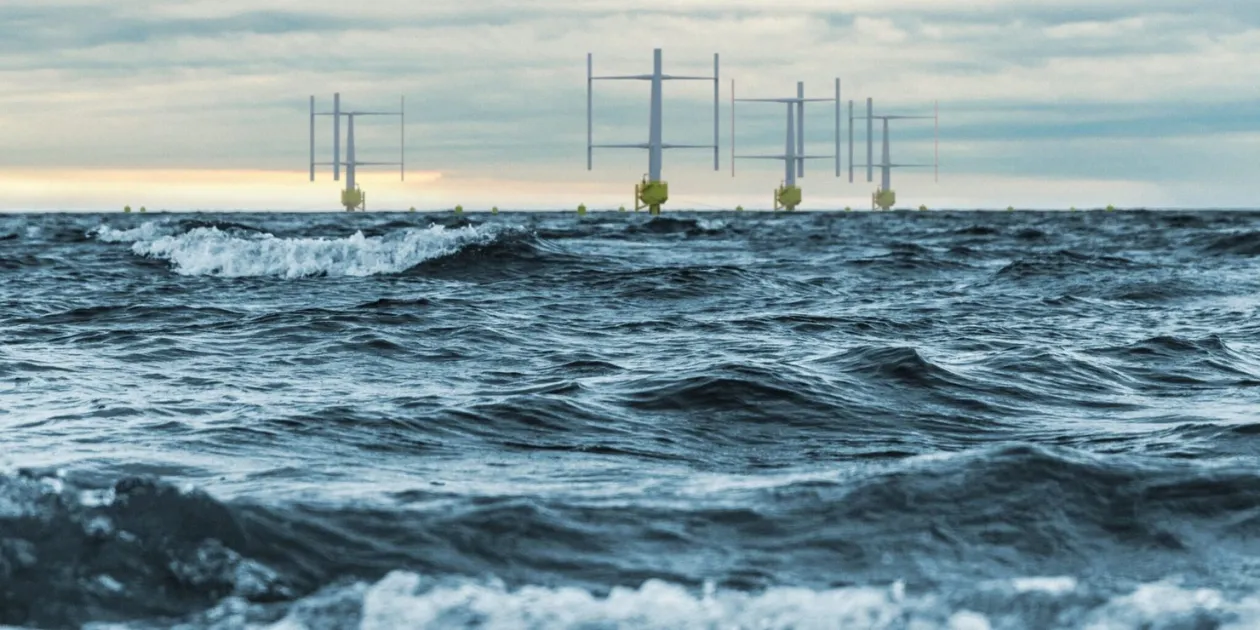
Swedish floating wind power innovator SeaTwirl has signed a five-year memorandum of understanding (MoU) with an Australian company that could lead to the construction of a 20-megawatt (MW) demonstration project using its vertical-axis turbines.
SeaTwirl develops floating vertical-axis wind turbines that it claims are easier to build, install, and maintain, and may in fact be “more suitable for the marine environment” compared to traditional horizontal-axis wind turbines.
The company, founded in 2012, is yet to deploy a commercial-scale project, but has had a 30 kilowatt (kW), grid-connected demonstration of its technology installed off the coast of Sweden since 2015 and is in the process of installing an updated 1MW demonstration project in waters off Norway.
SeaTwirl said this week the MoU has been signed with Hunter Floating Offshore Wind Pty Ltd (HFlow), a Newcastle based firm focused on the Hunter offshore wind zone – one of several zones that the Coalition announced on Wednesday they would scrap if they were returned to government.
The Hunter zone was designated by the Australian government in July 2023 – a 1,854 kilometre-square area that extends from offshore of Norah Head in the south, to Port Stephens in the north, and boasts a potential capacity of up to 5 gigawatts (GW).
Due to the deep water, the Hunter zone would be the first in Australia to host floating offshore wind technology, but . these plans hit a major snag in August last year when the only project to be offered a feasibility licence pulled out.
In response, federal energy minister Chris Bowen announced the introduction of Research and Demonstration licences to support development and testing of floating offshore technology in designated development zones by developers, scientists, researchers and other interested parties.
“While floating offshore wind is nearing commercialisation, there’s still more work to do to support its development,” Bowen said at the time.
“The Hunter offshore wind zone remains ripe for investment given their local workforce, experience with heavy industry, and large energy use.”
Bowen said he expected licences might be used to deploy monitoring equipment such as special buoys to assess the feasibility of a region, or to demonstrate projects to investigate viability of new technology before applying for a feasibility licence to progress to a full commercial project.
The demonstration project proposed by SeaTwirl and HFlow proposes to have a nameplate capacity of 20 MW, using SeaTwirl’s 2 MW floating vertical-axis turbines.
HFlow says it will lead the project development activities in Australia, handling permits, stakeholder engagement, financing, port, and grid connection, while SeaTwirl will contribute technology, a reference design, and engineering support.
“SeaTwirl’s technology is truly groundbreaking,” said Dr Richard Finlay-Jones, director of development at HFlow. “It paves the way for a cheaper, more versatile form of offshore wind power that can be deployed on a wider scale.
“This has the potential to generate local manufacturing opportunities without requiring significant investment in port infrastructure and specialised vessels.”
One of the project’s primary objectives is to establish a credible pathway from the demonstrator to larger commercial deployments.
Johan Sandberg, CEO of SeaTwirl described Australia as a “continent of opportunities”
“Australia is a young offshore wind market, where yard infrastructure for offshore wind is currently not built out and domestic vessels are not able to install conventional offshore turbines.
“The Hunter zone is an R&D project perfectly suited for us and where innovative designs like SeaTwirl’s fit right in. We will be able to demonstrate that our turbines can be built without huge yard investments and operated with smaller vessels and prove that our design can enable floating wind wherever it is needed.”
To join more than 29,000 others and get the latest clean energy news delivered straight to your inbox, for free, click here to subscribe to our free daily newsletter.