Despite his bluster and conspiracy theories, US president Donald Trump and his administration have been unable stop renewable energy’s relentless momentum through the first 18 months of his second term, with strong and continued growth from solar, wind, and battery storage.
A new analysis from the Sun Day Campaign of data from the US government’s own Energy Information Administration shows that electricity generated by renewable energy sources through the first seven months of 2026 increased by 10.7 per cent compared to the same period in 2025.
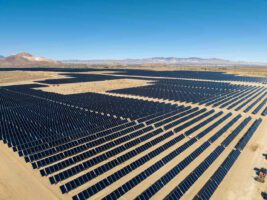
This growth was led by utility-scale solar, which saw generation increase by 22 per cent, small-scale solar (up 12.6 per cent), hydropower (up 9 per cent), and wind (up 5.9 per cent).
Electricity generated by all renewable energy sources accounted for over 29 per cent of total US electrical generation in July – up from the 22.3 per cent share of generation recorded at the start of the second Trump administration.
Conversely, and highlighting the comparative weakness of this administration’s efforts, the electrical output of the US fossil gas and nuclear power plants experienced growth of only 1.8 per cent and 1.5 per cent, respectively.
Even worse for the Trump administration and its numerous efforts to prop up the country’s coal industry, electricity produced by US coal facilities fell by 10.2 per cent.
During the first 18 months of this second Trump administration – running from January 20 to the end of July 2026 – installed utility-scale solar capacity increased by 32.7 per cent, or 41,051.6 megawatts (MW).
Small-scale solar capacity increased by 17 per cent, or 9,112.4 MW, while wind energy capacity increased by 8 per cent, or 12,195.4 MW, including 800 MW of offshore wind.
Uutility-scale battery energy storage capacity doubled during these 18 months, adding 26,629.5 MW.
By comparison, US coal capacity fell by 4,131.8 MW, or 2.4 per cent, while nuclear power added only 800 MW of new capacity and natural gas capacity rose by 7,561 MW, or 1.5 per cent.
“Over the last 18 months, the Trump Administration has used every conceivable trick to delay, hinder, or cancel new clean energy projects,” said Ken Bossong, the Sun Day Campaign’s executive director.
“Yet, while fossil fuels and nuclear power have added just 2.6 GW of net new capacity, renewables and battery storage have grown by 88.7 GW.
“Clearly, the White House has bet on the wrong horse.”
The EIA projects that over the 12-months through to July 31, 2027, utility-scale solar will add 43,558.0 MW of new capacity while the wind sector will grow by 9,481.8 MW, including 3,355.0 MW of offshore wind. At the same time, battery energy storage capacity will increase by 23,428.9 MW.
During this same 12-month period, the EIA projects that there will be no new generating capacity added by the nuclear power sector, and an overall net decline of 1,452.7 MW in fossil fuel capacity.
To join more than 29,000 others and get the latest clean energy news delivered straight to your inbox, for free, click here to subscribe to our free daily newsletter.