Andrew Forrest’s Squadron Energy is seeking a green light from the EPBC for its Ballyrogan wind project, a proposal set to be billeted in the beating heart of Victoria’s anti-renewable energy political activity.
The $3 billion project is proposed for nearly 14,000 hectares west of the Grampians ranges, according to documents lodged with the federal EPBC.
The current proposal is for a 690 megawatt (MW) wind farm with up to 115 turbines, connected to the Western Renewables Link (WRL) transmission line by a 45 km, 220 kilovolt (kV) overhead cable.
Squadron is starting the formal federal planning process for the project – little more than one half the capacity it once envisaged – at a time of extreme uncertainty for the Victorian energy sector.
Polls suggest the Coalition is favoured to win the upcoming election, bringing a commitment to cancel the VNI West interstate interconnector and review the WRL, both of which connect renewable energy zones in the west to Melbourne, and bring back merit appeals for all renewable energy projects.
Furthermore, the Grampians region is ground-zero for a newly influential protest group called Farmers Fightback, which launched from a Facebook collective into its current form late 2025.
The Ballyrogan project has been more than seven years in the making, but changes revealed in the EPBC documents indicate an appreciation of the political risk now facing renewables in Victoria.
The original plan called for 164 turbines and a 1.3 gigawatt (GW) project.
Since going public with the project in June last year, Squadron has not only whittled the project down, but also included elements that are key planks of Liberal and National renewable policy.
For example, the wind project ensures a minimum 2 km buffer from all non-associated homes, a detail the Victorian Coalition has promised to bring back if it wins the November election.
“Squadron takes community feedback seriously, as reflected in our decision to go further than the 1km planning control and update the design of Ballyrogan Wind arm to include a 2km setback from every wind turbine to a dwelling, unless otherwise agreed,” Squadron general manager of development Alastair Smith said in comments emailed to Renew Economy.
Neighbours living up to 3 km from a turbine will receive $2000 per turbine per year, and those living 3-4 km from a turbine will receive $1000 per turbine a year.
“We know neighbour agreement payments can sometimes be a source of community disagreement, which is why we use a transparent and equitable process based on proximity to wind turbines within the project,” Smith said.
That may not mollify people like Amanda Brady, who was featured in a video in April by opposition group Ballyrogan & Tatyoon Community Alliance protesting that there are still seven turbines proposed for within 4km of her house — a $7,000 annual windfall, if she chooses to take it.
The community benefits fund will be around $725,000, paid out over the life of the project.
One of many
Squadron acquired the Ballyrogan project in 2022 when it bought CWP Renewables, which had been working on the proposal since before 2019.
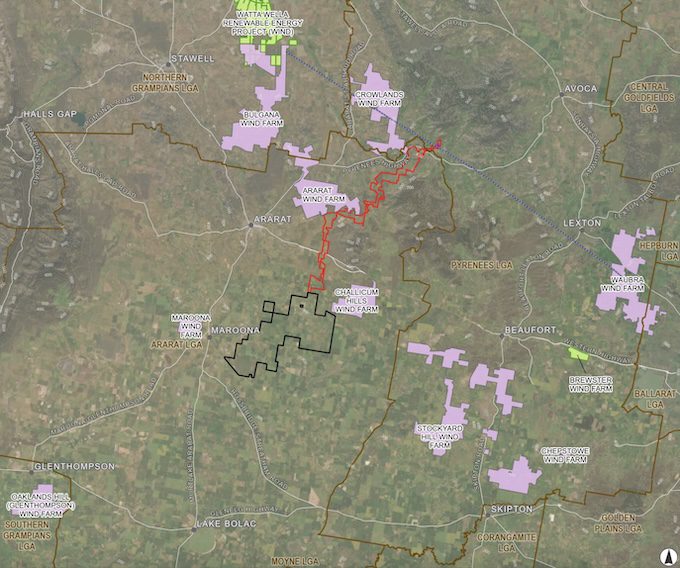
The project is about 180 km northwest of Melbourne in an agricultural area known for cropping and grazing. The nearest towns are Tatyoon, Maroona, Ararat and Buangor, which circle the project between 3 km and 12 km away.
It’s also not the only wind project proposed for the area.
Down the road, to the east of the proposed Ballyrogan project, is a windfarm viewing platform allowing tourists a look at the 52 MW Challicum Hills and, if they bring binoculars, the mini, two-turbine Maroona, 242 MW Ararat, and 528 MW Stockyard Hill wind farms.
Also in the area are the Crowlands, Bulgana and Waubra wind farms, and the proposed Watta Wella wind project.
The EPBC referral says construction would take about three years, which would see the project come online in the early 2030s – if government approval processes go as planned.
Because the area has been used for agriculture for such a long time, surveys taken between 2020 and 2025 found few EPBC-listed plants and animals on the massive block of land.
Surveys found two listed flora and three fauna species.
“Vegetation across much of the wind farm area is dominated by introduced pasture species and cropping land associated with grazing and agricultural practices,” the EPBC referral says.
“Within the wind farm area, native vegetation is more limited, with many areas comprising cleared paddocks where original woodland communities have been removed.
“Overall, vegetation condition across the referral area is generally degraded due to long-term agricultural use.”
The referral still assumes the project will have a direct impact on 64 native plants, animals or reptiles.