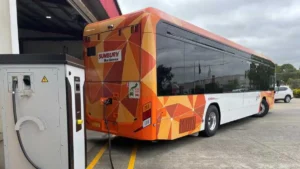
The federal government owned Snowy Hydro has landed a $1.9 billion contract with the NSW government to supply renewable energy to power the state’s train, tram and electric bus operations.
The seven-year contract effectively brings the electric power transport needs under one roof. Snowy already had the contract for Sydney Trains and other transport modes, such as light rail and electric buses, which was announced in 2021.
But it will now take over the contracts that Origin Energy had to supply the new Sydney Metro, although an existing Shell Energy contract to supply NSW Transport’s office buildings, street lights and other assets will remain in place
The NSW government says bringing the contract under a single supplier – in this case Snowy Hydro’s retail arm Snowy Energy – will save $130 million over the life of the contract, which runs from the middle of 2027 to 2034.
“Cost of living pressures are real for household and government budgets. This contract reduces costs and moves us towards better environmental outcomes while we deliver a reliable public transport network,” Transport minister John Graham said in a statement.
“Transport uses almost as much electricity as all other government agencies in NSW combined. It’s important we use our buying power responsibly and get the best possible deal for taxpayers, which is what we have achieved.”
The electricity needs amount to 1,200 gigawatt hours a year, and will grow to around 1,500 gigawatt hours a year by the end of the contract, and as the state adds more electric buses, more Metro lines, and the new Parramatta light rail.
But even at an annual rate of 1,500 GWh that translates into a price of around $200 a megawatt hour, which sounds steep – particularly as Snowy Hydro announced in 2018 that it had secured contracts from wind and solar providers at a “game-changing” wholesale price of less than $70/MWh – firmed – for 15 years.
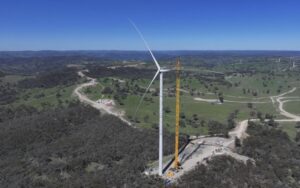
Snowy has since signed other contracts with the country’s biggest wind project – Golden Plains – and also for the 414 MW Uungula wind project that Andrew Forrest’s Squadron Energy is building near Wellington in the central west of NSW, (pictured above) and which forms part of this deal.
But the new deal is not a wholesale price, but a retail price, so includes electricity, renewable energy certificates, network charges (transmission and distribution), and miscellaneous items like market fees. It also factors in an escalation of these pass-through charges over the life of the contract.
It appears to be in the same ball-park as other large business contracts. AGL’s most recent accounts indicate an average of $196/MWh for more than 8,500 GWh of large customer contracts.
The contract was signed after a two-year open-market tender process. Government documents say the current Origin Energy contract, to supply Sydney Metro, is for $62.7 million for the 18 months to June 29, 2027.
That document does not say how much electricity that represents, but it would indicate that that component alone was worth around $280 million over seven years. The separate Shell deal, over 10 years to 2032, is priced at $276 million, according to the NSW contract notices website.
Snowy Hydro Chief Executive Officer Dennis Barnes said in a statement that the new contract with Transport for NSW indicates the demand for renewable energy solutions is growing at pace.
“There has been growing interest from businesses and government agencies across the country that are looking for innovative ways to decarbonise their operations,” Barnes said.
“Transport for NSW is a large energy user and they are leading the way in their efforts to reduce emissions. We were able to provide a tailored approach that meets their unique needs and secures long-term renewable matched energy from sources such as the Uungula Wind Farm right here in NSW.”
Snowy Hydro is also believed to be heavily involved in negotiations around the electricity supply for the state’s biggest energy user, the giant Tomago aluminium smelter near Newcastle, whose current coal-based contract with AGL runs out in a couple of years.
That deal is likely to require support from the federal and perhaps also the state governments to bridge the gap in price, particularly as NSW has not brought on enough new wind and solar capacity in recent years to meet Tomago’s power needs.
Note: This story has been amended after the NSW Transport said the Shell contract remains in place, contrary to the advice that had been provided by the minister’s office at the time of publication.
If you would like to join more than 29,000 others and get the latest clean energy news delivered straight to your inbox, for free, please click here to subscribe to our free daily newsletter.