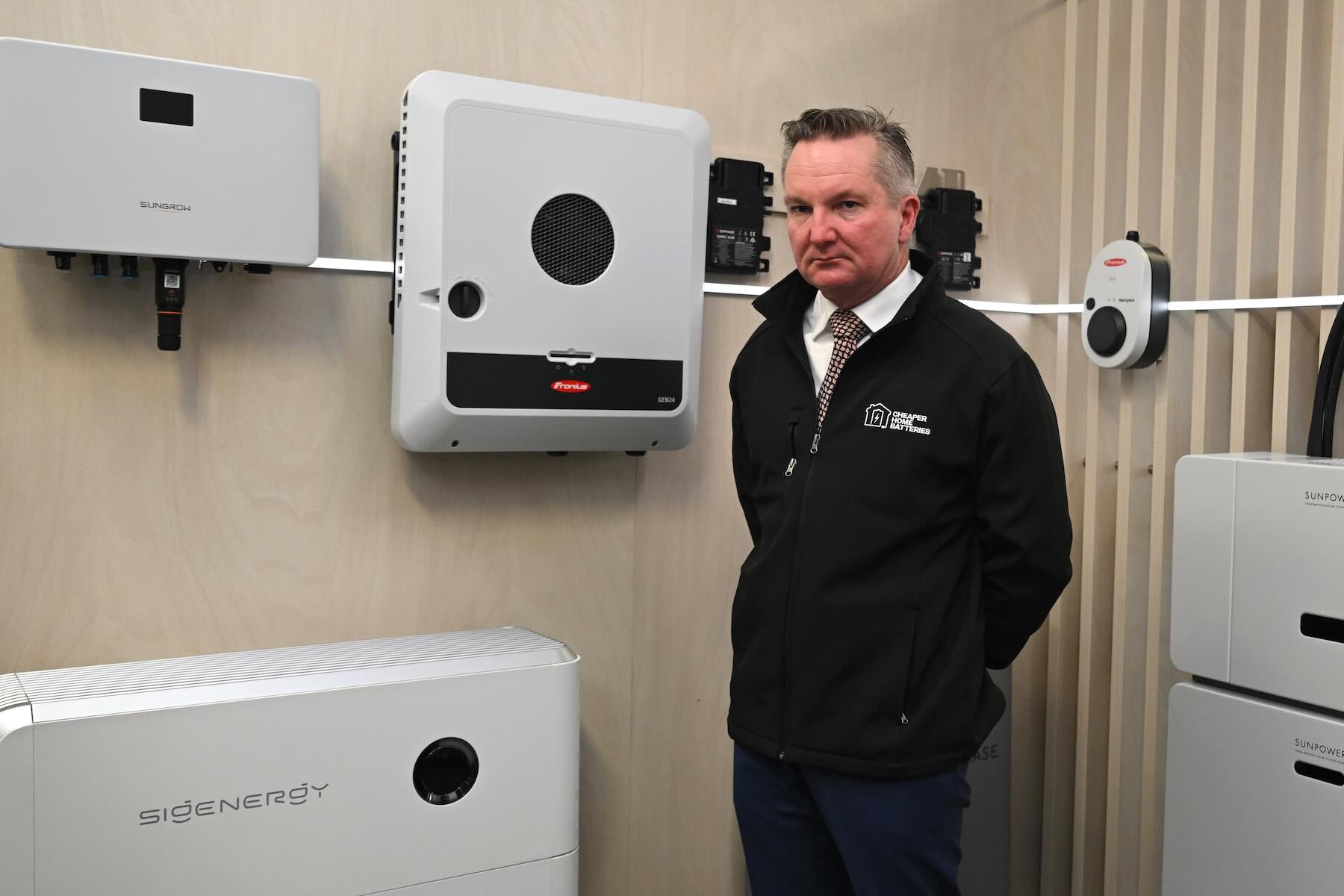
Energy and climate minister Chris Bowen has hailed another milestone in the federal government’s phenomenally successful home battery rebate scheme, saying the number of installations has now passed 400,000 in little more than 10 months.
Bowen also echoed observations by both the Australian Energy Regulator, and the Australian Energy Market Operator that home batteries are helping to lower wholesale electricity prices. The regulator has indicated this should feed into slightly low bills in the coming year.
“Yesterday (Friday) we surpassed 400,000 Cheaper Home Batteries,” Bowen said at a media briefing on Saturday morning to discuss the latest improvement in liquid fuel supplies amid the fossil fuel crisis sparked by the Middle East war.
“400,000 Australian households reducing their bills very dramatically, but also helping the grid and helping all Australians reduce their bills,” Bowen said.
“11.2 gigawatt hours of extra storage introduced in less than a year …. which means that there is less gas and coal being used in the nighttime, which is reducing prices for everyone, not just those Australians who have put in Cheaper Home Batteries.
“So, this is remarkably successful policy. Australians getting on with it, particularly in the outer suburbs and regions, getting on with it, putting in their Cheaper Home Batteries. 400,000. Quite a remarkable milestone for those Australian households.”
The numbers provided by Bowen indicate that the rate of home battery installations shows no signs of slowing, despite the change in rebates that came into effect on May 1, favouring smaller batteries over bigger ones.
If anything the pace has increased. Just 10 days ago Bowen told the Smart Energy Council conference in Sydney that “as of today, 380,712 batteries have been installed, representing 10.7 gigawatt hours of storage.”
Which means that batteries have continued to be installed at the rate of 2,000 a day, including weekends, although the average battery size appears to have reduced from around 28 kWh to 25 kWh, if those numbers are accurate.
It’s also worth noting that the 11.2 GWh of home batteries cited by Bowen means that the amount of home battery storage installed in just over 10 months is equivalent to the amount of utility-scale battery storage installed over the last 12 months.
The Australian Energy Market Operator said in late April that 4,445 megawatts (MW) and 11,219 megawatt hours (MWh) of new large-scale batteries had been added to the grid in the 12 months to March 31, more than doubling the installed capacity.
“The significant increase in large‑scale and household battery capacity is changing how electricity is produced, consumed and priced across the day,” said Violette Mouchaileh, the head of policy and corporate affairs at AEMO.
The Clean Energy Regulator also noted last week that the surge in home batteries, along with the revival in rooftop solar installations as more homes installed solar and others boosted the size of their arrays, will help Australia meet its 82 per cent renewable energy target by 2030, by reducing the pressure on stalling large scale wind.
“What I am saying is that it looks plausible now. It doesn’t look like a super stretch target,” the CER’s executive general manager Carl Binning told the SEC conference.
“The amazing thing about small scale is how flexible and fast it is. Eleven gigawatt-hours (of home batteries) in 12 months just blows your mind.”
If you would like to join more than 29,000 others and get the latest clean energy news delivered straight to your inbox, for free, please click here to subscribe to our free daily newsletter.