Australia’s renewable energy sector is facing an increasingly complex operating environment at a time when the country needs clarity and certainty to accelerate investment to meet growing demand and maintain energy security.
This is the top-line finding from a new report published by the Clean Energy Council CEC), developed in partnership with insurance broker Lockton, which identifies and ranks the pressures and roadblocks faced by those developing, financing, building, and operating renewable energy projects across Australia.
Based on an online survey of more than 100 industry participants ranging from CEOs, to policy officers, directors, and working-group members – the report aims to establish a new benchmark of the risks affecting Australia’s clean energy sector and pathways to mitigate and resolve these.
What the survey finds is that project approvals are becoming harder to achieve, grid connection is getting more complicated and taking longer, and state-led initiatives such as the development of renewable energy zones and new grid infrastructure are bumping up against delays and policy rethinks.
CEC CEO Jackie Trad says the picture being painted is of an increasingly complex operating environment, at a time when the country needs to rapidly ramp up development to meet targets and usher out coal.
“The message from industry is clear: certainty attracts investment, jobs and opportunity, and uncertainty slows these down,” Trad said said in a statement.
“With electricity demand growing and racing against the impending closure of Australia’s ageing and unreliable coal-fired power stations, the focus should be on removing barriers to investment and project delivery to the greatest extent possible, and to a high standard.”
This is particularly the case when developers are trying to secure approvals, with survey respondents explaining that securing planning and environmental approvals for renewable energy projects becoming increasingly challenging at both the state and federal levels.
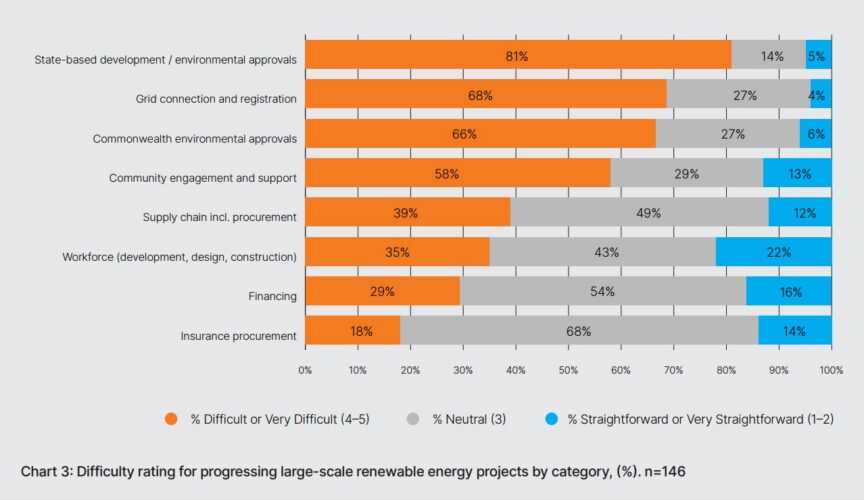
“State-based development and environmental approvals received the highest difficulty rating of all eight project stages, with 81 per cent of respondents rating these as difficult or very difficult,” the report explained.
“Notably, 71 per cent of respondents reported that state-based development and environmental approvals have become harder over the past three years.”
Two thirds of respondents reported similar issues at the federal level, with half saying that approvals have been harder to obtain over the past three years.
Delays in assessment and approval timelines not only materially increase the cost of developing projects but also jeopardise viability, as well as exacerbate other challenges such as financing.
With this in mind, the report concludes that “approval systems must be clear, coordinated, risk-based, and proportionate,” with improvements needing to focus on building clearer and faster approval pathways without lowering environmental standards.
Additionally, ongoing refinements to policy settings are required, including energy market rules, tenders for the Capacity Investment Scheme (CIS), and the Safeguard Mechanism.
Such refinements can provide vital certainty to investors as well as reduce risk premiums and costs that, in the end, often end up being passed on to consumers.
Grid connection and registration is another of the biggest barriers to entry for renewable energy developers, with two thirds finding grid connection and registration to be “difficult or very difficult”.
The report also calls for a faster rollout of Renewable Energy Zones (REZs) and major transmission projects, alongside continued reform through initiatives such as the joint Australian Energy Market Operator (AEMO)/CEC Connections Reform Initiative (CRI).
The report says that clearer national guidance on benefit-sharing with local communities is also needed, to build genuine and consistent community partnerships during a project’s development and avoid .
“We’ve seen encouraging steps from states and territories to improve planning and approvals processes without compromising environmental standards, while work to reform national environmental laws is also moving in the right direction,” said Trad.
“Work also continues between industry and governments on progressing several of the foundations for the proposals outlined in this report, including reform to grid connections processes and energy market rule changes among other initiatives.
“Giving industry the confidence to deliver the projects that will power Australia’s future must remain a top priority.”
If you would like to join more than 29,000 others and get the latest clean energy news delivered straight to your inbox, for free, you can click here to subscribe to our free daily newsletter.