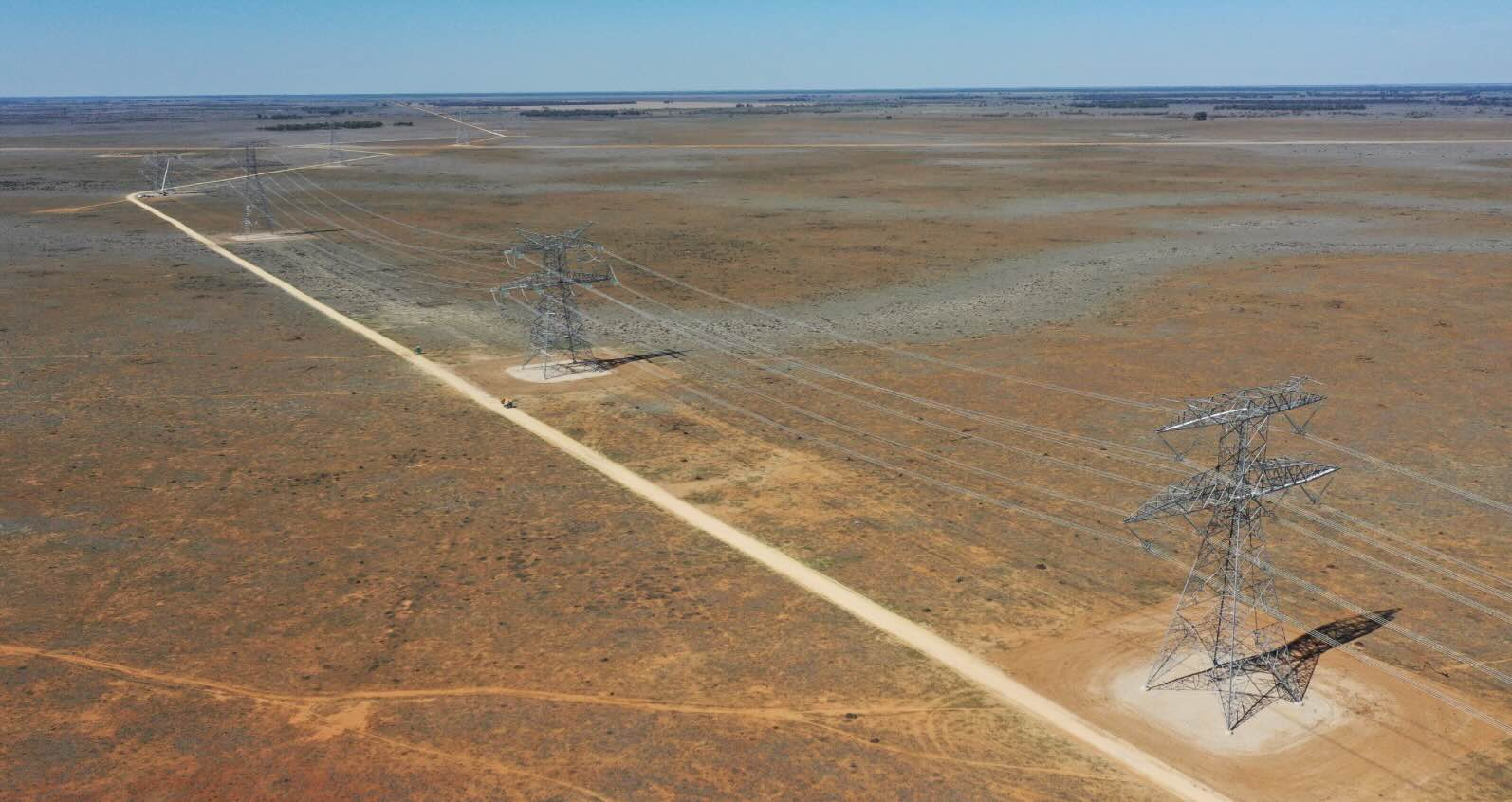
Transmission giant Transgrid says it has finally “energised” Australia’s biggest transmission link, after delays and major cost overruns on its 700 km part of Project EnergyConnect.
The project was to have been completed in 2026, and the South Australia link was done on time and on budget, but Transgrid has struggled with delays and costs that have pushed the budget out from $2.1 billion to $3.8 billion.
The project is considered crucial to boost the security and reliability of Australia’s main grid, help South Australia reach its stated target of 100 per cent “net” renewables by 2030, and support new generation essential to allow NSW to phase out the last of its coal fired generators.
The project, however, has also been criticised because it is considered too small – at 330 kV as opposed to 500 kV – to support much of the capacity that is available in the wind rich south-west of NSW.
“This critical interconnector has not been easy to deliver,” Transgrid CEO Brett Redman says in a speech to be delivered at the Australia Energy Week conference in Melbourne on Wednesday.
“It needed more money than originally expected, and we do not take that lightly. Every additional dollar matters to consumers. But now the full route is connected, it will start to reduce constraints, improve resilience, and over time, support lower-cost energy.”
Transgrid’s share of Project EnergyConnect has blown out from an original estimate of $2.1 billion to $3.6 billion, and the costs of the associated HumeLink, which it is also building to connect Snowy 2.0 into the main grid, has gone from $3.3 billion to $4.9 billion.
Transgrid has blamed global supply chain impacts, labour shortages, to record inflation, flooding and the insolvency of a delivery partner for the cost blowouts
Redman insists, however, that the net benefits are still significant – $964 million – and the increase in consumer bills (from $30 in NSW to $75 in South Australia) will be offset by benefits from falling wholesale prices because more renewable power can reach its destination.
The first stage of Project EnergyConnect, from Robertstown in South Australia to Buronga in NSW, with a spur to Victoria, has already been completed and has allowed an extra 150 MW to be imported and exported into and out of South Australia.
The completed line, with an additional 1,500 towers and over 10,000km of high-voltage conductor, will be commissioned after testing by the Australian Energy Market Operator, and will provide 800 MW of transfer capacity between the two states.
“Energisation of EnergyConnect marks the culmination of one of the nation’s most significant transmission builds and is a defining moment in the delivery of Australia’s clean energy future,” Redman said in a statement.
“EnergyConnect will benefit consumers by enabling access to lower-cost sources of energy like solar and wind, also known as wholesale energy, which is the largest component of household bills. The project will also help achieve Australia’s climate change targets as we replace coal-fired power with renewable energy.”
In his speech, Redman underlined the need for wind energy (which needs transmission), rather than just relying on solar and batteries, and also called for tariff reform to ensure that homes without solar and batteries can benefit from the transition.
“We need to tackle tariff reform. Otherwise, we risk creating a system where those who can least afford it carry a disproportionate share of the cost,” he said.
“This is another piece of the social licence puzzle as we go throughdeep transition. A fair transition can’t depend only on who owns a roof, has a driveway, or can afford the upfront cost of new technology.”
Transgrid forecasts data centre demand could grow from 3 terawatt hours (TWh) to27 TWh in less than a decade in New South Wales and the ACT, which Redman says is equivalent to the annual power generated by nearly two Eraring coal fired power stations – or nearly 47 million solar panels.
“Where infrastructure is required specifically for large new loads, those costs should sit with the proponents creating that demand, not be socialised across consumers,” Redman said.
“Consumers should benefit from a stronger grid and a larger demand base, not carry costs that don’t belong to them.”
If you would like to join more than 29,000 others and get the latest clean energy news delivered straight to your inbox, for free, please click here to subscribe to our free daily newsletter.