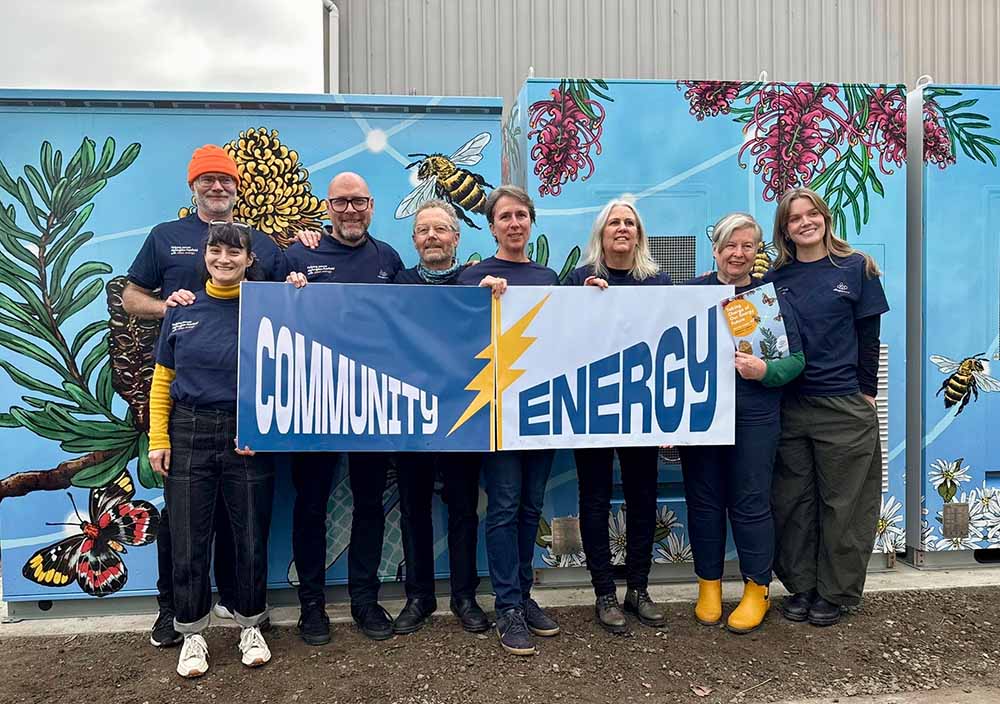

After eight years of volunteer effort and what Village Power president Graeme Martin describes as a game of snakes and ladders, the Alphington community battery in Melbourne’s inner north is finally live on the grid.
But for the community group behind it, the bigger achievement may be exposing why community-led energy projects remain so difficult to deliver in Australia.
Village Power’s experience has prompted a call for electricity distributors to reveal how much electricity local communities already generate and consume locally. They say that would better recognise the value of community batteries and other consumer energy resources.
The proposal comes as the Australian Energy Market Commission (AEMC) finalises new rules requiring distributors to provide much greater transparency about the operation and future needs of their local networks.
Village Power supports those reforms but argues they should go one step further.
Its submission to the AEMC argues that distributors should regularly publish the proportion of electricity generated and consumed within each local network area. This could help identify where local batteries, rooftop solar and flexible demand are already reducing pressure on the grid.
Village Power’s own eight-year journey explains why. When the volunteer group began their community battery project in 2017, the vision was straightforward: build a genuinely community-owned battery that local residents could subscribe to, and share the benefits of energy storage.
Instead, almost every major obstacle pushed the project further away from that model.
“It’s really been like a marathon relay,” Martin told the SwitchedOn Australia podcast. “It’s been a testimony to the passion, resilience of people who want to make a difference.”
Snakes around every corner
The first major snake was insurance. No commercial insurer was willing to cover a community group whose only significant asset would be a battery. Village Power also approached its local council, hoping it might insure the battery alongside other public assets, but without success.
“So that knocked it out of the picture,” Martin says.
The second “killer punch” came from electricity retailers. Village Power spent years developing a subscription model where local households would pay for access to shared battery storage. Several retailers expressed early interest, but when tenders were finally issued, none were prepared to offer the subscription service.
“The subscription side of that was something that they decided was just too hard,” Martin says. “It wasn’t commercially viable for them … we were offering 100 customers. It was just too small.”
Without insurance or retailer support, Village Power’s original model became impossible.
The project survived though, but in a very different form from the one first imagined. The group has partnered with Acacia Energy, which now owns and operates the battery commercially while Village Power runs a community energy program and receives a modest share of the battery’s profits under a five-year agreement.
“I think it’s important that when you approach these things, that you build up a coalition of partners to make this happen,” Martin says.
Measuring community energy
The battery itself operates as a “solar soaker”, charging from excess rooftop solar during the middle of the day and discharging into the local network during the evening peak.
Unlike a behind-the-meter home battery, local households do not directly own or control part of its storage. Instead, Village Power has shifted its focus towards helping residents understand how much renewable electricity their community is already producing and using.
Using energy data from up to 100 participating households, together with modelling of rooftop solar generation, Village Power is calculating how much electricity is generated, shared and consumed within the local neighbourhood.
“We want to recognise all the energy that’s created within the local network, recognise it and report it so that people can actually see what that is,” Martin says.
He argues this should be happening right across the energy network, and distributors should record and make transparent the amount of energy that is generated and consumed locally.
“From a climate change point of view, that is the greenest energy you can have,” he says.
“If it’s renewable, it’s generated locally, it hasn’t come from somewhere else. It hasn’t come from over a vast distance and had transmission lost.”
The next step
While new planning rules create a framework for greater distribution-network transparency, Village Power argues the Australian Energy Regulator’s forthcoming reporting guidelines should also require distributors to publish how much electricity is generated and consumed locally within every zone substation area.
The group says distributors already hold much of the necessary information. Making it publicly available would help communities, developers and investors identify where local energy resources are already supporting the network and where additional community batteries or flexible demand could deliver the greatest benefit.
“What we’re doing is what we think should happen by the energy distributors, and they should publish that data because I think it makes more transparent the fact that communities can be far more self-reliant in terms of their own energy,” Martin says.
To join more than 29,000 others and get the latest clean energy news delivered straight to your inbox, for free, click here to subscribe to our free daily newsletter.