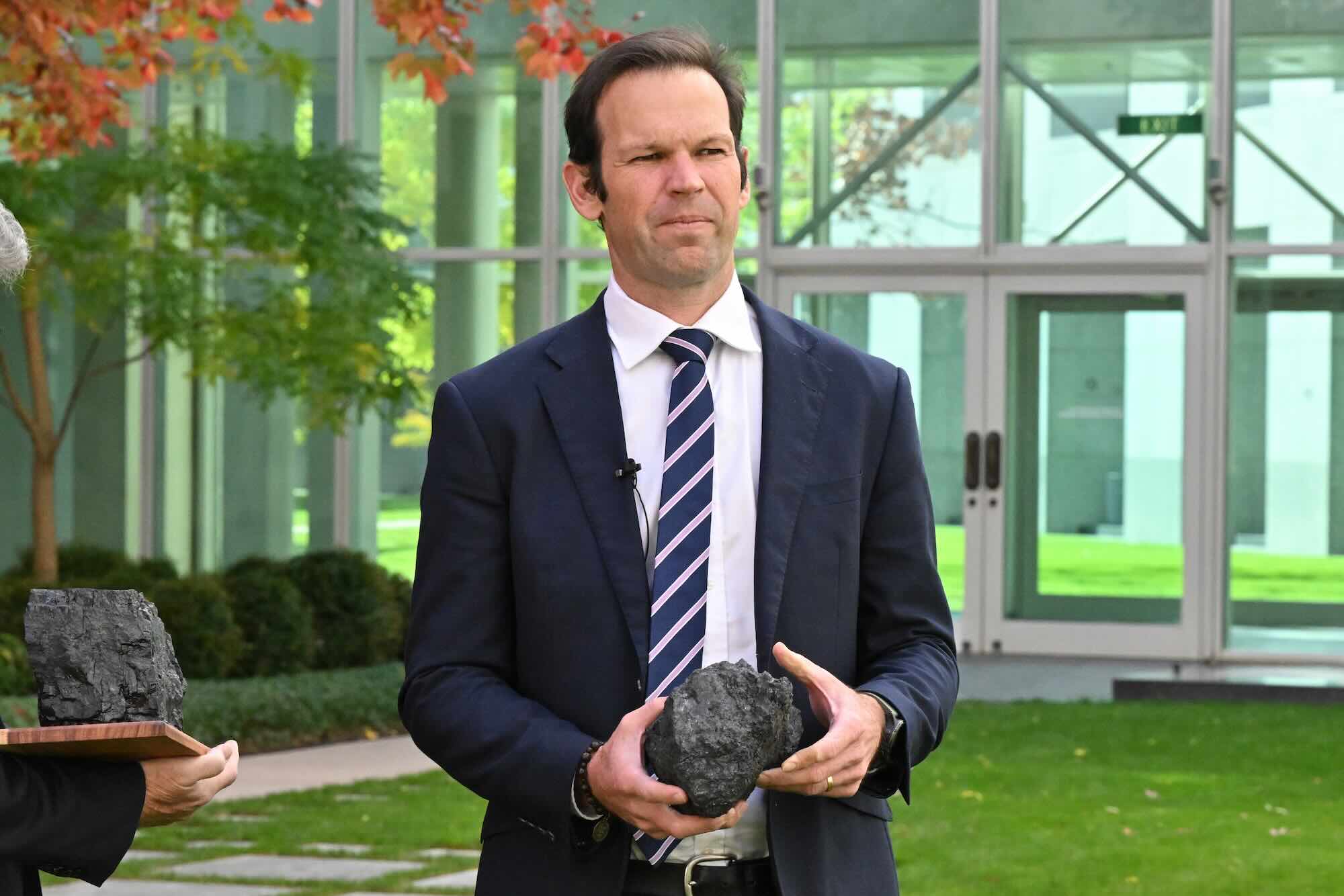
Matt “Mr Coal” Canavan – the chief agitator for the federal Coalition’s abandonment of net zero and probably its most vocal anti-renewables member – has been elected to lead the National Party, following the sudden resignation of David Littleproud.
The Queensland senator won a leadership ballot in a snap meeting of National Party members on Wednesday morning, with Darren Chester – the federal member for Gippsland in Victoria – appointed as his deputy.
The shock change of leadership comes less than a month after a regime change in the federal Liberal Party, when Angus Taylor toppled Sussan Ley, 34 to 17, in a leadership spill just nine months into Ley’s role as the first woman to head up the party.
The shifting of deck chairs sets a distinctly anti-renewables, pro-fossil, climate-denying tone for the federal LNP, just as the second conflict-driven global energy crisis in five years prompts calls for an even faster shift to energy independence through solar, wind, energy storage and electrification.
Taylor and Canavan know each other well – when Taylor was energy minister, Canavan was resources minister. Barnaby Joyce, Canavan’s former boss and now with One Nation, was deputy prime minister.
So what can we expect from Canavan the Nationals leader? In comments following the vote on Wednesday morning, the shit-stirrer-in-chief said he’s “got a different job to do as a leader, and I’ll commit myself to doing that.”
Presuming he doesn’t abandon his core beliefs, however, let’s take a look at some of Canavan’s greatest energy and climate hits of the past few years, to paint a better picture of what we’re getting with new leader of the federal National Party.
Matt Canavan the net zero killer: Matt Canavan hates net zero and, well, of course he does, given the policy commitment – which is backed by a global treaty, decades of science and most of the world’s major economies – effectively means no more coal power; and Matt Canavan loves coal power.
Canavan has been railing agains net zero for a while now, and likes to blame the policy for literally everything, including the current oil price shock sparked by the conflict between the US, Israel and Iran.
The senator took this hatred to the next level last year, however, when he introduced a bill to the federal senate to repeal net zero at the same time as recent Joyce introduced the same bill into the House of Reps.
The stunt worked, to a degree. In November a motion for the National Party to “abandon its support for a net zero mandate” was passed. Not long after that, the Liberal Party joined in and agreed to formally abandon its own commitment to net zero emissions by 2050.
Matt Canavan the climate denier: It’s hard to support a net zero target when you refuse to accept the science of climate change. And its hard to accept the science of climate change – and the basic tenets of climate action – when you are heart and soul aligned with Australia’s coal and gas lobby.
Canavan has described climate science and reports informed by climate science as “a cynical attempt to spread fear and panic among people,” and he has made such authoritative statements as “there is no climate crisis,” and “there’s just not credible evidence that droughts or floods are getting worse in this country.”
Matt “Mr Coal” Canavan: Canavan’s love of coal is legendary – he has even dusted his face with the fossil fuel, and in 2020 drew widespread condemnation for brandishing a “black coal matters” sticker. In the same year he told the ABC’s Q&A program that there were no fossil fuel subsidies in Australia.
More recently, at a Senate inquiry last year, Canavan recommended that the Capacity Investment Scheme be opened to new coal power.
This, despite the fact that the cost of building new coal is around double the price of wind and solar, even with storage and transmission, according to CSIRO’s GenCost report, which compares the cost of building probable and existing energy sources, as well as nuclear, which is even more expensive.
Matt the Cheaper Home Batteries hater: Canavan’s latest renewable energy bugbear is the Albanese government’s enormously popular Cheaper Home Batteries scheme, which has so far helped more than 250,000 households add discounted storage to their solar.
The scheme has also added more than 6.2 gigawatt-hours of battery energy storage to Australia’s grid via peoples’ homes, which will soak up ultra-cheap daytime solar and shift it into the evening peak, driving down electricity prices for all and helping to stabilise the grid.
How can you be angry about that? Just ask Matt. He recently denounced the federal battery rebate as “middle-class welfare on steroids” – despite the data showing it has been most popular in Australia’s regions and outer suburbs.
“Labor’s battery scheme is only accessible to the well-off because you still need to spend thousands to access it,” he said. “In a country with so many resources, we should not have a two-tiered energy bill system where the rich can get a discount and the poor have to suffer higher and higher bills.”
But then again, Matt has never really got batteries. In 2018, when he was Australia’s federal minister for resources, he famously told a CERAWeek conference in Texas that Australia’s game-changing Hornsdale big battery was “the Kim Kardashian of the energy world.”
“It’s famous for being famous,” he said of the battery – the nation’s first, famously constructed within 100 days to support the coal-free and heavily renewable-powered South Australia grid. “It really doesn’t deliver very much.”
Oops. Flash forward to February 2026, and Rystad Energy has described Australia as the “global proof point” of the importance of grid-scale batteries, with the technology overtaking peaking gas output in Victoria, New South Wales and Matt’s home state of Queensland.
“Battery storage is no longer just enabling renewables – it is actively replacing gas generation,” the report from the Norway based energy consultants said last month.
“This rapid expansion positions BESS among the fastest growing energy technologies of the decade, driven by the urgent need for fast, flexible capacity to support power systems with rising renewable penetration.”
What about Darren Chester?
Darren Chester is the federal member for Gippsland in Victoria – a seat he has held since 2008 – putting him right at the intersection of Australia’s coal-fired past and its renewable energy future.
Chester has been openly supportive of renewable energy in the past – welcoming the CEFC backing of Octopus Australia’s Gippsland Renewable Energy Park back in March 2022 – just before the Coalition lost the federal election – as important for local jobs and “keeping the energy sector in our region.”
In 2021, Chester welcomed the Coaliton’s introduction of legislation to develop an offshore wind industry, with waters off the coast of Gippsland expected to host Australia’s first projects in this sector.
More recently, however, Chester has toed the Coalition party line on nuclear, a shift in tone that has perhaps helped secure his new role as 2IC next to Canavan.
Interestingly, One Nation Senator and National Party defector Barnaby Joyce told reporters on Wednesday that he expects there will be tensions over policy positions between Canavan and Chester.
“Their hearts will be in the right place with Matt; it’s just policy will be completely different,” Joyce said.
“I know Matt, I know him very well, and he is an exceptional guy and a good fella, but his policy beliefs are just a million miles away from where a lot of the Liberal Party is, and to be quite frank , they’re quite a distance away from where Darren [Chester] is.”
If you would like to join more than 29,000 others and get the latest clean energy news delivered straight to your inbox, for free, please click here to subscribe to our free daily newsletter.