On Monday morning, four horses – Broccoli, Clyde, Wallace and Clarence – will set out from Narrabri on a journey that will trace the contested path of one of New South Wales’ most controversial fossil fuel projects.
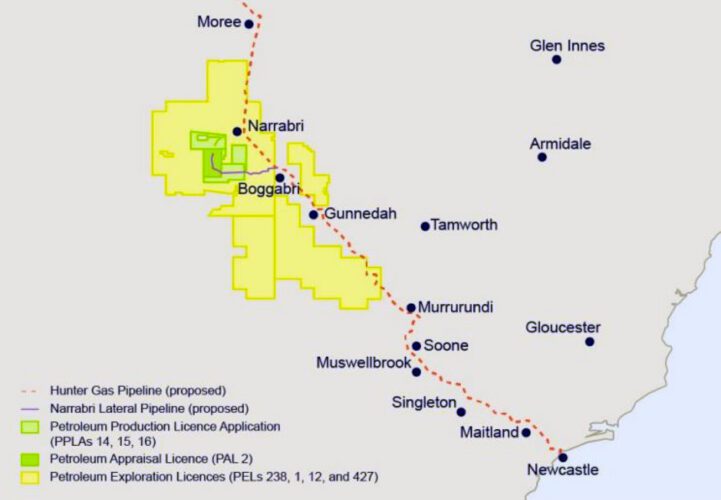
For the next two weeks, renewable energy advocate Sally Hunter and three friends will ride over 400 kilometres on horseback, following the proposed route of the Narrabri Lateral Pipeline and the Queensland–Hunter Gas Pipeline across some of the state’s most productive farmland.
They’re calling it Ride the Gas Line and it will take them through Breeza, Quirindi and Scone, finishing near Newcastle at the Millers Forest Muster, tracing the path of Santos’ planned pipeline that will link its Narrabri coal seam gas field to the east-coast gas network.
The journey aims to bring attention to the communities, farms and landscapes that sit along the proposed pipeline route.
“The Narrabri gas project is a dog of a project,” says Hunter. “It’s poor quality gas, there’s not much of it and it risks far too much from landholders, forest and climate.”
A project still waiting for its pipeline
The Narrabri coal seam gas project, owned by Santos, was approved by the NSW Independent Planning Commission in 2020, allowing the development of up to 850 coal seam gas wells over 20 years.
But the project still lacks a crucial piece of infrastructure: a pipeline capable of transporting the gas to market.
The Narrabri Lateral Pipeline, a 55-kilometre link connecting the gas field to the longer Queensland–Hunter pipeline, still requires final planning approval and Santos has not yet made a final investment decision on the Narrabri lateral.
The longer Queensland–Hunter pipeline – which would carry gas through the Liverpool Plains and Hunter Valley to Newcastle – was approved years ago but is yet to be built.
“The Queensland Hunter pipeline cuts through the guts of NSW and through the guts of the Liverpool plains which is the most fertile farming country that we’ve got in the state,” says Hunter.
Pipeline approval could become the real political battleground for the project. This is where land acquisition, farming impacts and environmental approvals collide, and where the fate of Narrabri may ultimately be decided.
Riding through contested country
Hunter is a farmer, renewable energy advocate and founder of the Narrabri community energy group Geni.Energy.
When Renew Economy spoke to her last week, she was standing with other farmers outside the gate of a property near Baan Baa, where the proposed Narrabri lateral pipeline will join the Hunter pipeline corridor.
The group had set up a vigil after Santos notified the landowner and farmer, Shaine Maunder – who opposes the pipeline project – that they intend to gain access to her property to conduct the final cultural heritage survey which they need to obtain prior to planning approval.
More than 460 landowners lie along the proposed pipeline corridor between Narrabri and Newcastle. Santos claim they have secured support for the Narrabri lateral from about a third but Hunter says the majority of landholders along the pipeline route oppose the pipeline.
She believes the ride will provide an opportunity to hear directly what landowners think, and share those stories beyond the region.
The debate over gas supply
Santos and supporters of the project, including the NSW State Governmnet, say Narrabri could supply up to half of NSW’s gas demand, helping to support manufacturing and energy security.
Last year AAP reported that NSW Premier Chris Minns told an Australian Workers’ Union conference: “I want to send a clear message today that we need the Narrabri gas field to produce energy as soon as possible.”
Controversially the government also said it will consider using compulsory acquisition powers if negotiations with landowners fail.
But critics say the case for Narrabri gas is far from clear. An analysis released in February by the Institute for Energy Economics and Financial Analysis (IEEFA) argues that increasing supply from Queensland fields could reduce gas prices more effectively than developing the Narrabri resource.
In a submission to the planning department the think tank wrote: “Santos’s proposal to build the Narrabri lateral pipeline, as part of the broader Narrabri gas project, should be delayed.”
“Making more Queensland gas available to southern markets could lower gas prices in NSW, whereas Narrabri gas is unlikely to lower gas prices.”
IEEFA also warned the project could undermine the state’s emissions goals.
“The Narrabri gas project will also account for a significant share of the state’s greenhouse gas (GHG) emissions, and is not consistent with the NSW government’s emissions reduction targets.”
Hunter says the broader trend in the energy system also raises questions about the need for new gas supply.
“We are seeing a decrease in gas demand every year … if we encourage reduction in the use of gas it can go down even further.”
The rights of landowners
One of the most contentious issues about the pipeline project is land access.
Hunter draws a distinction between the treatment of fossil fuel infrastructure and renewable energy projects. With renewables, she says, landowners can refuse to host developments on their property.
Gas projects operate differently. Pipeline easements can ultimately be acquired if negotiations fail.
“With gas fields you do not have a legal right to say no. That’s it, full stop, no questions asked.”
Hunter argues the contrast with electricity transmission projects is stark. Transmission infrastructure can also involve compulsory acquisition, but it is typically government-owned and part of the shared electricity grid.
“The saving grace is that at least it is owned by the government.”
By contrast, she says, the Narrabri pipeline would give a private company control over critical infrastructure.
“The pipeline will have compulsory acquisition rights for a private company that will own a monopoly of the gas pipeline, from their own field that they can do whatever the hell they want with. It’s just ludicrous.”
That loss of control is one reason the project has become so divisive in regional communities.
“That disempowerment drives me, and creates really bad social outcomes in regional communities and that’s why I’m strongly opposed to this gas field,” says Hunter.
Over the next two weeks Hunter and her friends will argue that energy infrastructure debates are not just about markets or supply forecasts — but about land, livelihoods and the choices shaping Australia’s energy future.