Fortescue’s decision to accelerate a large-scale heavy industry green grid in the Pilbara is a practical demonstration of the future Australia must now choose: batteries and electrification replacing barrels and diesel, backed by firmed renewables rather than gas and oil.
It lands squarely in the terrain mapped out recently in a six-point plan for ending Australia’s dependence on oil and securing our energy future.
At its core, our mapped approach to energy security in the 2020s and 2030s, rather than just shoring up supplies in the next few months, will come from electrified transport, renewable generation, storage and smart systems, not from bigger fuel tanks or new fossil projects.
Fortescue’s Pilbara green grid – designed to power its operations 24/7 without fossil fuels by the end of this decade and now targeting multi-day fossil-free operation earlier than planned – is precisely this logic applied to heavy industry.
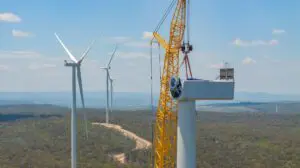
The company is building out large-scale solar, wind and batteries to eliminate diesel and gas from its mining fleet and processing operations, with a fully integrated renewable grid expected by 2029–30.
That aligns directly with several planks of the six-point plan we suggested in The Conversation:
accelerated renewables and storage deployment so clean local energy pushes out imported oil and gas;
- using EVs and large batteries as resilience assets; and planning the orderly decline of oil rather than extending dependence through new subsidies or reserves.
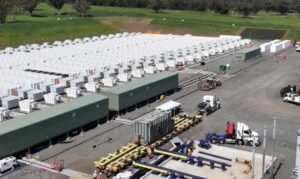
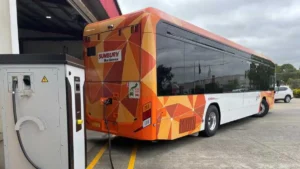
Fortescue’s heavy mobile fast-chargers, battery-electric haul trucks and electrified sites in the Pilbara are a large-scale version of that prescription: trucks become electric loads on a green grid instead of consumers of imported diesel, while batteries and smart controls provide system strength and backup.
The battery storage provides 100% backup as its now cheaper than any fossil fuel backup which partly explains how Fortescue has achieved this transition much faster than originally planned.
Crucially, the Fortescue announcement shows that this is not just a transport agenda but an industrial one. Its green iron and green metal projects at Christmas Creek are designed to pair a green mining fleet with renewable-powered ironmaking, demonstrating a “green pit to product” supply chain and opening the door to exporting embodied clean energy in green metals.
That is exactly the kind of new economy Australia risks missing if it clings to fossil frameworks instead of using today’s oil and gas shocks to drive structural reform.
If national policy mirrored Fortescue’s ambition it could become the organising principle for Australia’s next industrial era. Most of all, can we accelerate our net zero goals to 2030 by facilitating electrification of freight and establishing grids with 100% renewables and battery storage?
Prof Ray Wills (Adjunct Professor, The University of Western Australia; Managing Director, Future Smart Strategies), Prof Peter Newman (Professor of Sustainability, Curtin University)