A final investment decision on Marinus Link, the undersea transmission cable proposed to connect North West Tasmania and Victoria’s Latrobe Valley, is “just around the corner,” a conference has heard, despite crucial environmental decisions hanging in the balance and Tasmania’s parliament being in turmoil.
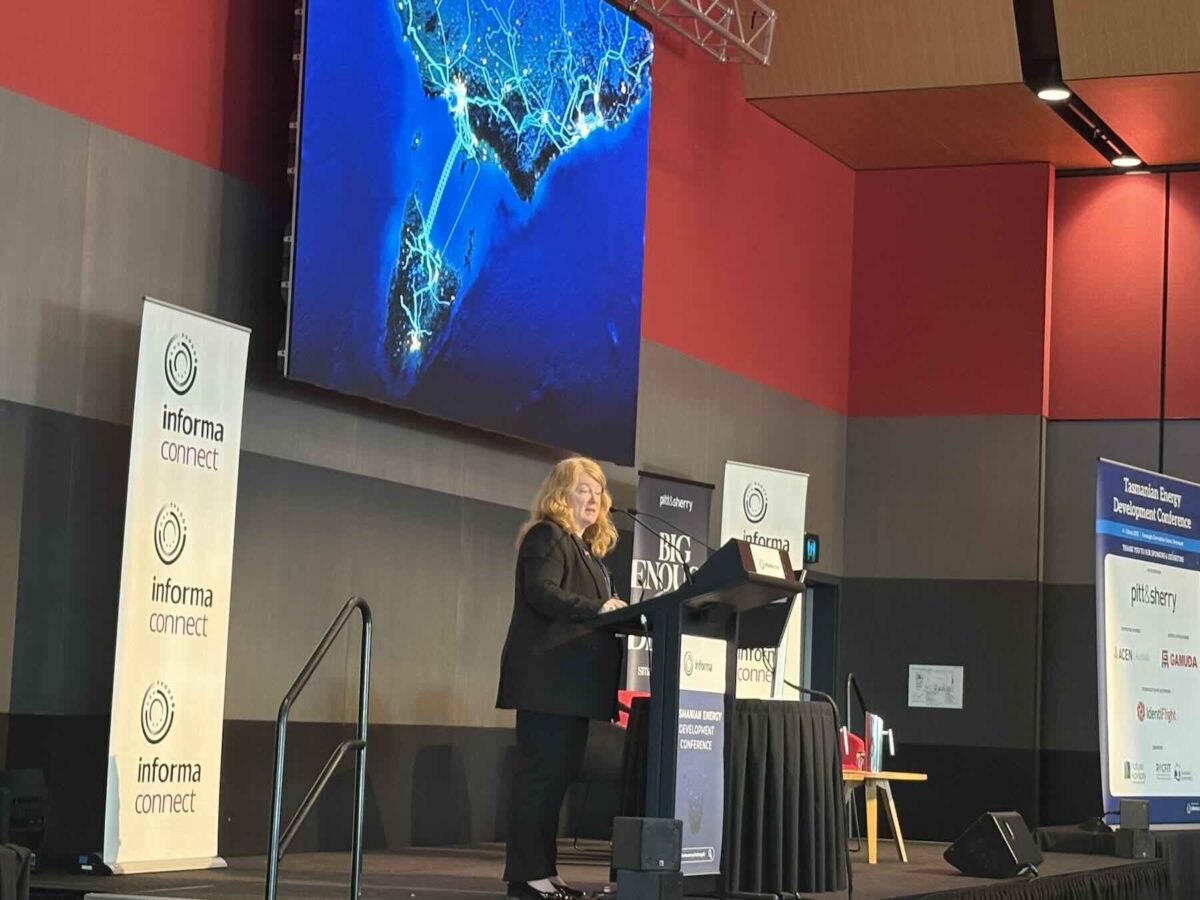
The brand new CEO of Marinus Link, Stephanie McGregor, delivered a progress report on the huge and controversial project at the 7th Annual Tasmanian Energy Development Conference in Devonport on Wednesday – her third day in the new role.
Although very fresh to the helm at Marinus, McGregor has an impressive pedigree in developing and delivering renewable energy transmission projects across the UK, Europe and Australia.
“The last one I worked on before I returned to Australia was the Norway interconnector between the UK and Norway,” she tells the conference.
“I’m incredibly proud to have the opportunity and the privilege to now lead a project that is both nationally significant and deeply rooted in the aspirations for Tasmania’s future.”
But Marinus Link has also been a hugely contentious and increasingly costly project, decried by opponents as is “an expensive risk” for energy consumers, a white elephant of the energy transition, and a “boondoggle” that will offer “virtually no benefit to Tasmanians.”
Having been first proposed as two cables with a combined capacity of 1500 megawatts (MW), Marinus Link was cut in half in late 2023, in a deal between federal Labor and the Victoria and Tasmania state governments, in response to ballooning costs.
Now, pared back to a first stage of just one 750MW cable, and with the federal government agreeing to take a bigger stake to reduce the financial burden on Tasmania, the project is forging ahead.
Last week the Victorian government issued environment approvals for its parts of the project and the Marinus Link board made a recommendation that shareholder governments of the project make a decision to proceed to final investment decision.
The recommendation advises that there is a sound financial and economic investment case for proceeding with the construction of the 750 MW stage one of Marinus, based on an assessment of forecast costs, revenues and associated benefits and risks.
The federal and state governments will now undertake their own detailed analysis, due diligence and risk assessments before determining a formal final investment decision in July. The project is also awaiting a twice-delayed federal environmental decision through the EPBC Act.
“In my short time at MarinusLink I’ve quickly learned that the project is moving at an incredible pace. We are clearing key milestones and deliverables almost weekly,” McGregor tells the conference.
“Our organisation is mobilising to deliver MarinusLink, and from everything I’ve seen, the team is pretty excited to move on to that next phase.”
But the next phase will be a tough one – particularly in light of the chaos currently unfolding in the Tasmanian state parliament. Media reports on Wednesday morning suggest that a no-confidence motion in the premier Jeremy Rockliff is likely to succeed.
The Guardian reports that in a social media post, Rockliff said a successful no-confidence motion would force Tasmania back to the polls.
Where this would leave Marinus Link is unclear. But in the realm of public opinion – or even expert opinion – the battle is certainly not won, despite the strong “Hooray for Marinus” energy that ran through the morning session of the conference’s first day.
“This is a once in a generation opportunity to power Tasmania’s next era of growth, unlocking major investments, supporting new industries and strengthening energy security across our state,” Tasmania’s energy minister Nick Duigan said via pre-recorded interview.
“Together with the North West transmission developments, Marinus Link, amongst new generation projects, supports further capacity and strengthens the backbone for our electricity system.
“It will, of course, enable more clean generation to be built right here on the island, creating jobs, boosting regional economies and securing long term benefits for Tasmanian communities.
“Our decision with our shareholders is now just around the corner.”
MvGregor, too, is upbeat – albeit after only three days in the role.
“We’re making real progress in planning, approvals, contracts, construction readiness,” she tells the conference.
“At the same time, we’ve honed in on the intergenerational legacy and empowerment the project can bring to communities that this project will connect, both in the north of Tasmania and in Gippsland and Victoria.
“Hundreds of local Tasmanian businesses have expressed interest in working on Marinus Link, and we’ve made sure that our bidders know who those organisations are.
“We’ve had further engagement in Tasmania over January and February, when our development application and environmental impact statements appeared on public exhibition.
“In February here in the North West [of Tasmania], we hosted an industry briefing in Burnie which had a turnout of nearly 200 people.
“And lastly, Marinus was listed on the Australian government’s first ever national renewable energy project priority list, which given it’s a transmission project, I think is pretty cool.”
McGregor says there are still plenty of ducks to get in a row, including finalising a lead civil construction contractor – a short-list of two has been made.
Outstanding tasks include achieving financial close with the Clean Energy Finance Corporation, achieving a final revenue determination from the Australian Energy Regulator and keeping on track with remaining environmental and planning approvals.
“I see my role and that of the team that is now leading this project into delivery as one of custodianship to build on the investment and aspiration of others who have gone before us,” she says.
“What drew me to Marinus Link is what brings many of us here today – the opportunity to be part of something transformative and make an enduring difference.
“Marinus … isn’t just about cables and converters. It’s about shaping the future of the community we want to live in. It’s about shaping the energy market so it is fit for purpose, for the aspirations we all hold for ourselves and our children. It’s about the economy and the future design of the climate we want to be happy to leave for those who come after us.”
McGregor says an “under-appreciated component” of Marinus is the fibre optic telecommunications cable that come with the undersea transmission line.
“Fibre optic cables bundle in with the electricity cables to ensure that the protection and control systems required to operate the electricity cables can can run, but that only actually uses a very small amount of the capacity in the fibre cable,” she says.
“The extra bandwidth capacity in that cable is more than 150 times the capacity of all three current data fibre cables into Tasmania across the Bass Strait.”
McGregor says a report the project team commissioned estimates that Marinus Link could enable “database industries” that need bandwidth with a potential investment value of $1.9 billion.
“Without exaggeration, Marinus could be a game changer that sets Tasmania up for technology investment and exciting new industries to be locally fostered and driven,” she says.