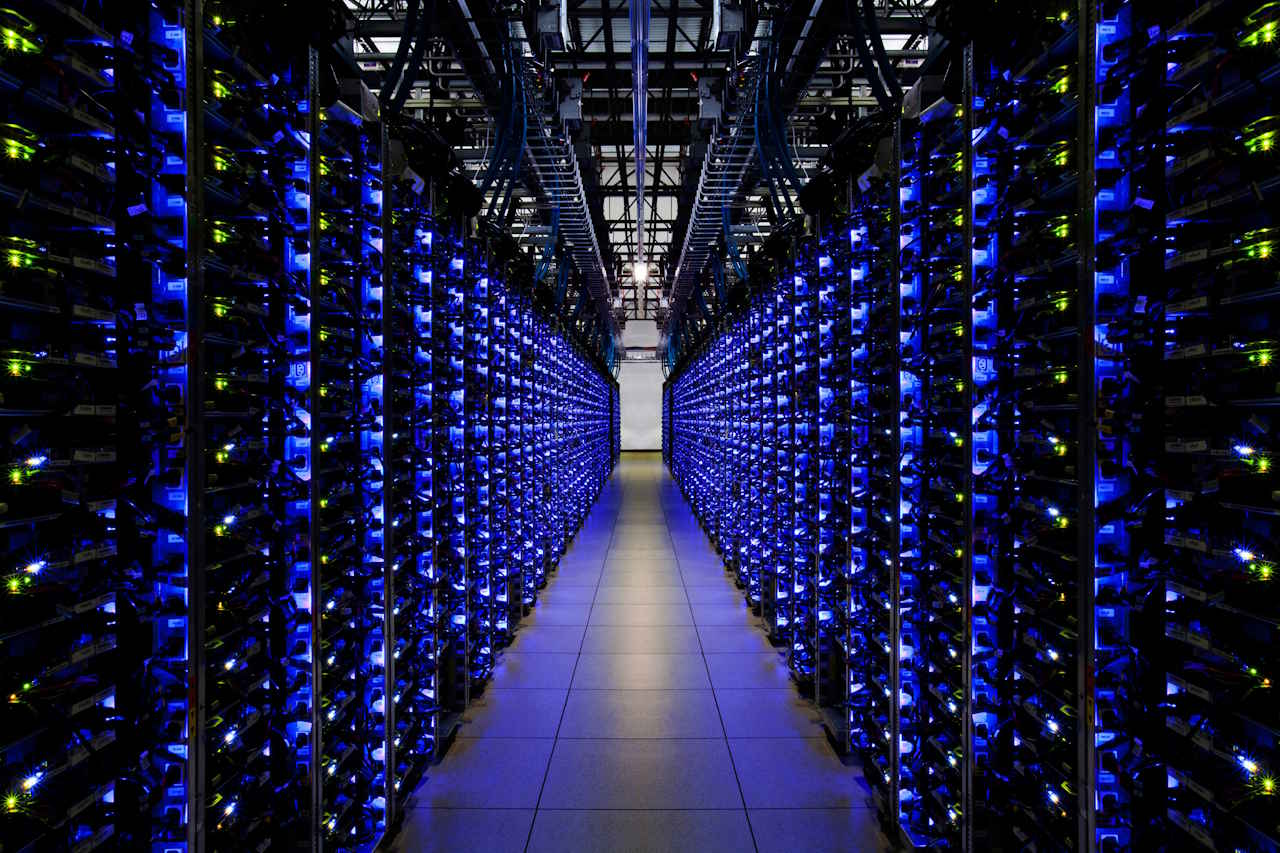
Data centres are already helping flatten the solar duck curve in Australia’s main grid, soaking up the output of rooftop solar along with home batteries and other industrial loads, but there is a lot more capacity seeking to connect to the grid, according to the market operator.
Data centres have emerged as a major talking point in Australia’s energy transition. The market operator is wary of them because of their size and potential to suddenly jettison loads, many local communities are pushing back against new developments, and there is concern about how they will source their insatiable power needs.
The Australian government is seeking state support to require data centres to bring new and additional firmed renewable capacity to the grid, and the renewable energy industry is hopeful this can finally provide the buyers the market has been desperately short of, and provide a path to financial close and construction.
But the data centres are already having an impact, according to the latest Quarterly Energy Dynamics (QED) report for the June quarter, published on Tuesday by the Australian Market Energy Operator.
It notes how they are helping change the shape of the grid, which is now seeing lower demand in the evenings (thanks mostly to home batteries) but greater demand in the middle of the day, thanks to those same home batteries, but also grid batteries and data centres.
Together, they are outpacing the growth in output of rooftop solar, which is a good thing for the grid because it alleviates the pressures of “minimum demand” levels when create problems for the grid operator because there is no requirement for any large scale and controllable generation, which AEMO needs to retain control.
According to AEMO, data centre demand doubled in the state of Victoria to average 204 MW over the June quarter, and in NSW it jumped by 35 per cent to average 435 MW.
“The NEM demand profile continued to shift from the evening peak towards daytime hours in Q2 2026,” AEMO writes. “Increased home daytime operational battery charging, together with growing industrial and data centre loads, lifted daytime operational demand, more than offsetting growth in distributed PV output.”
The big question is what happens when even bigger data centres – multiple gigawatt facilities now being talked about in Australia – connect to the grid. AEMO is seeking rules to prevent any sudden movement that could see a gigawatt of load suddenly disappearing from the system, creating potentially devastating ripple effects across the grid.
According to a report published earlier this year by Data Centres Australia, Australia is currently home to 162 operational data centres nationally. Other estimates place that number much higher, closer to 300 according to at least one source.
In 2024-25, data centres used around four terawatt-hours (TWh) of the electricity in Australia’s main grid, or around 2 per cent, equivalent to the electricity usage of over 700,000 homes, according to the Clean Energy Council. By 2030, this number is expected to skyrocket to 12 TWh, or around 6 per cent of the electricity in Australia’s main grid.
In the QED report, AEMO reports that there are 17 data centres with a combined maximum connection capacity of 9 GW working through various stages of the transmission network connection process.
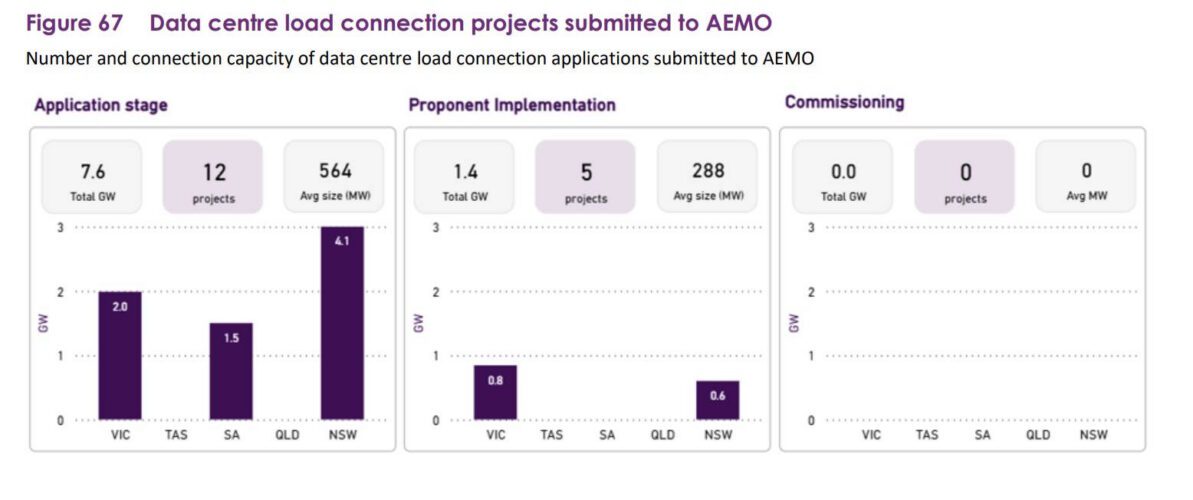
While acknowledging that “realised demand is typically lower than the connection capacity”, the speed with which new data centres are being brought online and proposed is potentially concerning.
According to the AEMO, over half of the new data centre capacity will be in New South Wales, with another third in Victoria. Of the 17 projects, 12 are in the application stage with a combined maximum connection capacity of 7.6 GW and five were progressing through implementation with a combined capacity of 1.4 GW.
A YouGov survey of 1624 Australians commissioned by the Climate Council found last week that 82 per cent of respondents agreed that governments should insist that new data centres pay for additional renewable energy and storage infrastructure that matches their electricity consumption.
“Australians have sent a crystal-clear message: operators cashing in on the AI boom must bring their own clean energy to the table,” said Amanda McKenzie, Climate Council CEO.
“With energy demand from Australian data centres set to triple by 2030, we can’t afford to let this industry drain our grid, push up electricity bills and create more climate pollution.”
If you would like to join more than 29,000 others and get the latest clean energy news delivered straight to your inbox, for free, you can click here to subscribe to our free daily newsletter.
To join more than 29,000 others and get the latest clean energy news delivered straight to your inbox, for free, click here to subscribe to our free daily newsletter.