Home » Chart of the day » Big batteries took a bite out of gas generators’ evening peak party, then they ate the whole dinner

Big batteries took a bite out of gas generators’ evening peak party, then they ate the whole dinner

Western Downs renewable energy hub. Image: Neoen.
Western Downs renewable energy hub. Image: Neoen

We included this graph below as part of the monthly review written by the good folk over at Open Electricity and published here earlier this week, but it is so stunning, and has sparked so much interest on LinkedIn and elsewhere, that it’s worth highlighting all by itself.

For decades peaking gas remained supreme in Queensland’s peak demand periods, adding revenue cream to the country’s most coal dependent grid by switching on as demand surged, particularly in the evening peak.

Queensland, in fact, was the country’s largest gas-generating state, as well as being its most coal dependent.

Then along came battery storage.

As the first big batteries came on line, they started to nibble into the evening peak. Then, as numbers grew, they ate more and more of the peaking gas generators’ party mix until – in March and April this year – they have pretty much eaten the whole lot.

The graph below illustrates how.
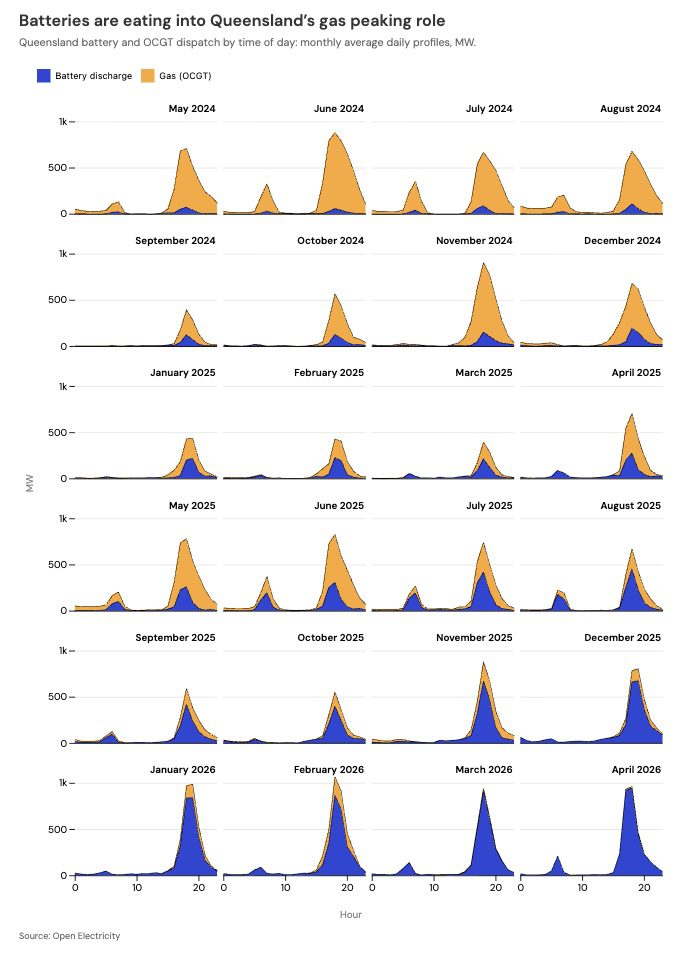
It’s a spectacular change in such a short period of time. And significant too, because so many forcecast are based around the assumption that gas is essential for balancing out the grid, and is being used as justification by state governments to open up new regions for gas exploration.

Gas generation will play a role in the future, renewables dominated grid, but it will rapidly diminish and likely focus on seasonal lulls in wind and solar generation, rather than daily variations – on that they can no longer compete with battery storage, particularly as more households install their own battery back-ups.

If you would like to join more than 29,000 others and get the latest clean energy news delivered straight to your inbox, for free, please click here to subscribe to our free daily newsletter.

If you wish to support independent media, and accurate information, please consider making a one off donation or becoming a regular supporter of Renew Economy. Please click here. Your support is invaluable.

Giles Parkinson is founder and editor-in-chief of Renew Economy, and founder and editor of its EV-focused sister site The Driven. He is the co-host of the weekly Energy Insiders Podcast. Giles has been a journalist for more than 40 years and is a former deputy editor of the Australian Financial Review. You can find him on LinkedIn and on Twitter.

Related Topics

Latest posts

S-curve modelling says renewables can kick coal out of Australia by 2032. But is this soon enough?

S-curve modelling says renewables can kick coal out of Australia by 2032. But is this soon enough?

In the race to renewables, the big question is whether “faster than we thought” is the same as “fast enough.” S-curves say we can do the first. Nothing in the modelling tells us we’re on track for the second.
“It’s a commercial system. And it has a customer:” Sodium-ion battery sale hailed as a first for Australia

“It’s a commercial system. And it has a customer:” Sodium-ion battery sale hailed as a first for Australia

The sale of a 100 kilowatt and 200 kilowatt-hour sodium-ion battery system is being claimed as an Australian first – and may herald next generation of storage tech.
Energy Insiders Podcast: Will the green bank save the Tomago deal?

Energy Insiders Podcast: Will the green bank save the Tomago deal?

CEFC boss Ian Learmonth explains why big wind projects may finally get delivered this year. Plus: Tomago aims for 100 pct renewables, and the big utility profits.
Balcony solar or building integrated PV? The emerging options for apartment dwellers and owners

Balcony solar or building integrated PV? The emerging options for apartment dwellers and owners

A Victorian parliamentary inquiry on apartment energy issues has recently reported and identified several issues that require urgent attention to address the failures of energy policy. One interesting issue that relates to both high rise apartments, and plug-in ‘balcony solar’, is where solar fits into apartment occupant energy costs.  High rise apartment buildings have very […]
7 Comments