Australia’s main grid chalked up its worst one-day wind drought in more than two years over the weekend, causing a series of price spikes in South Australia and highlighting the urgent need for more battery storage in the state with the highest penetration of renewables.
National Electricity Market (NEM) watchers note that after a week of relatively strong wind contributions to the South Australia electricity mix, a sudden onset of the doldrums that settled in for the better part of 24 hours sent some markets into the spiky territory of the not-so distant past.
“After months of relatively flat spreads, the NEM finally delivered some price spikes last night, and South Australia was where it happened,” OptiGrid posted on LinkedIn on Monday.
“The volatility didn’t stop there. Elevated prices persisted overnight, and this morning delivered another period of $20,000 [per megawatt-hour] prices in SA.”
According to OptiGrid, the combination of “close to zero” contribution from wind power, with elevated demand and the market operator’s introduction of a new thermal constraint to protect the network near Balranald, all added up to leave South Australia short of cheap supply.
“Obviously, no wind meant gas generators had a field day,” David Leitch writes in his own LinkedIn post on the pricing event. “I guess they needed it. There have been so many posts about the decline in gas generation.
“Batteries in South Australia are paying $250/MWh to recharge and on this day ultimately did little to keep prices down.”
As OptiGrid explains it, many of the state’s batteries discharged heavily through Sunday afternoon and early evening and, as batteries across the state ran low on charge, several dispatch intervals cleared above $3,000/MWh, with prices peaking above $20,000/MWh.
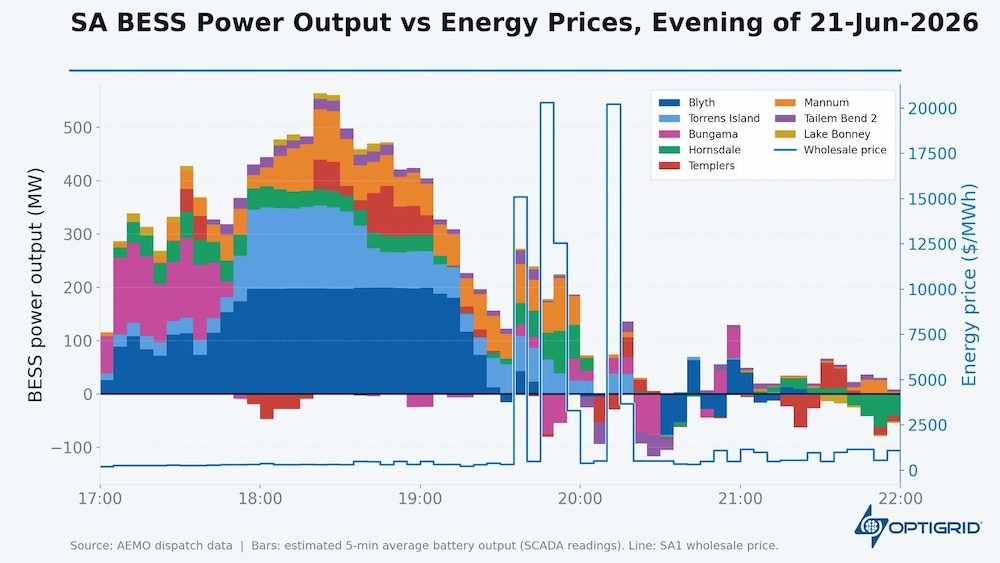
Image source: OptiGrid, LinkedIn
“Around half managed to catch the first extreme price interval,” says OptiGrid, “but far fewer were able to discharge in the later spikes. A couple of batteries were even charging through dispatch intervals above $10,000/MWh.
“By [Monday] morning, many batteries still had limited energy available after the overnight price event. Despite another period of $20k prices, relatively little battery capacity was able to respond.”
Ultimately, according to David Osmond, principle wind engineer at WindLab, what unfolded on Sunday was “the worst 1-day wind drought in over 2 years on Australia’s NEM,” topping out at just 24 gigawatt-hours of wind generation – the lowest since June 13, 2024 when it reached just 16 GWh.
But Osmond says there was one bright side to the dunkelflaute – and that came from solar.
“Solar generation was pretty good, so the 1-day VRE total (wind+utilityPV+rooftopPV) yesterday of 105 GWh of was signficantly better than the severe 1-day VRE drought on May 18 last month with just 82 GWh.”
Paul McArdle from Watt Clarity shared a snapshot (below) taken from NEMwatch at 07:30 (NEM time) that illustrates how spiky prices continued through Sunday night and into Monday morning.
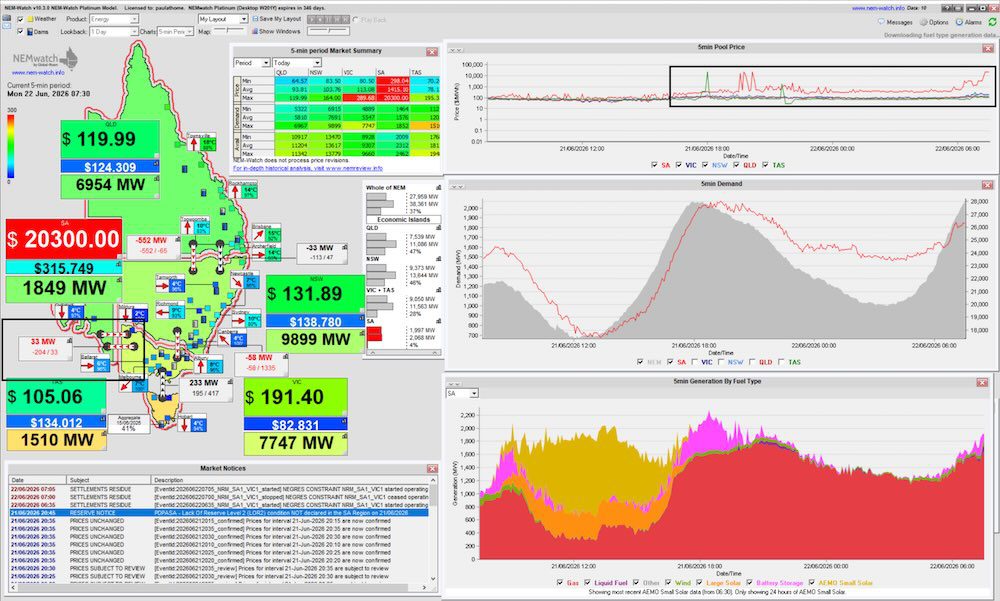
“These are the situations that separate battery trading strategies,” says OptiGrid. “In SA, forecasting is difficult because battery behaviour can influence the market as much as it responds to it, particularly when network constraints isolate the region from the rest of the NEM.
“The challenge for operators is forming the best bid considering uncertainty as market conditions evolve. Holding charge for a spike that may never arrive is an uncomfortable decision, right up until it turns out to be the only one that mattered.”
If you would like to join more than 29,000 others and get the latest clean energy news delivered straight to your inbox, for free, please click here to subscribe to our free daily newsletter.