As Australia’s biggest wind farm becomes the first in the country to pass the gigawatt-output mark, it is worth remembering that not all wind projects go according to plan.
The Golden Plains wind farm in Victoria, as Renew Economy editor Sophie Vorrath reported on Friday, reached the 1 GW output mark last week as commissioning continues on the second stage of its 1.33 gigawatt (GW) project.
But the TagEnergy project wasn’t supposed to be the first 1 GW wind farm in Australia. In May, 2022, Spanish energy giant announced it had begun construction of what was then described as the 1.026 GW Macintyre wind precinct in Queensland.
It had already suffered delays from Covid and supply constraints, but it was downsized back to 923 megawatts (MW) in 2023 after partner CleanCo decided to pull its commitment to the 103 MW Karara component, citing high costs and delays.
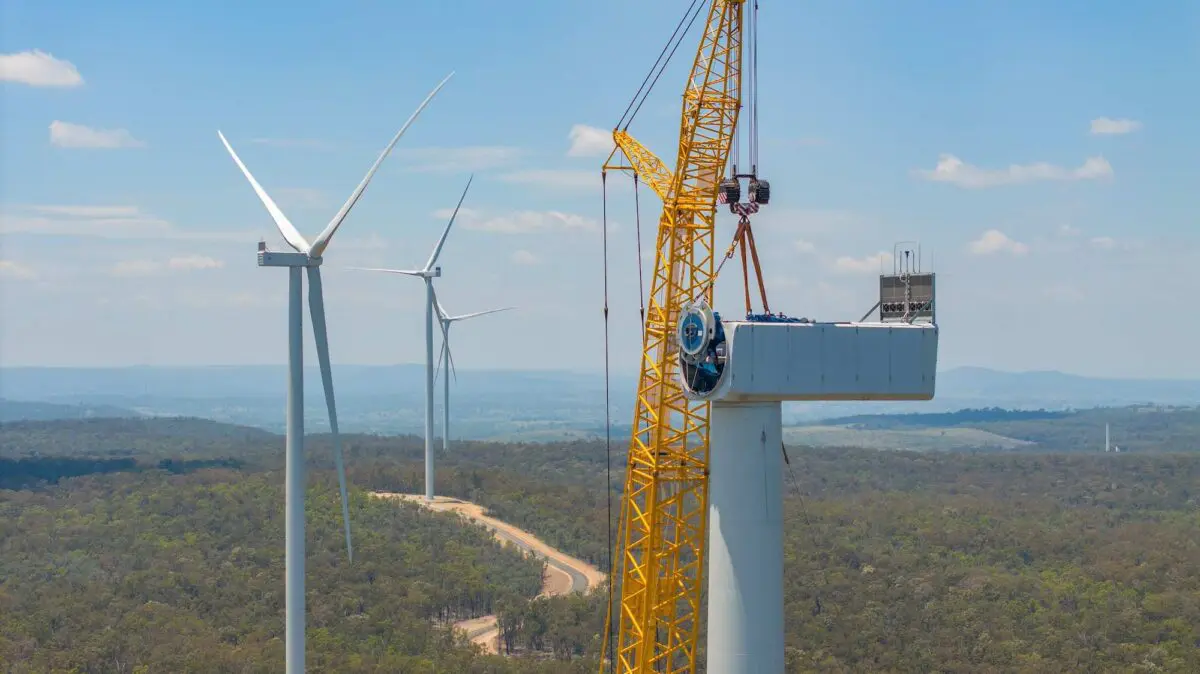
The remaining 923 MW component, however, has been overtaken by Golden Plains (which started construction in early 2023) and has been hit by a number of issues, particularly with the blades on the 5.7 MW turbines provided by Nordex, the German manufacturer partly owned by Acciona.
The company reported a turbine break at MacIntyre in January, 2025, and in December told stakeholds of the repair and replacement of dozens of turbine blades which had to be shipped in from overseas.
The project is still stuck at the half-way point of its commissioning process – with output capped at around 450 MW – and it does not expect to complete the repairs and replacements until the end of the year.
“We continue to progress commissioning activities at the MacIntyre Wind Farm,” a company spokesperson said in an emailed statement to Renew Economy.
“As previously communicated, detailed inspections of all wind turbine blades were completed following the issue with a broken blade in December 2024, and repair and replacement works are underway.
“We expect that to be mostly completed by the end of the year. Commissioning activities are continuing in parallel, and we remain focused on bringing the project to full operation safely and as soon as practicable.”
Wind energy in general has struggled in Australia in recent years, due to the combined effects of rising costs, social licence, planning issues and grid access, but there are signs that the sector is starting to move.
A number of smaller wind projects – with the help of Capacity Investment Scheme deals and power purchase agreements – have reached financial close and have started or are about to start construction – including Delburn in Victoria, Carmody’s Hill and Palmer in South Australia, and Waddi in Western Australia.
There are also a number of new gigawatt-scale projects that hope to reach financial close by the end of this year or the start of the next.
These include three big projects in Queensland, the 1.4 GW Bungaban project that has a contract to help supply Rio Tinto’s Gladstone smelters and refineries, and RWE’s 1.1 GW Theodore wind project.
Queensland is regarded as an excellent resource for wind energy, because most of its output comes during the evening and is considered a foil for the generation profile of wind projects in the south of the country.
Acciona still harbours plans of eventually doubling the size of the MacIntyre wind project to 2 GW, and create what it calls the “Big Mac”.
However, the future of renewables in the state – particularly those not associated with the repowering of the Gladstone smelters, is now under a cloud because of the LNP’s scrapping of the renewable energy target, the call-in of a number of wind and battery projects, and its vow to continue to burn coal into the 2050s.
Further south, Origin is seeking investors for its 1.45 GW Yanco Delta project in NSW, while Tilt Renewables is still mulling options for its gigawatt-scale Liverpool Plains wind project, also in NSW.
If you would like to join more than 29,000 others and get the latest clean energy news delivered straight to your inbox, for free, please click here to subscribe to our free daily newsletter.