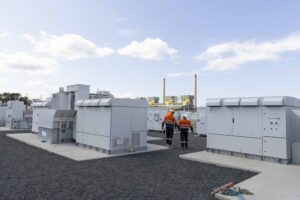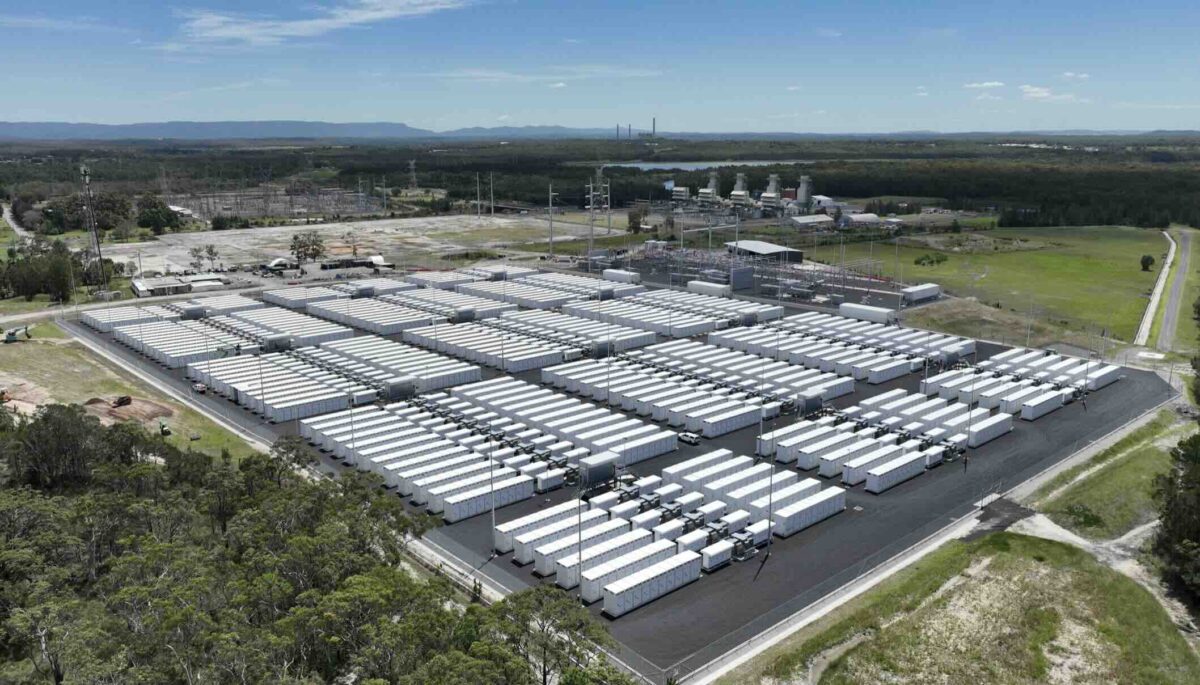
The Waratah Super Battery, which will rank as the most powerful battery in Australia – and some say the world – was called into action on Thursday and Friday to prevent blackouts as demand surged and one third of the coal generators in New South Wales was offline.
Waratah, located at the site of the shuttered Munmorah coal fired power station in NSW, is normally tasked to act as a kind of “shock absorber” to the grid which allows the transmission lines feeding in to the main cities – Sydney, Newcastle and Wollongong – to operate at greater capacity.
On Thursday however, as demand rose in the midst of a heatwaves, and with one third of the country’s biggest coal fleet offline due to scheduled and unscheduled repairs, the Australian Energy Market Operator turned to the Waratah battery to avoid having to shed load, or cut power from customers.
AEMO issued a direction to the Waratah battery just before 6pm to stay fully charged at 740 megawatt hours (its current capacity), and await instructions. It had warned of a potential “Lack of Reserve 3” situation where load must be shed to protect the grid.
At the time there were four big coal units offline – two at Bayswater (totalling 1,320 MW), one at Eraring (720 MW), and one at Vales Point (660 MW), or a total of 2.7 gigawatts of what the fossil fuel industry and its political supporters laughingly call “always on baseload.”
At 6pm, demand was more than 12 gigawatts, and around 500 MW of wind and solar were curtailed by network constraints. Hydro, gas and imports helped fill the gap.
In the end, Waratah was not required to inject its power. The “Lack of Reserve 2” situation – where power supplies would be at risk of coming up short if another big generator tripped or failed – was cancelled soon after 7pm, and all directions were also cancelled.
The situation on Thursday was repeated on Friday, when it was directed to hold 725 MWh from 4.20pm before the direction was cancelled just over an hour later. Again, an LOR2 situation had been declared.
The directions highlight the increased flexibility and options that AEMO now has at hand with the growth of big batteries, and it would be interesting to discuss what impact – if any – the growing number of household batteries, particularly those geared to cash in on evening demand and price peaks, had on the situation.
AEMO has made it abundantly clear that the biggest threat to power supplies is the failure of ageing coal generators to be operating at exactly these times, because they have become so unreliable.
It is not the first time that AEMO has turned to Waratah for support. Soon after it was registered and first started sending power to and from the grid in November last year, it was called in to support the grid at a particularly critical moment – once again a period of surging demand in a heatwave, and with multiple coal units offline.
Waratah – owned by Akaysha Energy – was to have been fully commissioned now at its full capacity of 850 megawatts (MW) and 1680 MWh, but a “catastrophic” transformer failure in October during its final tests has set it back by at least six months, and required a new transformer to be built, and repairs to another.
It is now delivering half of its contracted “shock absorber” services, and has indicated it will be able to deliver the full service in May. But the delays will have cost Akaysha dearly in lost revenues.
Note: This story has been updated to record the events that occurred on Friday.
See also: Wind, solar and batteries smash output records in midst of pre-Christmas heatwave