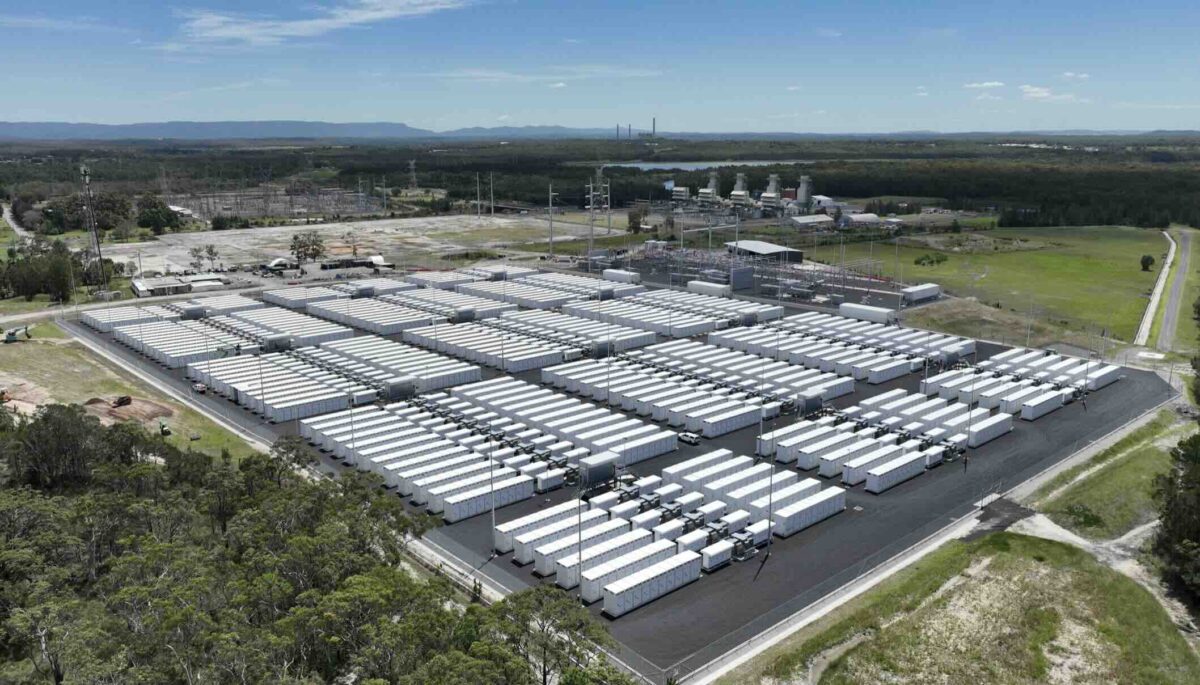
The Waratah Super Battery – the most powerful battery in Australia and quite likely the world – faces more delays following a catastrophic failure of one of the project’s three transformers.
The failure, not revealed until now, occurred on Saturday, October 18, just as the 850 megawatt (MW), 1680 megawatt-hour (MWh) facility, located at the site of a former coal-fired generator at Munmorah on the central coast, was preparing to complete the last of its “hold point” tests and to reach full commissioning.
The project had already been delayed by up to at least six months due to a series of events – mostly blamed on bad weather, according to public pronouncements by its owner Akaysha Energy – but now faces another six-month delay, or even longer, if the transformer cannot quickly be replaced.
Issues were also found with the second of three Wilson transformers installed at the site, further complicating the timeline to reach full capacity – which is sure to have a major impact on the regulated revenues it was due to receive.
The Waratah battery is one of the flagship projects of the New South Wales government’s renewable infrastructure plan, which plots a path to build enough new wind, solar and storage to replace the state’s ageing coal assets which are expected to retire by 2035, if not earlier.
Waratah is contracted to act as a kind of giant “shock absorber,” to allow the transmission lines feeding into the major load centres of Sydney, Newcastle and Wollongong to operate near full capacity. The battery would absorb the “shocks” of any network events.
It is the most powerful battery by size, if not storage, and is in fact the biggest machine of any type to the connected to the Australian grid, setting a series of records as it worked through its commissioning phase.
It was supposed to be operating at full capacity before the anticipated closure in August this year of the country’s biggest coal generator, the 2.88 gigawatt (GW) Eraring facility just up the road, but that closure has been delayed by at least two years.
On March 4 this year, Akaysha advised Transgrid, which is responsible for the operation of the shock absorber scheme, of a delay to both its interim and final completion dates.
That prompted an application for a variation in the fee schedule, the details of which have not been released but are likely to be significant.
It now faces more variations, and more lost or delayed revenue, with the completion of the battery now not expected until some time in 2026.
CEO Nick Carter told staff in an email last month that the transformer suffered a “catastrophic failure” leaving it “beyond repair.” He said the team was “bitterly disappointed” because the battery was just a few hours away from reaching its next commissioning milestone.
Akaysha says is still able to provide the “interim” SIPS (System Integrity Protection Scheme, the official name of the shock absorber service), which requires 350 MW and 700 MWh of capacity, despite the loss of one transformer and issues with another.
But its next commissioning milestone – hold point 5 – is on hold. At full capacity, Waratah is required to make 700 MW and 1,400 MWh for the SIPS scheme at times, and lower amounts at others. The remaining capacity is traded in the market.
In a statement, an Akaysha spokesperson said:
“The Waratah Super Battery is still operating at 350MW capacity and actively bolstering energy security for NSW’s grid.
“The Waratah Super Battery continues to meet its System Integrity Protection Scheme (SIPS) service requirements of 350 MW, which is the interim commercial operating capacity.
“During ongoing Hold Point testing to transition the battery to full capacity, issues were identified with two transformers.
“The battery’s remaining capacity is expected to come online during 2026.
“There is no impact to the NSW electricity grid as the WSB remains operational and continues to meet its SIPS service requirements of 350MW.”
Akaysha recently overtook Neoen as the biggest operator of big batteries in Australia, including those in operation, under construction, or contracted, according to Rystad Energy.
Apart from Waratah, the company has completed, or is nearing completion of the smaller Ulinda Park and Brendale batteries in Queensland and is also building the 415 MW, 1660 MWh Orana battery in NSW.
It has also signed a long-term off-take deal with Snowy Hydro, the largest of its type in the country, with the 300 MW, 1,200 MWh Elaine battery project in Victoria, and has won a federal underwriting agreement for the 275 MW, 1,200 MWh Deer Park battery project in Victoria.
Its CEO, Nick Carter, was recently named as one of Time Magazine’s Climate100 – in the “titans” section alongside the Pope and King Charles – for his work at Akaysha Energy and the innovations at the Waratah project.
See also Renew Economy’s Big Battery Storage Map of Australia for more information.
If you would like to join more than 27,800 others and get the latest clean energy news delivered straight to your inbox, for free, please click here to subscribe to our free daily newsletter.