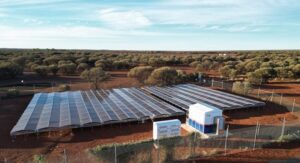
Australia’s first grid-connected, industrial-scale sodium-sulfur battery has been switched on at the site of a materials processing plant in Brisbane, where it will help power the plant’s operations while also demonstrating the novel long-duration storage technology under real-life conditions.
The 250 kilowatt (kW) and 1.45 megawatt-hour (MWh) “NAS” battery system, manufactured by Japan’s NGK, has been commissioned at Lava Blue’s Centre for Predictive Research into Specialty Materials (PRiSM) and connected to the Energex distribution network in Brisbane’s south east.
The up to six-hour battery will work alongside an already installed 200 kW solar system to supply up to 100% of the facility’s peak operating load, including energy-intensive advanced materials processing equipment.
The project was developed through the Queensland Energy Storage Technology (Quest) Hub, a QUT and Queensland government-backed initiative designed to accelerate the development and commercialisation of battery alternatives to lithium-ion.
NGK’s NAS batteries use sodium (Na) anodes and sulfur cathodes, separated by a fine ceramic solid electrolyte. They can be repeatedly charged and discharged through sulfur-sodium chemical reactions.
Batteries using this chemistry are capable of long-duration, large-capacity energy storage and are known for their long lifetime and high reliability, making them a good fit as an alternative to lihtium-ion for peak load shaving, load balancing and to help stabilise renewable energy output.
Allset Energy, a Melbourne-based company, provided the electrical engineering, installation and system integration for the project, including development of the interface between the battery, PRiSM’s solar generation, the facility and the grid.
Allset was also behind Australia’s first industrial scale NAS battery system, installed in 2023 as part of a microgrid at a remote Western Australian mining site.
That project, also conducted in partnership with QUT, has since provided in-field data on the technology’s performance under Australian conditions.
Further down the track, the goal for QUT and Allset is to commission a 1.5 megawatt (MW) sodium sulfur battery with at least six hours storage at Swanbank, a former coal generation site near the Queensland city of Ipswich that is being rapidly transformed into a clean energy hub.
This bigger project might not use NGK’s NAS batteries, however, as the Japanese company announced late last year a decision to discontinue the new production of all NAS Batteries, with the last shipment set for January 2027.
In a statement, NGK said “it is expected to take time for stable and continuous demand to emerge for long-duration, large-capacity energy storage, where NAS batteries have distinct advantages.
“In addition, due to various factors, including recent surges in material costs and intensifying competition with lithium-ion batteries, the Company has determined that stable operations and profitability will be difficult to achieve.
“Based on these factors, the Company resolved at the Board of Directors meeting on October 31, 2025, to discontinue the manufacturing and sales activities of NAS batteries.”
For its part, however, Quest Hub says the PRiSM installation extends the WA work into a grid-connected industrial setting, to further inform the potential future deployment of NAS technology in Australia.
“The successful commissioning of Australia’s first grid-connected NAS battery energy storage system marks an important milestone for Queensland’s battery industry and Australia’s energy transition,” Quest Hub director Associate Professor Joshua Watts, from the QUT School of Chemistry and Physics, said on Wednesday.
“The project has brought together researchers, industry and government to demonstrate an alternative long-duration energy storage technology under real industrial operating conditions.
“It has also … [helped to] demonstrate how long-duration storage can be integrated with renewable generation to reduce the energy costs associated with the refining of high-purity materials.”
The light-industrial operating environment of Lava Blue, which is a founding industry partner of the Quest Hub, was considered a good fit to test the battery against variable processing loads, solar generation and grid requirements.
“PRiSM was established to bridge the gap between laboratory research and industrial-scale materials processing, so it is an ideal environment in which to demonstrate a long-duration battery technology,” said Lava Blue managing director Michael McCann.
“Our advanced materials processes include high-temperature and other energy-intensive operations.
“Integrating solar generation with long-duration storage gives us the ability to supply those loads with renewable energy for extended periods and better understand how advanced manufacturing can operate alongside future energy systems.”
As part of its work, Lava Blue has developed hydrochloric-acid-based mineral processing approaches aimed at recovering high-purity materials from a range of mineral resources and feedstocks.
McCann says the company’s work reflects a broader focus on designing processing technologies for future critical minerals projects that are efficient and sustainable.
“The transition to renewable energy is also a materials transition. It requires both new energy technologies and new ways of producing the high-purity materials those technologies depend on,” he said.
“This project brings those two sides of the challenge together at one site.”
To join more than 29,000 others and get the latest clean energy news delivered straight to your inbox, for free, click here to subscribe to our free daily newsletter.