Australia is spending $13 million to help Pacific nations quit fossil fuels, electrify and transition to renewables as countries across the region race to switch from the fossil fuel imports that are eating up budgets.
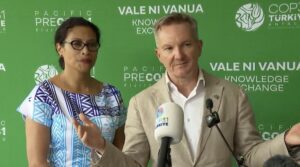
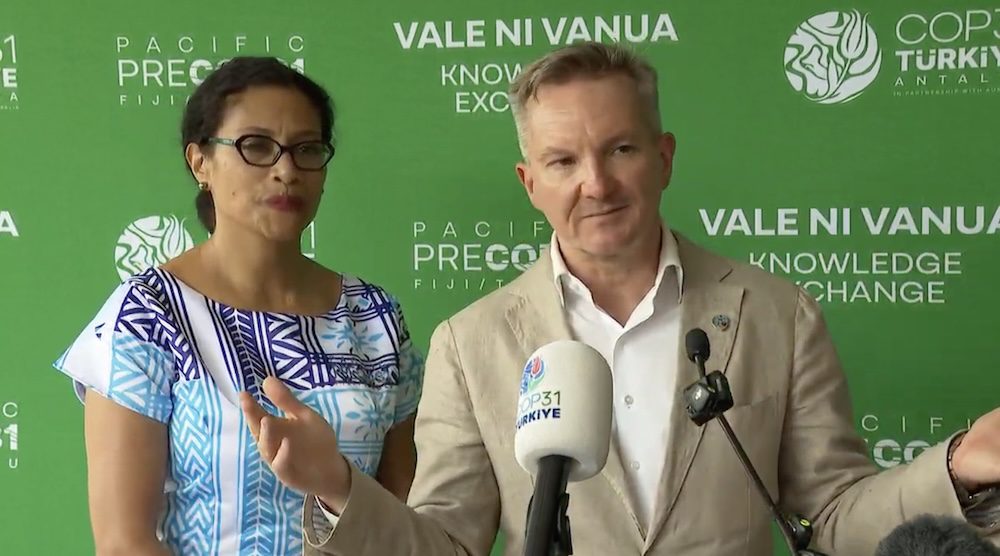
At pre-COP talks in Fiji on Monday, Australia’s federal energy minister Chris Bowen announced a $7.29 million fund for supporting grid modelling engineers, and set up a training program for energy professionals to lead the region’s transition.
Bowen also promised another $1 million on solar schools in Fiji, $2.2 million to scale up access to renewable energy in the Oro province in Papua New Guinea, and $2.5 million to projects in the north of Bougainville.
“Some Pacific countries spend 25 per cent of their GDP on diesel,” Bowen said at a press conference this afternoon.
“That’s terrible for emissions. It’s terrible for respiratory health, and it’s terrible for the economy, and it’s terrible for supply chain certainty.
“We want to help the Pacific with that. For example, the battery we just opened in Palau will see Palau avoid 1 million litres of diesel a year, and lift Palau’s renewable energy proportion [to] 25 per cent of their grid.”
A recent UNSW study found that replacing diesel generators across the region with renewable energy and batteries would cost about $650 million a year but be paid off within a decade.
That same study revealed the enormous cost countries are paying as the US war on Iran keeps fossil fuel prices high.
“The ongoing conflict in the Middle East, and the closure of the Strait of Hormuz, has driven Pacific diesel prices up by 35%. This threatens to add $US375 million to Fiji’s annual fuel bill – exceeding its entire health budget – and drain 5% of Vanuatu’s GDP,” wrote UNSW research associate Wesley Morgan for Renew Economy.
Australia also signed a Memorandum of Understanding with Vanuatu to help it integrate more solar power into the grid.
The funding could help Vanuatu electrify all of its government buildings by 2030, including schools and hospitals, Energy Efficiency Council chief executive Luke Menzel said.
“If Vanuatu can do it, Australia can do it, and so can the world,” he said.
The news comes as Australia co-hosts pre-COP talks with Fiji and Tuvalu this week, ahead of the COP31 in Türkiye later this year.
Bowen has promised that, this year, Pacific leaders will not be left out of discussions over the closing communique.
“I’ll be keeping the Pacific nations fully advised of the negotiations, what the obstacles are, how we’re going, what challenges there are and consulting about the way forward,” he told a press conference in Nadi.
“I’ll be very frank with you… I’ve seen Pacific ministers called in to meet with the COP president at 2 o’clock in the morning after the agreement’s reached with no say. That won’t happen in this COP. The Pacific ministers will be part of the process.”
Australia failed to win hosting rights to this year’s annual climate talks after a losing bruising fight with Türkiye in November last year.
It’s also slowly trying to repair its reputation in the Pacific after Liberal then-immigration minister Peter Dutton shredded that government’s standing in the region when he was caught on a live microphone joking about sea level rise.
Dutton was recorded saying “time doesn’t mean anything when there is water lapping at your door,” before colleague Scott Morrison pointed out the boom mic above them.
The current government set up a $125 million fund in late 2024 to help Pacific nations quit fossil fuels.
To join more than 29,000 others and get the latest clean energy news delivered straight to your inbox, for free, click here to subscribe to our free daily newsletter.