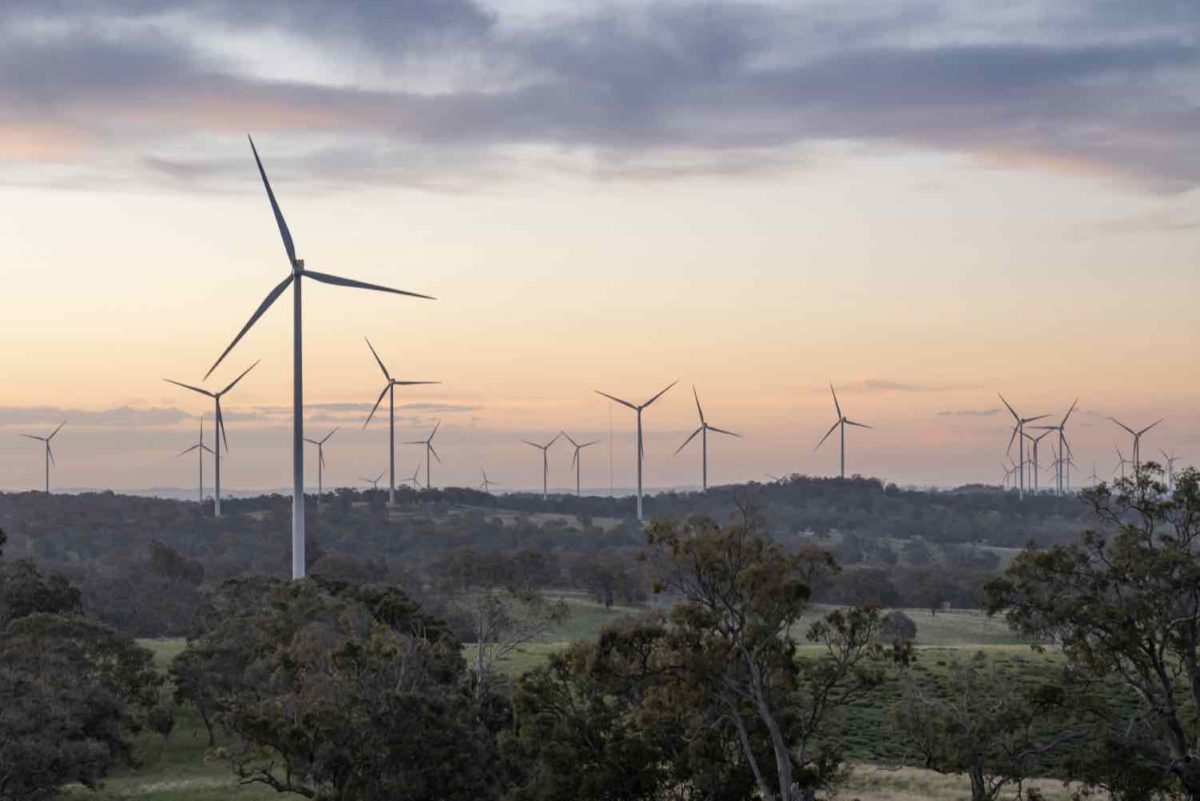
Andrew Forrest’s Squadron Energy has unveiled another major wind project, this one located just outside an already crowded renewable energy zone in the south-west of New South Wales.
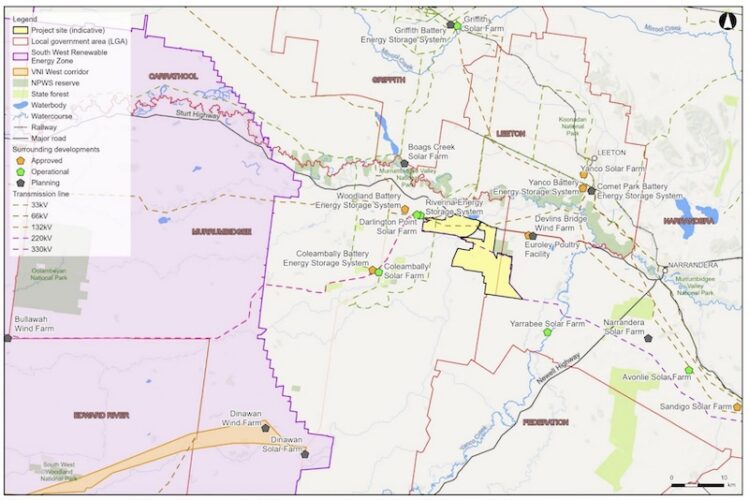
The 558 megawatt (MW) Banandra wind project is proposed for 11,600 hectares of mostly grazing land south-east of Darlington Point, and just east of the newly created South West renewable energy zone (REZ), which has already reached capacity.
However, Squadron says its 90-turbine project will seek to plug into the existing 330 kV line between Darlington Point and Wagga Wagga, a similar strategy to other renewable projects in the region that have been unable to gain access rights to the undersized REZ.
The South-West REZ has granted access rights to just four projects, three of them scaled down, because the new Project Energy Connect is only rated at 330 kV, rather than the 500 kV that many developers say would have unlocked more capacity from one of the country’s best renewable energy zones.
The turbines will have a tip height around 270m, and with an early layout taking in all sections of the huge area, but with 2km setbacks away from all homes surrounding the project.
It’s still at the very earliest stages of development, with community consultation starting in May and Squadron lodging the state planning application and the EPBC referral at the start of July.
Squadron hopes to have the planning processes wrapped up by 2029, construction to start in 2030, and be at full power by 2032.
With Banandra, Squadron has 30 wind, solar and battery projects in its development pipeline worth a total of 15.6 gigawatts (GW), according to project tracker Renewmap.
The EPBC application gives a worst-case scenario of potential impacts on up to 35 threatened species, although it makes clear that it yet to conduct any surveys in the area to see if they are present.
“No targeted flora or fauna surveys have yet been conducted in the project area,” the EPBC referral for the project says. “The proposed actions from the project are likely to have a direct impact on the species identified, if they occur in the project area.
“As a precautionary approach, all species with a moderate or higher likelihood of occurring have been assumed present, and a ‘worst-case’ scenario of clearing has been applied based on the development corridor used for scoping.”

The land itself is a mix of cattle and sheep grazing, cropping, and 7574 hectares of natural grasslands, shrublands or wetland vegetation.
What has actually been seen on site, during an initial visit in 2024, were superb parrots, but plains wanderers are local to the area as well, both of which are endangered.
The Coleambally canal, a tributary of the Murrumbidgee river, runs through the site so it was included as a possible habitat for the Murray cod and other threatened fish such as the tiny flathead galaxias.
With an environmental impact statement (EIS) still to come, Squadron plans to stick as much as possible to existing tracks and land already used for agriculture and reduce the amount of clearing of native bush as more information comes in, its NSW scoping report says.
There are 18 wind, solar and battery projects within 50km of the project, and 139 neighbours within 5km of the project.
Squadron will also need to consider the cumulative effect of noise from the 680 MW Devlin’s Bridge project, which is on the eastern boundary and whose proposed wind turbines are within 10 km of the Banandra machines.
If you would like to join more than 29,000 others and get the latest clean energy news delivered straight to your inbox, for free, you can click here to subscribe to our free daily newsletter.