The data centre-driven revival of the nuclear power debate in Australia is yet another political distraction from the urgent task of rapidly decarbonising the energy system, a new report has warned, only this time it’s focused on a technology that doesn’t technically exist: small modular reactors.
Small modular reactors (SMRs) aren’t operating commercially anywhere in the world despite decades of research and hype, won’t sate data centres’ energy hunger, and will dash federal Coalition hopes for an alternative to renewable energy, the report by the Australian Conservation Foundation (ACF) finds.
The Phantom Energy report, released on Thursday, details the lack of progress of SMRs globally.
“Nuclear power is too slow, too expensive, too unpopular, too dangerous and too thirsty to be a viable source of power for data centres in Australia,” the report says.
This has not stopped major technology firms such as Microsoft, Google, Amazon and Meta, from announcing nuclear energy partnerships to support growing data-centre demand, including inking more than a dozen agreements worth nearly 10 gigawatts (GW) of capacity.
“However, these commitments are largely non-binding agreements, power-purchase arrangements, or modest investments in SMR developers rather than direct funding for reactor construction,” report author Jim Green argues.
In particular, the US – home to those tech giants – has no SMRs or even large-scale reactors under construction. Plans to restart three shuttered reactors to power data centres “face obstacles and delays and only represent a tiny percent of electricity demand for data centres,” the report says.
Indeed, it cites a report by the Bulletin of the Atomic Scientists from July that found nuclear funding commitments from Amazon and Google to be fraction of 1% of their annual expenditures earmarked for building data centres.
The spending was “primarily meant as greenwashing, in order to divert attention from the negative environmental impacts of data centre operations,” including much larger fossil fuel investments, the bulletin found.
Debate over how to power Australia’s data centre boom has intensified, as communities wrestle with how another 225 planned or proposed centres can be accommodated by a grid already hosting about 165 of them.
On the one hand, Chris Bowen, the federal climate change and energy minister, is insisting they source and supply their own renewable energy, although Queensland and the Northern Territory are pushing for fossil-fuel carveouts.
The federal Coalition, however, is pushing for nuclear energy – reviving a stance that was widely rejected in the 2025 elections, costing them as many as 11 seats. Prohibitions would need to be overturned under federal law and in states, including Queensland, New South Wales and Victoria.
Matt Canavan, the Nationals leader even told ABC’s Insiders last weekend that he’d “welcome nuclear power here every day of the week”.
“I’d much prefer a nuclear power station next door to me than a 300-metre wind turbine,” he said.
Aside from the “theoretical” possibility of having SMRs – defined as having an electrical generating capacity of 300 megawatts or less – advocates have to explain how they would produce competitively priced power in the US, Australia, or elsewhere.

“Electricity from the Natrium and Xe-100 SMR designs would cost at least twice as much as electricity from large nuclear plants [in the US] and the cost of electricity from large nuclear plants is at least three times higher than from solar and wind,” the ACF report says.
No wonder, then, that a 2025 survey found 78% of US adults polled were somewhat or very concerned that new data centres would increase their power bills, it said. (The data centre issue also reportedly hurt Republicans – the US equivalent of the Coalition – in the recent mid-term elections.)
The annual GenCost report by CSIRO, meanwhile, has consistently underscored the high cost of nuclear energy – both large and small – as the ACF noted.
SMRs are “the most expensive form of energy you could possibly choose,” Mia Popper, a nuclear free campaigner at the Australian Conservation Foundation, told Renew Economy.
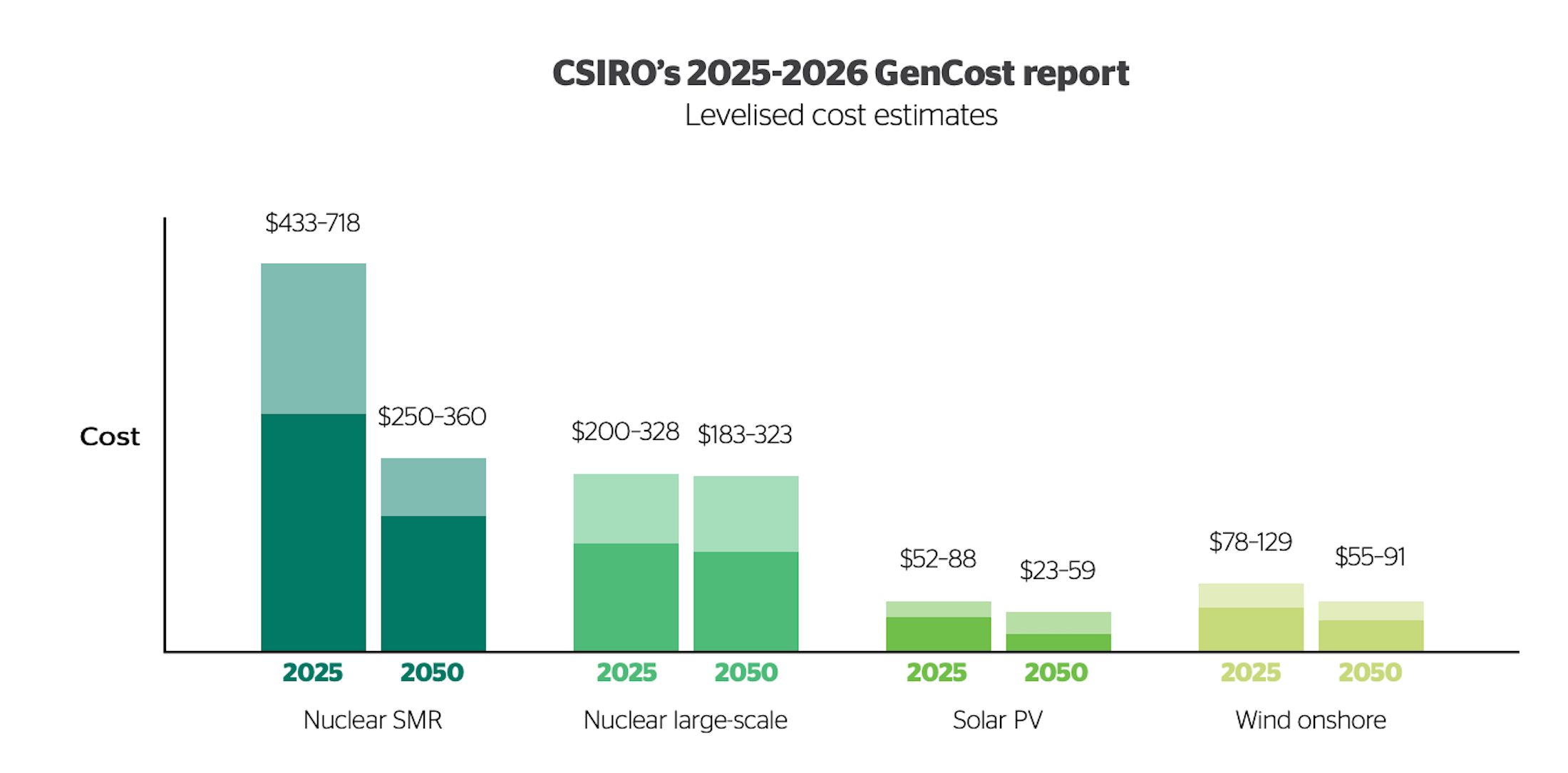
Even those cost estimates are assuming standardisation, the ACF report says.
“With no truly modular SMRs yet built and no factories in operation to mass-produce them, the underlying theory remains unproven in practice.
“Despite hundreds of design proposals and dozens of competing companies, no single SMR design or vendor has secured the customer base needed to justify the massive investment required for manufacturing facilities,” the report says.
“This reality undermines the central promise of modularity and the economic argument that costs can be significantly reduced through mass production.”
It is not as though money isn’t being thrown at the problem. A 2025 report by OECD’s Nuclear Energy Agency found that 380 verified SMR financing announcements have been made outside of China and Russia, totalling approximatively $US15.4 billion ($A22,4 billion), of which $US10 billion has come from public sources.
In total, though, that sum, if used for a single nuclear plant, might deliver 1 gigawatts of capacity, a tiny share of the 380 GW worldwide nuclear capacity now.
The ACF report noted that the world was adding 2 GW of new renewable generation capacity per day, with $US327.5 billion invested on clean energy in the first half of 2026 alone.
While there had been much enthusiasm about SMRs, investors were now “walking away from them because they don’t stack up economically”, Pepper said.
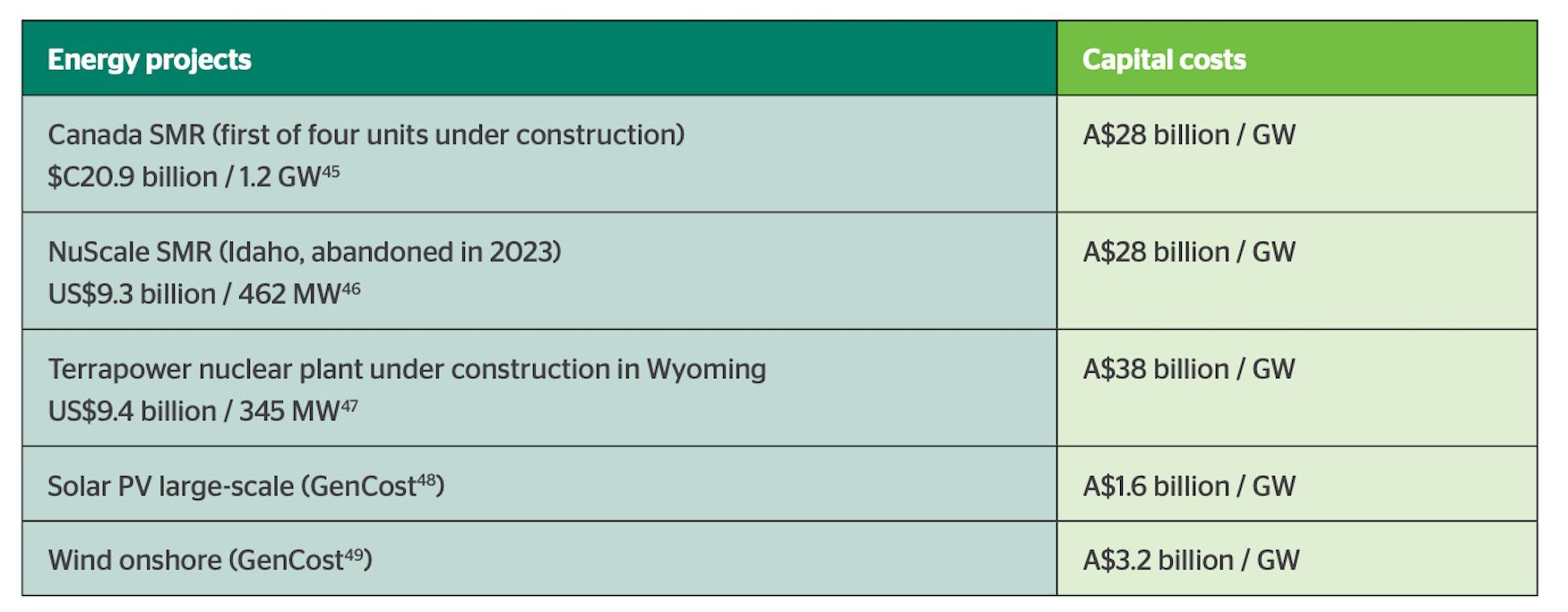
The ACF provided a comparison of some of SMR projects, compared with renewables.
The ACF noted the IEA projects renewables will provide around two-thirds of new electricity generation for data centres between 2024 and 2035, compared with just 6% from nuclear.
Even the latter might prove optimistic. As the ACF noted, the number of countries building power
reactors has fallen from 16 to 14 over the past three years. Nuclear accounts for just 8.7% of global electricity generation – less than half its historic peak of 17.5%.
Against that, the share of renewables in global electricity generation to rise from 32% in 2024 to 43% by 2030, the report noted, citing the IEA.
Only a few SMR construction projects are underway worldwide, including one at the Darlington site in Canada, with another three planned there. Russia is building a couple at home and one in Uzbekistan, and China has one under construction.
- The US state of Idaho’s NuScale plant abandoned efforts to build six 77 MW reactors with a combined capacity of 462 MW in 2023 after cost estimates rose to a prohibitive $A28 billion per gigawatt (GW) and a levelised cost estimate – excluding subsidies – of $A179 per MW-hour.
“Even with subsidies amounting to $A6 billion, NuScale was unable to get the project to the construction stage,” the ACF report said.
“The NuScale failure led the Australian Coalition parties to abandon their SMR-only policy and to also promote large, conventional reactors despite previously giving them a ‘definite no’”, it said.
The ACF’s Pepper noted that One Nation had now joined the Coalition in pushing nuclear for data centres, a combination that might be a hard sell to wary communities.
“The push for nuclear-powered data centres risks distracting – possibly deliberately – from the urgent task of rapidly decarbonising Australia’s energy system,” she said, in an accompanying media release.
“Combining two of the most unpopular industries, data centres and nuclear power, is a strange political strategy to win over a public that staunchly opposes both.”
If you would like to join more than 29,000 others and get the latest clean energy news delivered straight to your inbox, for free, please click here to subscribe to our free daily newsletter.