Australia’s prospects of becoming a major destination for offshore wind farm investors hangs in the balance even after Victoria’s commencement of its long-awaited auction process earlier this month, Jim Rijks, Iberdrola Australia’s engineering manager, told the All Energy 2026 conference.
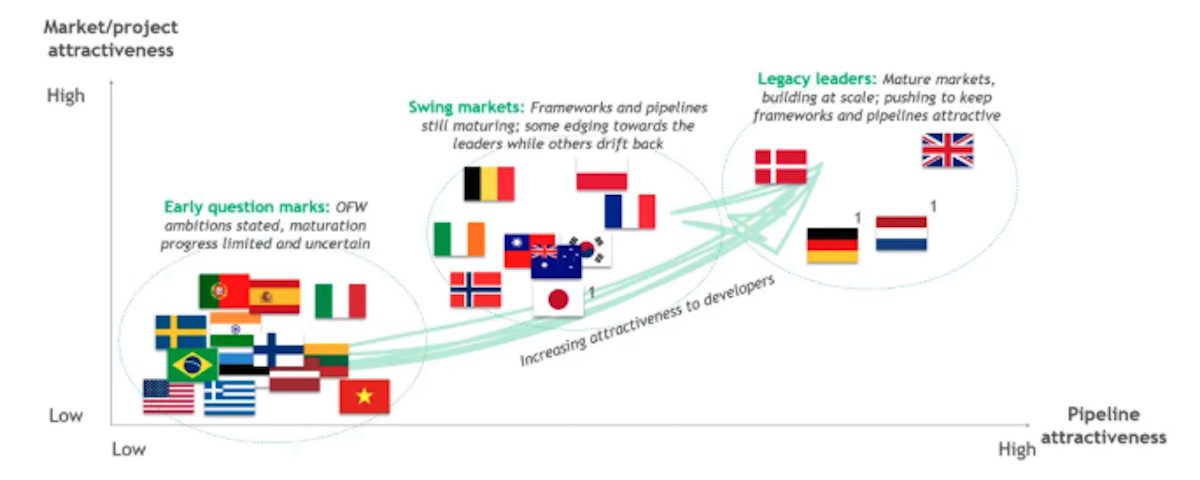
Rijks, who spoke at the conference in Melbourne on Thursday, cited an offshore wind update released this week by consultants BCG that listed Australia as among its “swing markets” where conditions were considered to be “still maturing”.
Australia’s status had improved from “emerging”, to join the likes of France, Poland, Taiwan, Japan, Ireland, and Norway, he noted, but conditions could also deteriorate.
“Offshore wind is a global industry, and markets compete for essentially the same capital, supply chain, technology, and expertise,” Rijkes, who was chairing an offshore wind session, said.
“Investment and supply chain interest can swing towards Australia as much as it can swing away from Australia, and that depends on the decisions that all of us … in the industry make,” Rijks said, later describing Australia’s conditions as “at the tipping point”.
“[I]f we don’t get that complexity right in the decisions that underpin the grid [and] the system of thinking, offshore wind can be a real challenge,” he said.

Australia has some promising offshore wind prospects not least because of the country’s lengthy coastline but also the resource’s complementary to other renewables. More reliable offshore breezes can provide power at night or when onshore winds are weak.
The challenges, though, include the relatively high cost of construction, particularly for initial transmission and expanding port-handling capacity, necessitating considerable government support.
According to the Australian Energy Market Operator’s 2026 Integrated System Plan, “consistent offshore winds deliver valuable resource quality and diversity, if wind farms can harness it and connect to onshore transmission”.
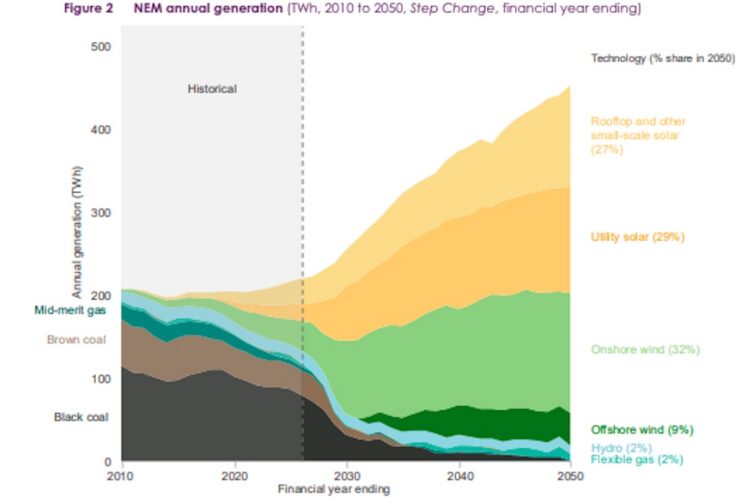
“Supported by government policies, 9 gigawatts of offshore wind is projected to be online by 2040,” it said. “However, as offshore wind is two-thirds more expensive than onshore wind to build and connect, no more is projected to be built through to 2050.”
Victoria’s Labor government in August officially opened the offshore auction process seeking the state’s first 2 GW of offshore wind from projects vying for a spot in the federally declared Gippsland zone.
So far, the state’s Liberal-Nationals opposition – which polls suggest is favoured to win next month’s state election – has backed Labor’s offshore wind plan. One Nation, though, has vowed to scrap it.
Felicity Sands, the acting executive director for offshore wind energy in Victoria’s Department of Energy, Environment and Climate Action, told the conference the sector was “critical” for the state’s development.
The first project would help create the foundations for a sustainable offshore industry that benefited communities, businesses, and industries “over the coming decades”, Sands said.
“Value for money and timely delivery of energy are key,” she said. “We also want to ensure the first 2 GW creates a pathway towards Victoria’s 9 GW offshore wind target, while supporting the growth of workforce capability, regional industry, supply chains, and long-term investment confidence.”
The government is planning the year-long auction process to result in awarded contracts in 2028, with construction starting in 2032 and the first power flowing to the grid by 2034.
That latter date, though, is not long before Victoria’s biggest coal-fired power station, Loy Yang A, is scheduled to close by July 2035.

“Successful bidders will receive a support package that consists of a revenue-neutral contract for difference with a term of 20 years to help mitigate market revenue variability risk and an availability payment,” Sands said.
That payment would be a fixed-sum, periodic outlay conditional upon infrastructure being available to generate electricity, and only payable following achievement of commercial operations, she said.
Victoria, though, is itself banking on the energy ministers backing in the Electricity Services Entry Mechanism that is designed to replace the existing Capacity Investment Mechanism beyond 2030 and include offshore wind in its mix.
The ESEM is expected to secure formal approval from energy ministers by the end of this year and be enacted into law by next March, the federal government says.
“In early September, energy ministers agreed to release a consultation package consisting of draft legislation, initial draft rules, and consultation paper outlining the proposed design of the ESEM,” Sands noted.
Queensland, though, has so far objected to the plan – but may not veto it – and both Victoria and NSW may have different energy ministers and governments by March 2027.
Victoria is hoping the allure of 4,000 direct and indirect jobs, mainly during development and construction, to cement electoral support for the industry. It is also expected to underpin 1750 ongoing jobs, mostly in the Gippsland region, Sands said.
“With the global offshore wind industry at different stages of maturity, there’s no single footprint,” she said, adding the government would aim to incorporate the best of the “valuable lessons” from abroad to shape local settings.
“So at its heart, this is about doing offshoring properly – planning it as a system, giving industry certainty through clear options and timelines,” Sands said, adding it would be done in a way that ensured benefits flowed back to communities while protect the environment and cultural heritage.
To join more than 29,000 others and get the latest clean energy news delivered straight to your inbox, for free, click here to subscribe to our free daily newsletter.