Here is a tale of the emerging two-speed transition in Australia’s electricity grids, and it reveals something troubling about the state of renewable investment across the country, particularly in the wind industry, and the role of the nation’s biggest privately owned utilities.
After a year long investment drought across Australia in 2025, new construction starts for wind projects have hit record levels – more than 2,500 megawatts (MW), according to industry analysts at Rystad Energy.
That’s the good news. It is still short of the 4 gigawatts of new wind capacity needed each year to meet the federal government’s renewable energy target, but there is now new life in a critical technology: Solar and battery storage have dominated recent investment, but wind is still needed to help fill in the gaps to be left by coal.
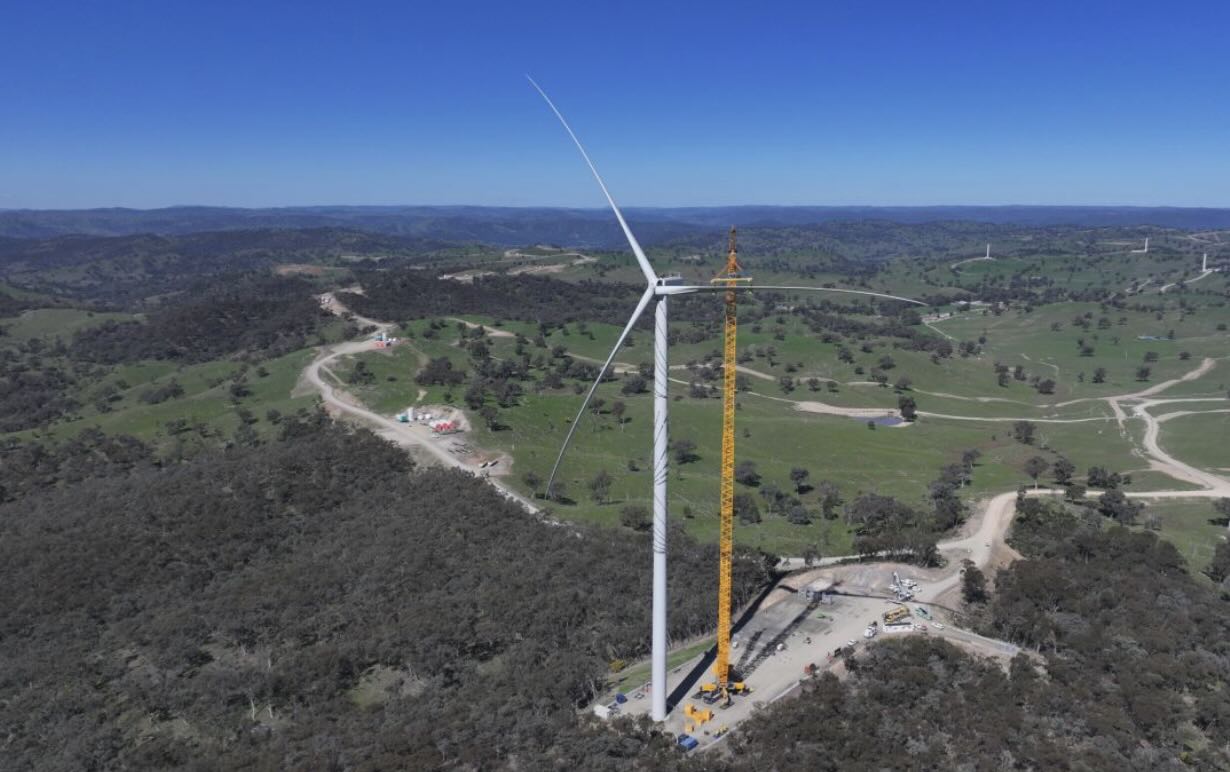
But in the state that likely needs it most – New South Wales, the country’s biggest state grid and which has the most coal capacity scheduled to close in the coming decade – the wind sector remains dead in the water. Only one wind farm is under construction in that state, the 414 MW Uungula facility, and that began in 2024.
No new wind farms have begun construction in NSW, or even secured a power purchase agreement, since the state government approved and underwrote an extension of the country’s biggest coal generator, Eraring in early 2025. And that is despite multiple gigawatts of wind projects obtaining underwriting agreements in state and federal auctions.
This past week has been a good one for the wind industry in the rest of the country. In Western Australia, the 470 MW Parron Maam Marang project became the biggest wind farm in more than two years to reach financial close in Australia and gave the go-ahead for construction.
That took the number of new wind farm construction starts in that state to five, with the biggest yet – Alinta’s 550 MW Marri project – still to come.
These wind projects are needed because the state plans to close the last of its own government owned coal generators by the end of the decade, and the government has stepped in to ensure this happens on schedule.
On Wednesday, the start of construction was announced at two South Australian wind projects – at the 346 MW Goyder North facility and the 288 MW Palmer project. That takes the number of new construction starts in that state this year to three – and takes it closer to the government target of reaching 100 per cent net renewables by the end of next year.
Those announcements also took total construction starts for all wind projects in Australia 2026 to a record 2,532 MW, according to Rystad Energy’s David Dixon. He says W.A. and South Australia account for 1,900 MW of that new capacity.
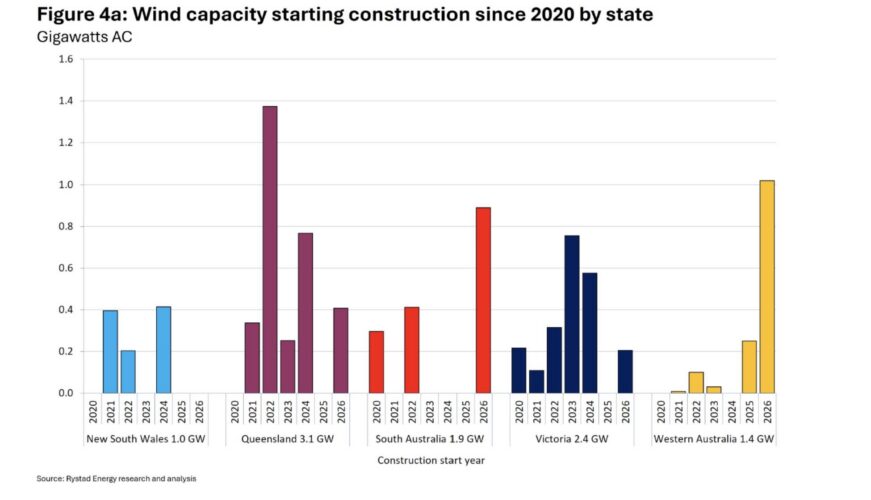
“New South Wales is the notable absentee,” Dixon wrote in a note to clients (see graph above). “It is the only mainland National Electricity Market (NEM) state with no wind projects commencing construction this year, and has added just 1 GW of wind capacity across four wind farms since 2020, the lowest of any state.”
Why is this so?
As Renew Economy wrote on Wednesday, all but two of the 10 wind farms that have started construction in Australia this year have have been underwritten by a power purchase agreement (PPA) and also emerged successful in the Capacity Investment Scheme (CIS).
The two exceptions are the 133 MW Nullagine wind farm, which will power Fortescue’s iron ore operations in the Pilbara, and the 205 MW Delburn wind farm in Victoria, which is owned by the government’s State Electricity Commission of Victoria
Government owned institutions have been key players. Four wind farms in Western Australia have been contracted by state-owned facilities, and the one successful wind project in Queensland, Gawara Baya, has a contract with the state owned Stanwell Corp.
Private players have only emerged in the Pilbara, where Forrest is determined to reach real zero emissions and eliminate the burning of diesel and gas by the end of the decade, and in South Australia, where mining giant BHP has signed key contracts to support renewable power at its huge copper and gold mines.
Australia’s biggest coal generator AGL has signed a PPA with Palmer, but in South Australia there is no coal generation to protect. There hasn’t been for more than a decade. And that is either a coincidence or very important.
Neither AGL nor Origin have signed wind PPAs in recent years in the states where their coal assets are still located, and EnergyAustralia, which is due to close the Yallourn brown coal generator in 2028, last signed a wind PPA in that state with Golden Plains, in 2024.
And this lack of engagement is a problem.
NSW has struggled with wind, because of endless planning issues, the lack of transmission capacity, court appeals against projects, and logistics issues for deliveries of oversize wind farm components. But the biggest problem has been the lack of corporate buyers.
As Rystad’s Dixon notes, the key challenge in NSW is securing sufficient revenue certainty to attain both the debt and equity needed to build the project. The Capacity Investment Scheme, which is designed to eliminate some financing risk, is not enough by itself to get wind projects over the line.
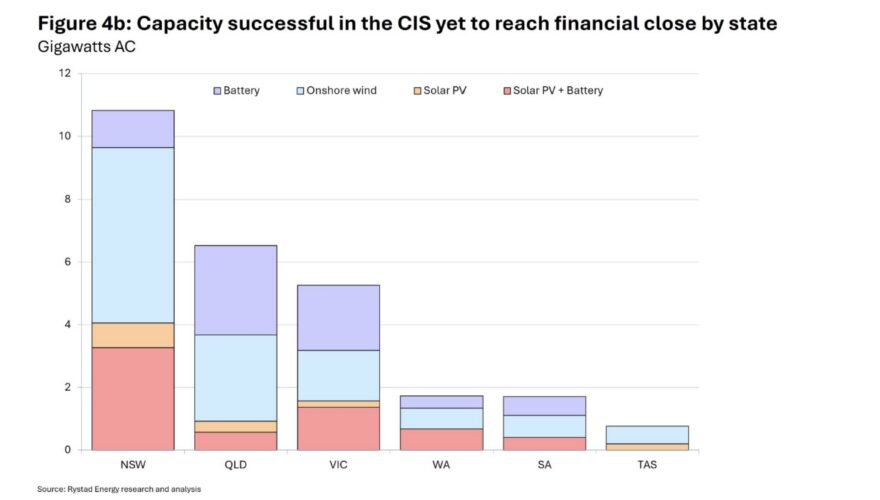
Dixon estimates that 27 GW of capacity that was successful in the CIS has yet to reach financial close, with NSW accounting for 40 per cent of that capacity, at 10.8 GW, and most of this uncontracted and unbuilt capacity is wind.
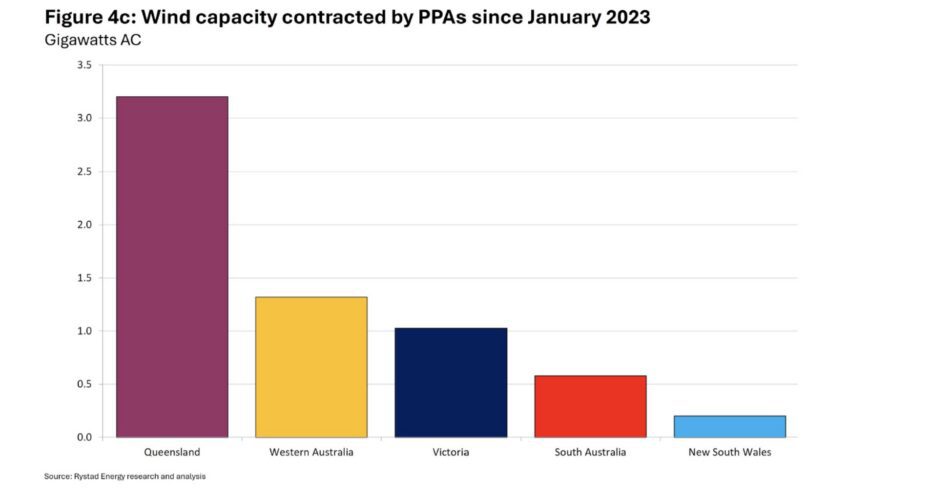
The state’s wind PPA market has stalled. Since January 2023, 6.3 GW of wind PPAs have been signed across the NEM and the WEM (the main grid in W.A.) but just 200 MW of this is in NSW (a contract signed by the government-owned Snowy Hydro for Uungula.).
“Until PPA activity recovers in NSW, it is difficult to see wind projects reaching financial close in the state,” Dixon writes. “The wider implication is that wind delivery in NSW remains the biggest bottleneck to the NEM’s energy transition. Its deployment is critical in providing winter energy volumes and supporting the retirement of coal plants.”
There is some hope. The state government has already announced major tweaks in the design of its own state auctions to make sure those underwriting agreements are assigned to projects that can get over their financial hurdles.
And the government-owned Snowy Hydro will play a critical role. It will be the vehicle used to funnel the $2.5 billion allocated by the state and federal governments to sign up new renewable projects to power the Tomago smelter, the country’s biggest electricity consumer, whose coal contracts expire in 2028.
The issue there is that there is no indication of how or when these negotiations will take place. Snowy Hydro is clearly pre-occupied with Snowy 2.0 pumped hydro project, which is facing further delays and yet another massive blow out in costs.
The company still has not tallied up the final cost of Snowy 2.0, despite announcing its costs review more than a year ago. Is it really best placed to accelerate the renewable transition in time to repower Tomago, and to avoid yet another delay in the closure of Eraring?
As ITK principal David Leitch wrote on these pages last week, the issue in NSW may come down to the role that government plays. He estimates that 5 gigawatts of wind is needed to replace just Eraring, but notes that none of the big utilities, least of all Eraring owner Origin Energy, has come on board.
“Gentailers though have had more than 5 years to come to the party and they have made it abundantly clear in words and deeds that they aren’t going to be there,” Leitch wrote. “Gentailers are, in fact, the market failure. Never mind. We are left with Government.”
But it also makes you wonder what might have been.
“It’s also been my strong belief that we need an organisation that actually wants to build, own and operate wind farms. The industry is full of get rich quick hopefuls in the form of developers,” Leitch wrote.
“But getting costs down requires staged building, teams that move from project to project, large portfolios that lower debt and equity costs, strong relationships and countervailing bargaining power with turbine and particularly transformer suppliers.
“And the ability to develop their own vertically integrated concrete companies including cement imports given the oligopolistic behaviour of the existing suppliers. In short a large ($20 bn) business with recognised expertise.”
NSW had the opportunity to have one of those when global investment giant Brookfield offered to pay $20 billion for Origin Energy, but that was knocked down by an Australian super fund more interested in protecting its fossil fuel investments.
Brookfield, meanwhile, bought Neoen, which is currently building the Goyder North wind farm in South Australia, the Goyder battery next door, and the Narrogin wind farm in W.A, and has more projects on the boil in other states.
As Dixon notes: “NSW remains the biggest bottleneck to the NEM’s energy transition. Its deployment is critical in providing winter energy volumes and supporting the retirement of coal plants.”
If the NSW state government still wants that to happen, it is going to have find a way to step in and make sure the capacity is built. It has already moved to get the transmission built, fix the roads, streamline the planning process and reach out to communities.
But, as Leitch notes, that next auction, and the one that follows, may be the last chance saloon for wind’s ability to replace coal anytime soon. But the industry still fears yet another extension for Eraring. The state government has been willing to step in to protect coal, now it has to show it knows how to build wind, not break it.
To join more than 29,000 others and get the latest clean energy news delivered straight to your inbox, for free, click here to subscribe to our free daily newsletter.