A big wind project in northern Victoria that is planning to connect to VNI West has other options to fall back on, if the Coalition is elected in the November state elections and follows through on its vow to dump the controversial transmission line.
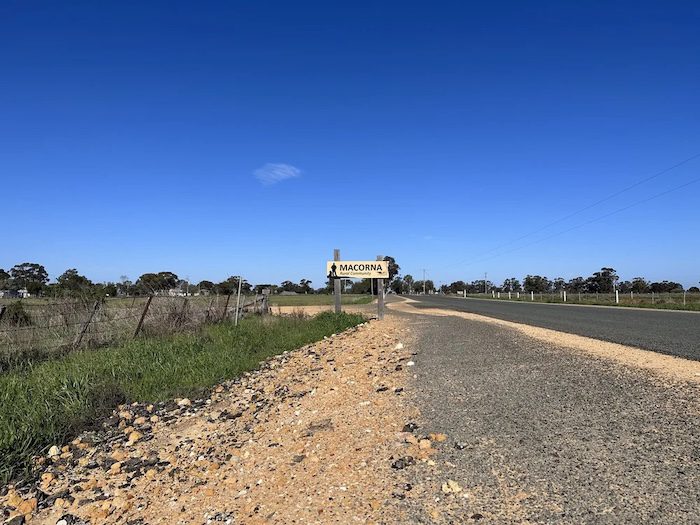
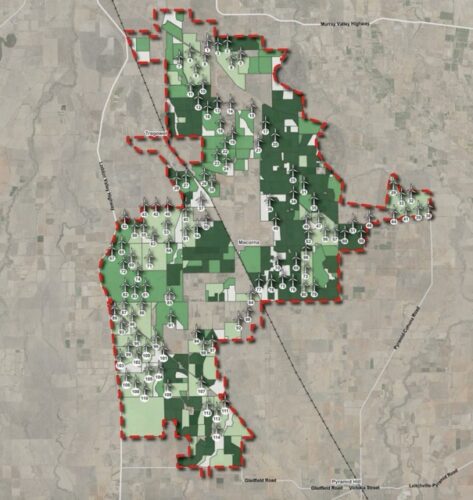
The 850 megawatt (MW) Macorna wind project, just south of Kerang, has been allowed to go through a streamlined planning approval process than is usual for wind farms in the state, a decision that will likely be welcome to developer Atmos Renewables if its connection plans are upended.
The Victorian Liberals have promised to scrap VNI West if they win the state election in November, which could put dozens of projects at risk of not going ahead.
Atmos head of development Kate Munro says the project is still viable even if VNI West’s 500 kilovolt (kV) line doesn’t go ahead.
“We don’t believe it’s a dealbreaker, but the alternative pathways are yet to be explored,” Munro told Renew Economy.
“We’re looking at other connection options. There’s an existing 220 kV line that runs through the site, but the viability of those connection options are yet to be finalised.”
The Macorna project is significant because it is the subject of Victoria’s first planning pathway decision on a wind project in 2026, allowing it to go through a simpler process than its peers.
It is the biggest wind farm yet to avoid the environmental effects statement (EES) pathway, the most onerous of Victoria’s three-tier planning system.
So far this year the state has made a planning pathway decision on one wind project, for Macorna, and approved three other wind projects: 600 MW Kentbruck (seven years between a decision on the planning pathway and approval) and 1,575 MW Warracknabeal (three years), and the smaller 80 MW Gelliondale wind project.
Picking up the pace
The simpler pathway means Atmos Renewables could obtain a decision within 12 months, a fraction of the time for most of its predcessors.
A Clean Energy Investor Group (CEIG) analysis earlier this year found that between 2021 and 2026, it took on average three years to get to a final planning decision in Victoria.
Wind projects approved by the state last year had languished for an average of four years, according to the CEIG analysis.
The Macorna project was originally pitched as 1000 MW to 1400 MW, with up to 140 turbines, but over the course of the past year developer Atmos Renewables shaved that down to 114 turbines.
It only launched Victoria and federal planning applications late last month and early in September, respectively, hitting the state process with 37 attachments detailing work already done.
The Macorna project will instead do an environmental report, which is a middle way between an EES and a straightforward planning permit.
“This is really unique. Only a handful of other wind projects in this state have been given a ‘no EES’ decision but they’re all smaller, and this one is not only in irrigation districts but adjacent to Ramsar wetlands,” says Rebecca Wardle, the head of Cogency which handled the planning side of the project.
“For a wind farm of this scale, this is a really significant outcome. From early in the process, our strategy was to front-load the environmental assessment and undertake a comprehensive EES referral, rather than leave key issues to be resolved later in the approvals process.”
Irrigated land at the Macorna wind project. Image: Atmos Renewables
Slim pickings
Macorna joins a slim number of wind projects in Victoria which have received a no EES decision, and it’s by far the largest.
In 2008, the 325 MW Darlington and 528 MW Stockyard Hill wind farms were assessed on the grounds of no EES with conditions, according to the state planning database.
The latter has been built, the former has not.
Three onshore wind projects have been allowed to go through the environment report track to date: the SEC-owned 205 MW Delburn, 420 MW Moreton Hill and the 400 MW Watta Wella wind and battery project.
These decisions were handed down in 2020, 2024 and 2022, respectively.
To date, the most likely assessment process for an onshore wind project in Victoria was to do an EES. Between 2008 and 2025, the Department of Transport and Planning (DTP) deemed 13 wind projects to need an EES. Two very small wind projects were sent through the regular planning process in 2017.
To join more than 29,000 others and get the latest clean energy news delivered straight to your inbox, for free, click here to subscribe to our free daily newsletter.