Somebody please wake up Chris Bowen’s media team (ok, not the affable Suze Metherell, who apparently just got married and has earnt a blissful honeymoon, not a bollocking).
The climate change and energy minister is winging his way to Saudi Arabia – not the most stable part of the world – to shore up Australia’s liquid fuel supplies. But media advisors left back at home base must be napping.
How else to explain the silence from the Albanese government that the cost of Australia’s energy transition has reportedly shrunk by $100 billion dollars?
How do we know?
Back in April, Robert Gottliebsen, among The Australian’s most senior of columnists, warned us Aussies had “been duped in a $1 trillion clean energy fantasy.”
The column, headlined “Renewable Plan A Rip Off”, calculated the 13-figure expense based on “long conversations” with Aidan Morrison, the energetic energy analyst with the Centre of Independent Studies.
The VBRN (very big round number) was based on tallying the cost of new transmission lines that were “likely to explode beyond $200b” and $160 billion for wind and solar generation funded by “high-cost loans.”
Together, these developments “could boost the total 35-year outlay above $1 trillion,” Gottliebsen mused. One could almost hear the clacking of the abacus beads.
Fast-forward to Tuesday’s bird-cage liner, and Gottliebsen has had (yet another) go in dissing the decarbonisation of the electricity sector.
In a missive aptly headlined, “Renewables Reality Check,” the seasoned scribe declared the clean energy “fantasy” had morphed into a “disaster.”
But, apparently, a discounted one.
“In collaboration with Aidan Morrison, I put the cost of the entire renewables project at [at] least $900 billion,” Gottliebsen said.
Cue, you know who to sum up the savings:
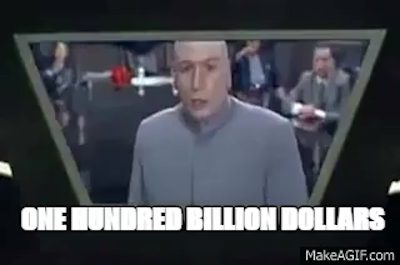
The discrepancy between the two guesses probably has as much to do with aesthetics as analysis.
You see, One Nation’s Treasury spokesperson Barnaby Joyce declared over the weekend One Nation would trade a Royal Commission into the “$900 billionn Australian renewables disaster” in return for guaranteeing supply in parliament.
Hence, that $900 billion has been doing the rounds on Facebook – such as FamilyVoice Australia’s page – and similar platforms.
Gottliebsen, who kicked off Tuesday’s column with the $900 bn figure, claims some credit for the One Nation notion, even if it was shy of his original VBRN.
“The Joyce declaration follows a series of commentaries by me and others uncovering massive government mistakes and concealment,” he boasts, before listing blowouts that largely have been marked by other media. (See Renew Economy reports here and here, for starters.)
For his part, Morrison said he “didn’t have any particular part to play in any subsequent adjustment to $900 b” and so, won’t comment on the adjustment.
Still, the lower estimate remains “consistent with a very credible assumption set,” he said. “A 10% change is relatively immaterial given the scale of uncertainties in such a projection.”
Morrison added he was finalising a major paper for CIS to detail a “much more thorough calculation that focuses on the transmission element of the renewable energy roll-out.”
Renew Economy contacted The Australian and Barnaby Joyce for comment.
No close observer of infrastructure outlays in Australia will be surprised to learn almost every project has ended up being much more expensive than initially flagged. After all, it’s in proponents’ interest to downplay the final tab if they can.
Wars in Europe and the Middle East – and now, the data centre boom – have done much to inflate costs for virtually every commodity. Central banks wanting to keep the inflation genie relatively bottled are pushing up the cost of borrowing for everything.
Still, you can’t blame One Nation or others for trying to get a VBRN to stick.
The Smart Energy Council was highly successful in tagging the Peter Dutton-led Coalition’s nuclear adventure with a speculative $600 billion price.
The VBRN ended up being commonly cited in focus groups, and featured prominently in Labor’s successful 2025 federal re-election campaign.
Coalition supporters tried to fight back with their own versions. Take the Murdoch media coverage of Frontier Economics’ detection in 2024 of a “$500b green hole” in the “real cost of a renewables-only grid.”

The Australian Energy Market Operator had pegged the cost in real terms of decarbonising the National Electricity Market at $122 billion, out to 2050. Frontier made its own calculation, coming up with $642 billion, hence, the $500 billion “green hole”.
Frontier’s report, though, conceded that once AEMO’s $122 billion was recalculated in nominal terms, it ballooned to $580 billion, as your correspondent noted at the time for Guardian Australia. Not so big a difference, then, and certainly not $500 billion worth.
“More front than Frontier,” to re-coin a phrase.
Of course, pundits and punters are generally drawn to scarily big numbers. Many figures will tower to formidable heights if you cast far enough into the future.
The 2026 Intergenerational Report earnt Treasury acres of print columns this week with its 40-year forecasts. Never mind that some numbers – such as climate impacts – were likely underdone.
In sum, going viral isn’t always a true measure of the value or virtue of what’s being touted.
To join more than 29,000 others and get the latest clean energy news delivered straight to your inbox, for free, click here to subscribe to our free daily newsletter.