Multiple gigawatts of potential wind and solar projects face an increasingly uncertain future, with some proposals evaporating altogether if the key VNI West transmission link is scrapped.
The echoes of cancelling the project – one of the key policy plans of the both One Nation and the Coalition in the lead-up to the November state election – will also felt in New South Wales and even in communities in eastern Victoria such as Eildon, whose power line is getting an upgrade as part of the VNI West works.
The scale of the projects at stake, unveiled below and which a range of industry and regulatory figures agree look “sensible,” highlight the risk that the Coalition and One Nation are taking with their plans to dump the controversial 500 kilovolt (kV) project.
VNI West has been criticised by some local groups, and has been dismissed as unnecessary by some energy analysts. Others, though, argue it is essential and it forms a key part of the Australian Energy Market Operator’s Integrated System Plan, the multi-decade blueprint for the green energy transition.
It has now become a proxy for the ideological war that has now erupted over the switch from coal to renewables, underpinned by the extraordinary scenes last weekend when opponents, led by leading One Nation politicians, burned effigies of renewable infrastructure at a protest.
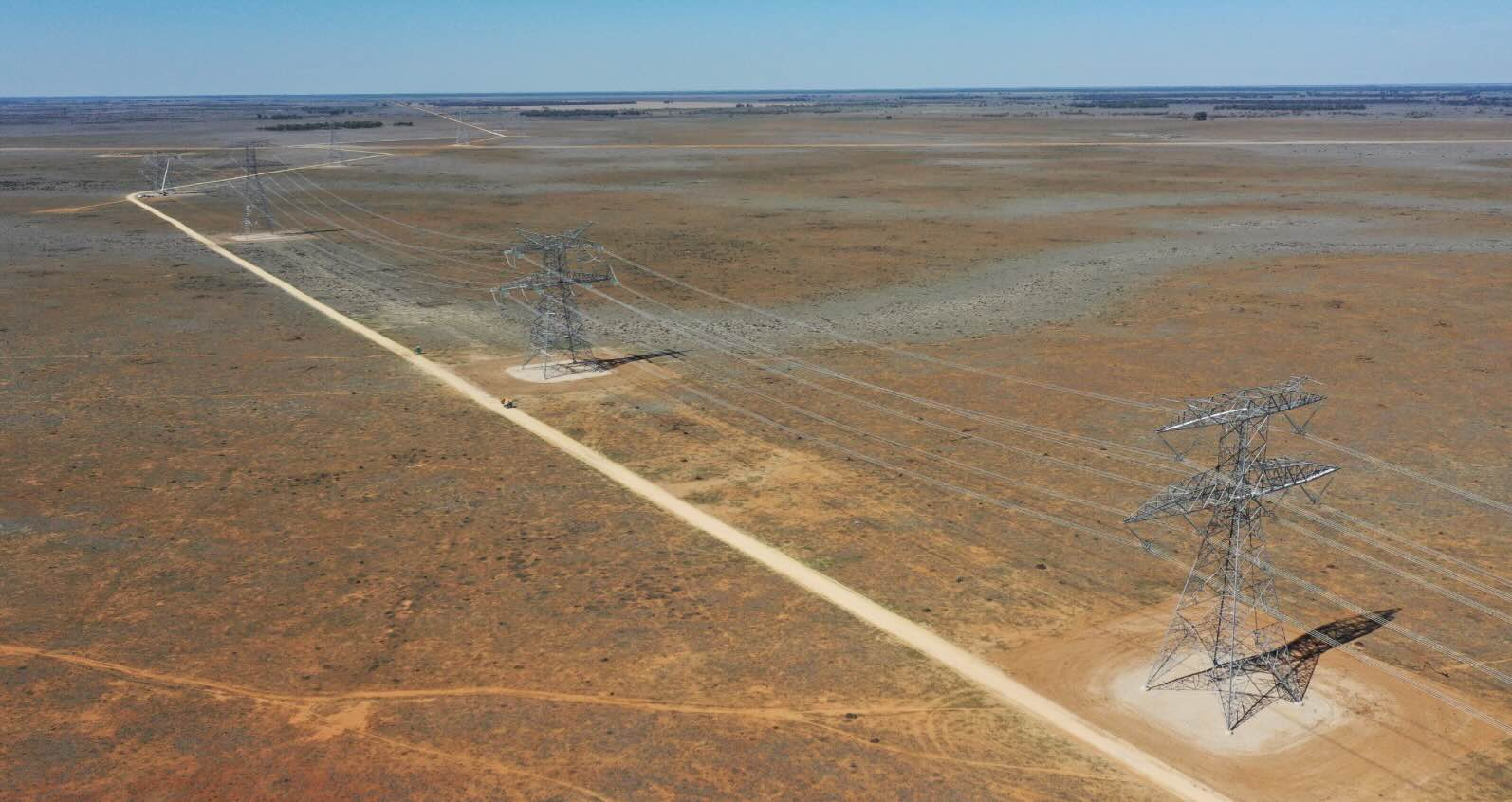
Earlier last week, the Victorian Coalition said it would scrap the 240km leg of VNI West that sits inside the state if it wins power in November. The line has a transfer capacity of up to 3.5 gigawatts, and will support a host of new wind and solar projects and take pressure off a swathe of other power lines across Victoria and NSW.
One Nation has since followed suit.
The Liberals and Nationals are struggling to fend off a buoyant One Nation and is hopeful it can replace any lost capacity with more gas and big batteries. One Nation, meanwhile, is proposing new coal and nuclear in place of renewable energy zones and transmission.
State Liberal leader Jess Wilson said Victoria “doesn’t need more unnecessary poles and wires,” while Nationals leader Danny O’Brien told radio host Raf Epstein that it’s not his “understanding” that projects will be lost.
But the data shows otherwise.
Some 8.5 GW of projects are jockeying for position along VNI West in Victoria, as well as a whopping 19.1 GW of proposed projects lie along transmission lines in Victoria and NSW that Vicgrid considers to be maxed out.
Currently, Victoria’s total generation base stands at 17.3 gigawatts (GW) across 88 facilities, not including rooftop solar, according to Open Electricity.
And the ramifications won’t be limited to Victoria; projects deep in New South Wales (NSW) are at risk as power lines that already feed electricity into Victoria are at capacity.
How did we get these numbers?
It is not clear which developers have the courage and financial firepower to brazen it out and continue, and which ones have the opportunities will move to greener pastures if VNI West is cancelled.
Some of the project proposals are still just plans on paper and could disappear for any number of reasons, while shrinkage is common for those already pushing through turgid planning processes.
Of the 20 project developers contacted by Renew Economy, the handful who responded said they were committed to their projects and have backup plans should VNI West not go ahead.
Renew Economy used marginal loss factor (MLF) data from Renewmap and congestion data from Vicgrid’s 2025 annual plan as a rough guide to look for projects still under development that might be most at risk if the controversial 500 kilovolt (kV) project is dumped.
We then sent this list to four industry grid specialists and two regulators, who gave it a thumbs up and added to it – but didn’t take any projects away.
MLFs decide how much of a generator’s output is credited as “delivered” to a customer and can affect a project’s profitability. An MLF of 1 means all electricity is getting to where it’s intended to go, anything lower shows how much isn’t getting to customers and therefore isn’t being paid for.
Grid congestion is a factor in MLFs, but specifically is when the power lines and transformers don’t have enough capacity to take the volume of electricity that wants to go through.
Too much electricity for a line’s rating leads to overheating – “thermal overloading” in regulator-speak – which damages equipment, causes the hot metal in power lines to expand and sag, and can lead to blackouts.
There are nine projects in Victoria directly along the western side of the VNI West route, where the limited number of operating projects have loss factors as low as 0.88.
The Squadron-owned 435 megawatt (MW) Murra Warra wind farm north of Horsham, for example, is only being paid for 88 per cent of the power it produces.
| Project | Capacity (MW) | Developer/Owner |
| Wimmera Plains Energy Facility (wind) | 312 | Baywa RE |
| Campbells Bridge Wind Farm | 1,000 | RWE Australia |
| Corack East Wind Farm | no capacity yet | ACEN |
| Wilkur Energy Park (wind) | 689 | Westwind |
| Curyo Wind Farm | 1,000 | Cubico |
| Southern Mallee Wind Farm | 550 | Greenleaf Renewables |
| Boort Wind Farm | no capacity yet | Fera Australia |
| Meering West Wind Farm | 1,300 | Virya Energy |
| Cannie Wind Farm | 400 | Res Australia |
There are another five projects along the NSW section of the line with capacity of 3.2 GW facing the same issue.
| Project | Capacity (MW) | Owner/developer |
| Wanganella Wind | 840 | Equis/Greenpoint Energy |
| Merino Wind | 1000 | Octopus Investments |
| Saltbush Wind (Boorooban) | 410 | Octopus Investments/Juwi |
| West Nyangay Solar | 800 | Australian Solar Farms |
| Conargo Wind | 168 | Squadron Energy |
All of these developers were asked if they are reviewing their projects in case VNI West doesn’t go ahead, and whether they would cancel them if that happens.
Squadron says it’s actively working on the Cannie site.
Virya Energy, European Energy and Westwind all have backup plans for their projects, be they to hook into existing networks or add their own network capacity.
“Virya Energy was selected by a group of Meering West landholders by a competitive developer tender in 2021,” general manager Steve Crowe tells Renew Economy.
“At this time, a private power line towards Kerang, connecting to what was then known as Kerang Link, was being considered. Meering West Wind Farm will revert to that original connection approach if changes are made to planned transmission.”
Westwind says “none” of its projects rely on VNI West, and hopes to start building Wilkur by 2032.
European Energy says its Mincha project is viable anyway and they’ve always intended to hook into the 220Kv Kerang to Bendigo transmission line.
However, this is where things get complicated, because the existing grid is part of the problem.
The Kerang to Bendigo line is one of those Vicgrid is very worried about being maxxed out.
Vicgrid’s 2025 annual plan expects more power to come from NSW when the Yallourn coal power station closes in 2028, putting even more pressure on power lines in the west, at Red Cliffs, and in the east heading into Wodonga.
“Many of the constraints listed are expected to be relieved by the completion of major augmentation projects such as Western Renewables Link and VNI West, with these two projects expected to reduce the impact of six of the nine constraints listed,” last year’s plan says.
The following projects are major developments that want to connect to the Kerang-Bendigo line in Victoria.
| Project | Capacity (MW) | Owner/developer |
| Tragowel Solar | 480 | Clean Energy Solar |
| Macorna Wind Farm | 1200 | Atmos Renewables |
| Mincha Wind | 280 | European Energy |
| Mologa Solar | 250 | Potentia Energy |
| Prairie Solar | 240 | Pacific Blue |
| Campbells Forest Solar | 205 | Risen Energy/South Energy |
| Derby Solar | 95 | Sungrow |
NSW will also be destabilised
Scrapping VNI West will not have the same impact as Queensland’s reversal on renewable energy; its impact will travel interstate and it will have far reaching consequences for southern NSW as well.
Gridscout cofounder Joel Bulow says grid congestion in the lines feeding Victoria is already very high.
He pointed to a triangle of sadness in NSW stretching from Buronga in the west to Wagga-Wagga, up to Darlington Point and down to Wodonga as being at capacity.
“Projects connecting in and around these locations send a material share of their output across the border into Victoria, and that corridor has recently become severely congested,” Bulow told Renew Economy.
“Over the last financial year, thermal limits on the Jindera to Wodonga 330 kV line (line 60) curtailed 447 GWh of generation, making it the single largest source of curtailment in the NEM. Without a project like VNI West, new and existing generation built in this area face materially higher congestion risk than they otherwise would.”
With these lines already at capacity, it means another three proposals in Victoria and another 24 in NSW are either at risk of falling over if congestion and MLFS make them uneconomic, or will need to be prepared to suffer.
| Project | Capacity (MW) | Owner/Developer |
| Gol Gol Wind | 840 | Squadron Energy |
| Mallee Wind | 402 | Spark Renewables |
| Euston Wind | 700 | Iberdrola/DP Energy |
| Koorakee Wind | 1,000 | Squadron Energy |
| Koorakee Solar | 1,000 | Squadron Energy |
| Junction Rivers (Burrawong) Wind | 585 | Windlab |
| Wilan Wind | 533 | Kilara Energy |
| Keri Keri Wind | 884 | Acciona |
| Baldon Wind | 1,400 | Goldwind/Omni |
| Tchelery Wind | 577 | Neoen |
| Abercrombie Wind | 2,500 | Vestas |
| The Plains Wind | 1,110 | Engie |
| Dragonfly Energy Hub (wind) | 500 | CleanGen |
| Boags Creek Solar | 300 | Edify |
| Devlins Bridge Wind | 680 | Stromlo Energy/Tag Energy |
| Banandra Wind | 558 | Squadron Energy |
| Narranderra Solar | 200 | Potentia Energy/Green Switch Australia |
| Strontian Solar | 328 | Grupo Cobra/New Energy Development |
| Sandigo Solar | 100 | OX2/ Esco Pacific |
| Galore Solar | 350 | Flow Power/ Trina Solar |
| Gregadoo Solar | 65 | Hanwha/Green Switch Australia |
| Livingstone Solar | 600 | Brunsdon Pastoral Co |
| Morven Solar | 125 | Glas Energy/ Elgin |
| Jindera Solar | 120 | Hanwha/ Green Switch Australia |